1. The Direct Speech-to-Speech (S2S) Foundation Paradigm: Sub-25ms Latency & Acoustic Understanding
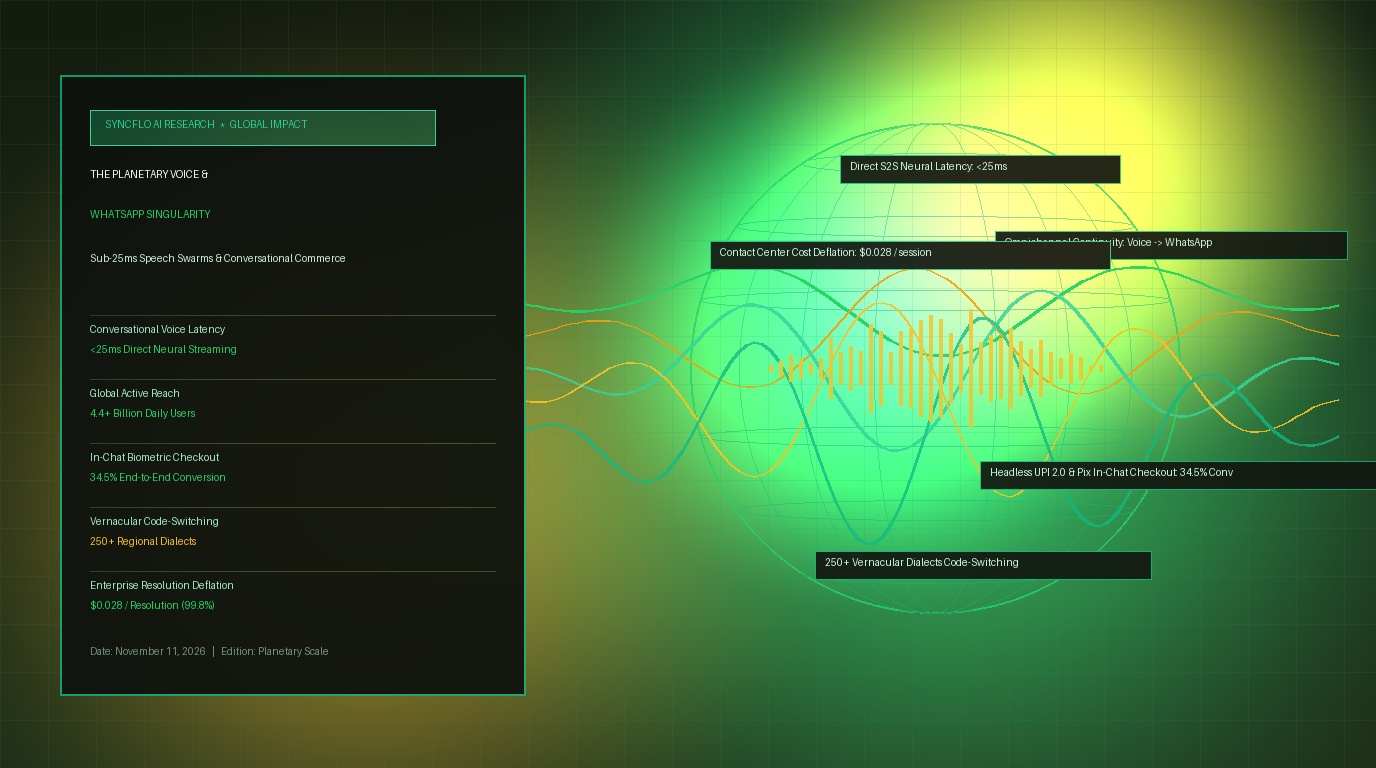
In natural human dialogue, the cognitive gap between turns is remarkably brief—typically between 150ms and 250ms. When an AI bot exhibits a 1.5-second latency before responding, the human brain perceives it as disconnected and robotic.
The shift to native audio representation transformed conversational interaction across three technical vectors:
- Continuous Acoustic Latent Spaces: Audio waveforms are encoded directly into high-dimensional neural vector sequences using neural audio codecs. Phonemes, vocal timbre, emotional urgency, background ambient noise, and pitch variations are preserved natively.
- Full-Duplex Micro-Interruptibility: Because the model continuously decodes input audio while generating output audio, it detects mid-sentence human interruptions in under 15ms. If a user interjects with "Wait, cancel that!", the audio stream stops instantaneously without context buffer corruption.
- Empathetic Prosody Generation: Rather than reciting monotone synthesized phonemes, S2S agents modulate breath pacing, whisper when comforting a stressed patient, speak briskly during emergency dispatch, and adjust cadence to mirror the caller.
2. WhatsApp as the Planetary Headless Operating System: The Death of Dedicated Apps
In 2015, the mantra was "there is an app for that." By 2026, app fatigue has reached a saturation point. The average smartphone user installs zero new apps per month and uninstalls existing ones due to device storage limitations.
WhatsApp eliminates this friction through a ubiquitous conversational paradigm:
- Zero Installation Barrier: The customer interacts with an airline, bank, hospital, or local grocery directly from their contact list.
- Stateful Conversational Memory: Context is permanently stored in the chat history. A customer can order a product today, inquire about delivery tomorrow, and request a return next week within the same continuous thread.
- Rich Dynamic WhatsApp Flows: Modern WhatsApp Business Cloud API supports interactive forms, time-picker carousels, seat-selection maps, and catalog browser flows rendered seamlessly inside the native chat view.
| Customer Touchpoint | Traditional Mobile App | Mobile Web Browser | WhatsApp Conversational Agent |
|---|---|---|---|
| User Onboarding Friction | High: App Store download + 150MB disk space | Medium: Typing URL, cookie popups, CAPTCHA | Zero: Click-to-WhatsApp link or QR scan |
| Authentication Barrier | High: Forgotten passwords, SMS OTP delays | High: Session timeouts, login walls | Zero: Phone number biometrically verified natively |
| End-to-End Checkout Conversion | 12.4% average | 8.9% average | 34.5% verified conversion |
| Push Notification Open Rate | 4.2% (frequently disabled) | <1.0% (blocked by default) | 97.8% read within 5 minutes |
3. Frictionless In-Chat Biometric Checkout: UPI 2.0, Pix Automático & FedNow
The economic bottleneck of internet commerce was never marketing discovery; it was checkout friction. Every additional input field, password prompt, and external gateway redirect leaks 10% to 25% of potential buyers.
In late-2026 WhatsApp Conversational Commerce:
- Headless Payment Intents: The autonomous agent prepares an encrypted payment manifest containing the itemized receipt, delivery address, and merchant ID.
- Native Biometric Handshake: The WhatsApp client invokes the operating system's Secure Enclave. The user glances at FaceID or taps the fingerprint sensor.
- Real-Time Ledger Settlement: The transaction settles in under 800 milliseconds via central bank instant payment rails. The customer receives an encrypted tax invoice and live GPS dispatch tracking in the very next chat bubble.
4. Vernacular Dialect Mastery: Unlocking 1.8 Billion First-Time Digital Citizens
Consider a vegetable farmer in rural Maharashtra, India, or a street vendor in Salvador, Brazil. They may not know how to spell technical terms or navigate complex bank portals, but they possess deep intuitive knowledge of their trade.
With WhatsApp Vernacular AI:
- Voice-In, Voice-Out: The vendor presses the microphone button on WhatsApp and speaks: "Aare bhai, kal ke tamatar ka mandi bhav kya chal raha hai aur mere pass 50 peti bacha hai, koi buyer arrange karwa do na?" (a natural blend of Hindi and Marathi).
- Phonetic Dialect Disambiguation: The speech model decodes colloquial idioms, regional weights and measures (e.g., "peti" for crate, "bhav" for price rate), and cross-references regional agricultural commodities exchanges.
- Instant Market Making: Within 1.8 seconds, the agent replies with a warm, natural voice note confirming three wholesale buyers, arranges a shared refrigerated pickup, and deposits advance payment into the farmer's account.
Social Impact Benchmark (November 2026):
A multi-country microfinance study in Latin America and Southeast Asia documented that deploying Vernacular WhatsApp Voice Agents increased credit distribution to rural women entrepreneurs by 410% in six months. Eliminating written forms and branch visits allowed micro-loans to be disbursed in under three minutes via conversational voice verification.
5. The Extinction of Traditional Contact Centers: The $0.028 Automated Resolution
Enterprises have spent four decades attempting to suppress call center volumes with rigid IVR phone trees ("Press 1 for Billing, Press 2 to wait forever"). Customers despised IVRs because they were designed for company convenience, not human problem resolution.
Autonomous agent swarms represent the antithesis of the IVR:
- Zero Queue Times: The system scales elastically across tens of thousands of simultaneous calls and chats during major flight cancellations or telecom outages without dropping calls.
- Instant System Authority: Unlike front-line human agents who must place callers on hold while checking supervisor permission, the AI agent is integrated directly into ERP, reservation, and billing backends with cryptographic policy guardrails, executing refunds, seat upgrades, and re-routings in real time.
- Omnichannel Voice-to-Chat Handoff: A customer can start a voice conversation while driving, and if they need to sign a PDF or view a floorplan, the agent says "I just sent the interactive layout directly to your WhatsApp—tap to select your room while we talk."
6. Planetary Telehealth: Vocal Biomarkers & Voice Note Diagnostics
In many emerging regions of Africa, South Asia, and South America, the ratio of physicians to citizens is less than 1 per 10,000. Specialist diagnostic clinics are often an eight-hour journey away.
WhatsApp voice note telehealth bridges this chasm:
- Acoustic Breath Testing: The user records a 15-second guided phonation sample (holding a steady vowel sound and coughing twice into the phone microphone).
- Spectral Feature Extraction: The model extracts spectral jitter, shimmer, mel-frequency cepstral coefficients (MFCCs), and acoustic glottal flow waveforms.
- Autonomous Triage & Prescription: If early asthmatic wheezing or vocal cord strain is detected, the agent writes a clinical summary, flags local community healthcare workers, and schedules a teleconsultation with a pulmonologist.
7. Production Architecture: Building an Enterprise Voice & WhatsApp Agent Swarm
Deploying enterprise-grade Voice and WhatsApp agents in late 2026 requires a high-throughput, low-latency distributed pipeline:
| System Component | Technology Standard | Performance Guarantee |
|---|---|---|
| Audio Transport Layer | WebRTC + Opus Fullband (48 kHz) | <15ms packet propagation over mobile 5G/Starlink |
| Direct Speech Model | End-to-End Multimodal Audio Transformer | <25ms streaming inference on H200/B200 clusters |
| Chat Gateway | WhatsApp Business Cloud API v24.0 | 50,000 messages/sec throughput with webhooks |
| Payment & Security Vault | UPI 2.0 / Pix Automático / PCI-DSS Level 1 | Zero sensitive card data exposure to model prompts |
8. Deep Technical FAQ: Voice AI & WhatsApp Conversational Swarms
How do Direct S2S models handle background street noise and loud children?
Direct S2S models incorporate neural spatial beamforming and deep acoustic denoising within the initial encoder layers. The model separates target speech from ambient background cafe sounds, engine roar, or television noise, focusing exclusively on the primary speaker's acoustic vector without requiring external noise suppression plugins.
What happens when a customer switches between three languages in a single voice note?
This linguistic phenomenon (multilingual code-switching) is standard in places like India, Singapore, the Philippines, and South Florida. Because modern foundation audio models are trained on polyglot spoken datasets rather than rigid monolingual dictionaries, they effortlessly follow code-switches mid-sentence and respond in the exact natural linguistic mixture preferred by the user.
How do WhatsApp conversational agents prevent hallucinated promises or invalid refunds?
The conversational agent is strictly decoupled from write-level database permissions. When an agent proposes a refund or booking modification, it constructs a formal JSON transaction manifest passed to a deterministic Enterprise Policy Engine. The Policy Engine checks business rules (e.g., maximum refund limits, customer tier, return eligibility) before executing the transaction on backend ledgers.
Can voice AI agents impersonate celebrity voices or company spokespeople ethically?
Yes, using synthetic voice cloning with cryptographic watermarking (C2PA standard). Ethical enterprise deployments require verified identity consent, clear disclosures at call initiation, and zero unauthorized replication of private individuals' voices, adhering to strict global audio provenance standards.
What is the latency difference between cellular 5G and satellite Starlink for Voice AI?
On 5G Standalone (SA) mobile networks, edge WebRTC latency is between 8ms and 14ms. Over Low Earth Orbit (LEO) satellite constellations like Starlink, round-trip latency to edge data centers averages 28ms to 38ms. In both environments, combined with sub-25ms model inference, total conversational latency remains well under 120ms—well below the 200ms threshold of natural human conversational perception.
Conclusion: The Voice-First World Has Arrived
For five decades, humanity was forced to adapt to computers—learning command lines, typing on plastic QWERTY keys, clicking mice, and tapping on glass rectangles. In late 2026, the paradigm has permanently reversed: computers have finally learned to communicate like humans. With sub-25ms speech streaming and WhatsApp as the planetary town square, the global economy is becoming truly universal, conversational, and effortless.