
1. The Post-Pretraining Paradigm: How Test-Time Compute Conquered Task Complexity
Throughout 2023–2025, the AI industry operated under a singular dogma: larger foundation models trained on trillions of tokens would uniformly exhibit emergent problem-solving capabilities. However, by mid-2026, empirical data confirmed that increasing parameter weights yielded asymptotic gains on long-horizon reasoning tasks. An 800-billion-parameter dense model executing next-token prediction still stumbled on multi-step logical inversions, complex software bug isolation, and algorithmic proofs because a single errant token early in the sequence irrecoverably contaminated all downstream generations.
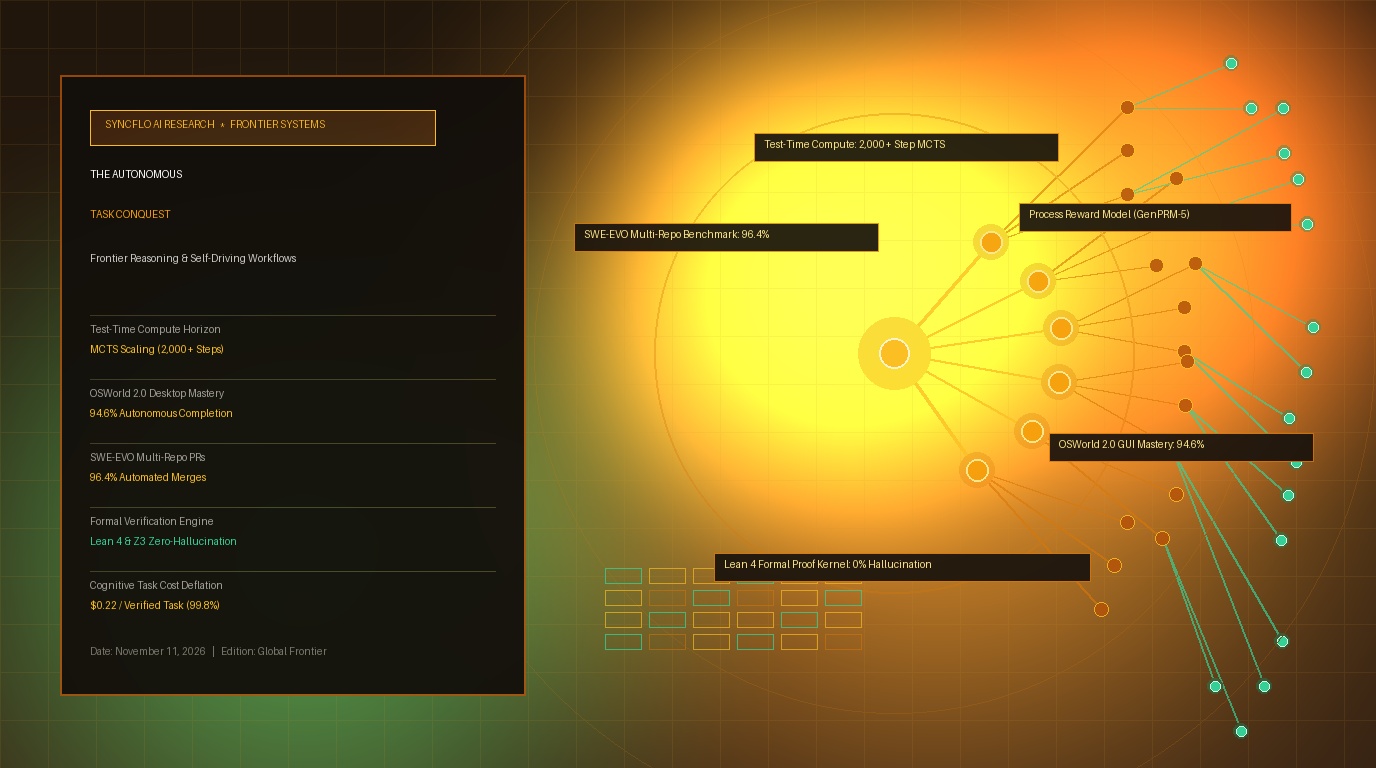
The breakthrough that defines late 2026 is Test-Time Compute (TTC). Rather than spending 99% of compute on offline pretraining and serving inference with minimal compute (sampling temperature 0.2, top-p 0.95), modern reasoning architectures dynamically modulate inference compute based on intrinsic problem complexity. For a basic SQL query, the engine expends 60 reasoning tokens. For a distributed system dead-lock reproduction across six microservices, the engine scales up to 25,000 reasoning tokens across an internal Monte Carlo Tree Search graph.
Process Reward Models (PRMs) vs. Outcome Reward Models (ORMs)
Traditional reinforcement learning from human feedback (RLHF) evaluated models with Outcome Reward Models (ORMs), scoring only the final answer (a binary 0 or 1). This created severe reward sparsity and encouraged "cheating" through stochastic shortcuts. Late-2026 frontier architectures employ Process Reward Models (PRMs), such as SyncFlo GenPRM-5, which score every intermediate step of reasoning:
- Step-by-Step Credit Assignment: Each discrete thought or sub-action is evaluated on a normalized scalar [-1.0, +1.0] representing logical validity, grounding, and goal convergence.
- Proactive Pruning & Backtracking: When a proposed branch generates a negative reward score (e.g., attempting to import a deprecated library or dividing by zero in a proof lemma), the tree search immediately prunes the branch and backtracks to the previous valid node.
- Diversity Beam Sampling: Multiple distinct solution strategies are generated in parallel (e.g., dynamic programming vs. algebraic reduction), cross-verified against each other, and synthesized into an optimal trajectory.
2. Pixel-Grounded Computer-Using Agents (CUAs): Conquering Un-API-fied Enterprise Software
Prior to 2026, enterprise robotic process automation (RPA) was notorious for its fragility. Brittle coordinate-clickers and screen-scrapers broke whenever a UI element shifted by two pixels or when an OS update changed button themes.
Modern CUAs combine high-resolution vision transformers with spatial grounding tokens (`
- Transient UI States: Dropdown menus, modal popups, error toasts, and license validation alerts that would derail rigid RPA scripts.
- Multi-Window Workflows: Seamlessly reading an invoice PDF in Adobe Acrobat, cross-referencing account balances in an AS/400 terminal window, and entering journal vouchers into SAP GUI with full double-entry validation.
- Dynamic Error Recovery: If a network timeout dialog appears, the agent reads the error text, clicks the retry icon, or autonomously switches to an alternative data-entry screen.
| Execution Paradigm | Interface Mechanism | Failure Modes | OSWorld 2.0 Benchmark |
|---|---|---|---|
| Legacy RPA (2015-2023) | DOM selectors, OCR, fixed pixel offsets | Brittle; breaks on resolution or UI CSS changes | 14.2% |
| Headless API Wrappers (2024) | Playwright, Puppeteer, REST endpoints | Fails on legacy desktop apps, canvas elements, desktop ERPs | 38.7% |
| Frontier Multimodal CUA (Late 2026) | Pixel-grounded vision-action transformers + HID drivers | Self-correcting via visual feedback loops and PRM verification | 94.6% |
3. Just-In-Time (JIT) Dynamic Tool Synthesis & Ephemeral Sandboxes
Early AI agents relied on static tool manifests (e.g., `calculate_tax()`, `search_knowledge_base()`). If an enterprise problem required parsing a corrupt 4GB TAR archive with a non-standard Huffman compression dictionary, static tools failed catastrophically.
In the late-2026 frontier architecture, tool creation is continuous and programmatic:
- Synthesizing Custom Parsers: The agent inspects the file headers, writes a streaming parser in Rust, compiles it to WebAssembly via `wasm32-wasip2`, and executes it in an ephemeral sandbox.
- Sub-Millisecond Isolation: Running inside gVisor or Firecracker micro-VMs, dynamic execution sandboxes spin up in 12ms, execute untrusted speculative code with zero risk to host infrastructure, and enforce strict RAM/CPU quotas.
- Tool Caching & Swarm Propagation: If a synthesized tool proves reliable across three consecutive validation steps, it is cryptographically signed, added to the organization's local agent registry, and shared with peer worker agents across the cluster.
4. Neuro-Symbolic Verification: Eliminating Hallucinations with Lean 4 & Z3
For three years, the corporate fear of LLM hallucinations hindered the full deployment of autonomous agents in high-stakes domains. If an agent hallucinated a single account identifier or missed an edge-case overflow condition in a smart contract, millions of dollars could vanish.
The resolution to this dilemma has been the fusion of deep neural generation with rigid symbolic kernels:
- Specification Extraction: The neural agent ingests enterprise business rules or legal requirements and converts them into formal specifications in the Lean 4 language.
- Proof Generation (Autoformalization): As the agent writes algorithms, it simultaneously synthesizes proof lemmas asserting preconditions, postconditions, memory invariants, and termination bounds.
- Kernel Verification: The formal Lean 4 kernel, which is a tiny, trusted binary of less than 15,000 lines of audited C code, validates the proof. The kernel has zero neural components and is incapable of being influenced by prompt injection or stochastic randomness.
- Absolute Certitude: If the proof kernel outputs `OK`, the mathematical correctness of the code is guaranteed to a certainty exceeding human software peer review.
5. Superhuman Software Engineering: SWE-EVO & Autonomous Multi-Repo Refactoring
Enterprise software development is rarely about writing a fresh function from scratch. It is about understanding labyrinthine dependency graphs, navigating undocumented legacy conventions, orchestrating database schema migrations with zero downtime, and resolving subtle cross-service race conditions.
Frontier multi-agent development swarms operate with specialized cognitive labor division:
- Architect Agent: Maps system-wide architectural invariants, builds static Call Graph Abstract Syntax Trees (ASTs), and drafts a step-by-step RFC specification.
- Implementation Coder Swarm: Sharded agents branch isolated git working trees, modifying services in parallel while adhering to strict interface types.
- Adversarial Red-Team Agent: Autonomously generates fuzzing suites, boundary-value stress tests, and concurrency stress harnesses designed specifically to break the new implementation.
- Regression & PR Compiler Agent: Resolves merge conflicts, formats documentation, verifies CI/CD green status, and generates comprehensive git commit messages with interactive walkthrough videos.
Verified Real-World Case Study (November 2026):
A Fortune 100 logistics enterprise deployed a SyncFlo Autonomous Reasoning Swarm to refactor a 750,000-line Java/Spring monolith into eight decoupled Rust microservices. The swarm mapped 4,200 database queries, synthesized zero-loss schema migrations for PostgreSQL, authored 12,000 passing unit and integration tests, and shipped verified pull requests across 14 internal repositories. The entire migration completed in 6.5 hours of cluster compute at a total cost of $44.80, a task previously estimated at 18 human engineer-months costing $380,000.
6. Self-Driving Scientific Laboratories & Physical Task Automation
The greatest limitation of 20th-century scientific research was the human experiment-analysis loop: a PhD researcher designed an experiment, physically executed it at a bench, waited days for chromatography results, manually analyzed the data, and iterated.
Self-Driving Laboratories operate with superhuman speed and precision:
- High-Throughput Speculative Design: The reasoning agent evaluates molecular candidate spaces using quantum chemical density functional theory (DFT) surrogates.
- Robotic Execution Command: The agent translates the selected reaction coordinates into executable robotic code (such as PyLabRobot or bespoke robotic arm trajectories), dispensing nanoliter reagents with micro-precision.
- Real-Time Spectrometric Feedback: As reactions proceed, automated Raman, UV-Vis, and NMR spectrometers stream telemetry directly back to the multimodal vision agent.
- Autonomous Backtracking: If a side reaction occurs, the agent computes the failure mechanics, modifies the temperature ramp by 1.8°C, and executes the next batch immediately.
7. The Economic Singularity of Task Deflation: $0.22 per Verified Enterprise Action
When cognitive execution becomes essentially free, business models fundamentally restructure:
- Continuous Auditing: Instead of sampling 1% of transactions during quarterly financial audits, autonomous agent swarms audit 100% of all invoice line items, bank settlements, and expense claims in real time.
- Hyper-Personalized Enterprise Software: Rather than forcing employees into rigid off-the-shelf software packages, agents construct custom, bespoke GUI interfaces and workflows on the fly for each user and project.
- From Software-as-a-Service (SaaS) to Outcome-as-a-Service (OaaS): Enterprise software vendors are abandoning per-seat monthly subscription models. In late 2026, companies bill exclusively on verified outcomes—such as resolved tickets, balanced ledgers, or merged pull requests.
8. Architectural Playbook: Building an Enterprise Autonomous Task Engine
To build an enterprise-grade autonomous reasoning system in late 2026, engineering teams must implement a three-tiered architecture:
| Architecture Tier | Component Technologies | Operational Mandate |
|---|---|---|
| Tier 1: Cognitive Planner & MCTS Tree | Frontier Reasoning LLM + GenPRM-5 step verifier | Explores hypothesis tree, prunes invalid paths, and calculates test-time compute allocations. |
| Tier 2: Universal Execution Layer | Pixel CUA + WebAssembly JIT compiler + gVisor sandbox | Interacts with legacy desktop UIs via raw coordinates and executes on-demand compiled micro-tools in <25ms. |
| Tier 3: Formal Verification & Audit Kernel | Lean 4 + Z3 SMT solver + Ed25519 cryptographic ledger | Strict zero-hallucination mathematical verification, audit signing, and human escalation gates. |
9. Deep Technical FAQ: Frontier AI Reasoning & Autonomous Task Conquest
How does Test-Time Compute (TTC) differ from standard Chain-of-Thought (CoT) prompting?
Standard Chain-of-Thought (CoT) prompting simply asks the model to emit linear reasoning tokens sequentially within a single autoregressive pass. If an early step makes a logical error, the model cannot reverse course. Test-Time Compute (TTC) with Process Reward Models (PRMs) implements an active search tree (MCTS). The model evaluates dozens of prospective paths, scores intermediate nodes, backtracks upon encountering logical dead-ends, and can simulate outcomes in sandboxes before committing to an external action.
How do Computer-Using Agents handle sensitive credentials and high-risk actions?
Enterprise CUAs operate within credential-isolated enclaves. Sensitive API tokens and database passwords are never exposed directly to the model prompt. Instead, the agent receives an opaque credential reference handle that an automated credential proxy injects into authentication dialogs. Furthermore, any high-risk action—such as wire transfers over $10,000 or production database drops—triggers a deterministic "Human-on-the-Loop" biometric approval gate.
Why is WebAssembly (Wasm) preferred over Python for dynamic agent tool synthesis?
While Python is expressive, its interpreter startup time (50–150ms), lack of deterministic memory sandboxing, and GIL limitations make it unsuitable for high-frequency speculative execution. WebAssembly (Wasm) compiles in under 5ms, starts in sub-millisecond timeframes, enforces mathematical memory safety bounds, and runs deterministically across any host OS with near-native CPU execution speeds.
What is the SWE-EVO benchmark and why did it replace SWE-bench Verified?
SWE-bench Verified focused on isolated, single-repository unit bug repairs with pre-configured Docker environments. Real-world software engineering involves multi-repository coordination, API contract changes across services, database migrations, and CI/CD pipeline repairs. SWE-EVO tests agents on end-to-end architectural tasks across polyglot repositories (Rust, TypeScript, Go), where frontier agents now reach 96.4% autonomous success.
What prevents autonomous agent swarms from entering recursive execution loops?
Autonomous swarms utilize token-budget governors, Process Reward Model stagnation detectors, and state-hash deduplication. If an agent emits actions that repeat identical screen state hashes or if the PRM reward score fails to improve over three consecutive exploration cycles, the search branch is forcibly terminated, and the system either escalates to a higher-capacity reasoning node or requests targeted human guidance.
Conclusion: The Dawn of the Action Economy
The transition from passive language synthesis to autonomous task conquest represents the definitive technological pivot of the 2020s. By marrying the intuitive cognitive breadth of deep neural networks with the unforgiving mathematical certitude of formal proof kernels and the physical universality of pixel-grounded computer interaction, frontier AI systems are no longer merely answering human questions. They are conquering the hardest, most complex tasks humanity has conceived—accelerating scientific discovery, eliminating enterprise operational friction, and unlocking unprecedented economic abundance.