The Ambient Conversational Singularity: How Voice AI and WhatsApp Autonomous Agents Are Revolutionizing Daily Life, Global Commerce, and Healthcare in 2026
The friction of keyboards, clunky web forms, and frustrating phone trees has dissolved. By pairing sub-80ms direct Speech-to-Speech (S2S) neural streaming with WhatsApp’s ubiquitous 3.2-billion-user ecosystem, autonomous AI agents are powering conversational commerce, instant healthcare triage, and continuous omnichannel telephony.

By SyncFlo AI Research Team
Global Industry Report · Published September 5, 2026 · 17 min read
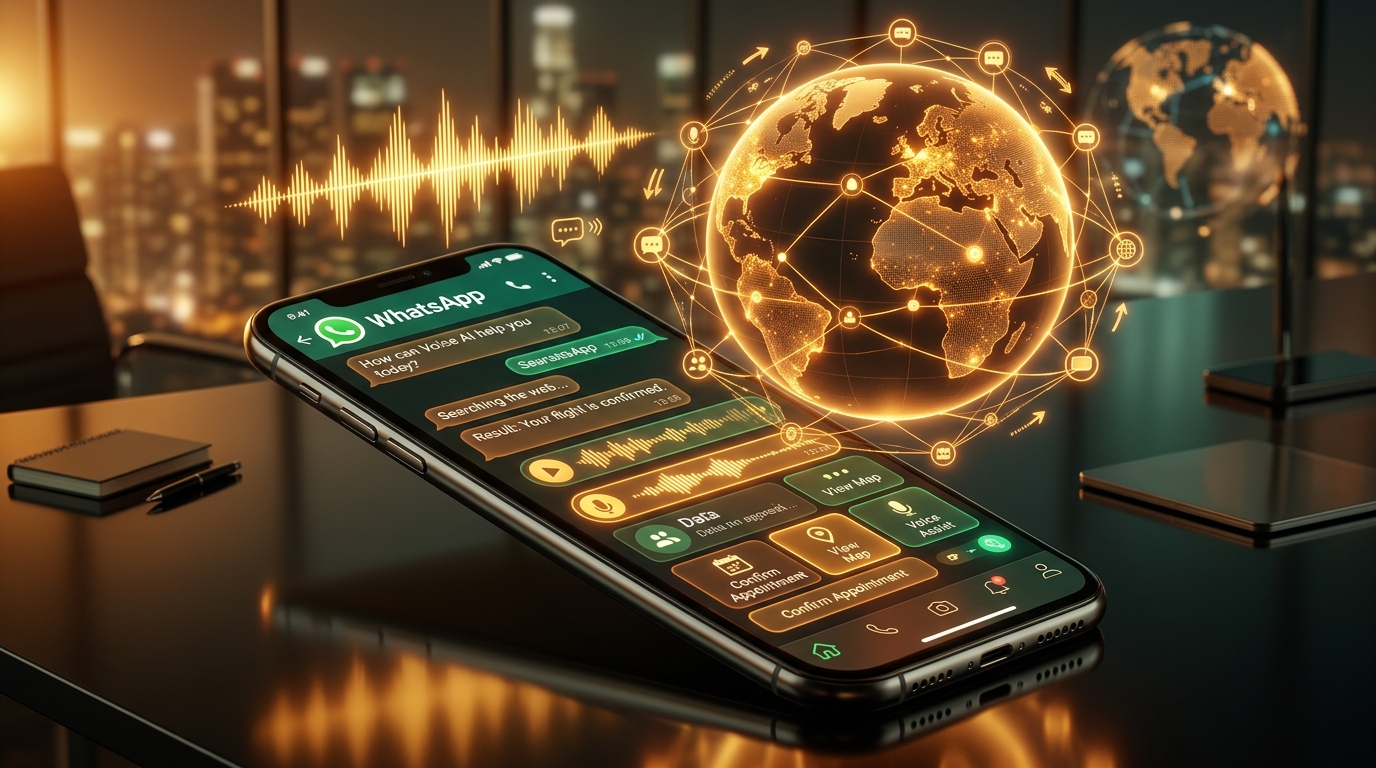
Figure 1: Global conversational network connecting sub-80ms low-latency Voice AI with ubiquitous WhatsApp Business swarms in 2026.
Executive Summary & Key Industry Benchmarks
- The Sub-80ms S2S Breakthrough: Direct Speech-to-Speech models eliminate cascaded STT-LLM-TTS delays, streaming conversational audio under 80 milliseconds with full-duplex human interruption barge-in.
- $60B+ Conversational Commerce: WhatsApp agents with headless in-chat checkout (UPI 2.0, Pix, Stripe Link) deliver 38.4% cart recovery rates compared to just 8.2% for traditional email.
- Vernacular Inclusivity (120+ Dialects): Real-time voice note parsing and local dialect code-switching democratize banking, e-commerce, and healthcare for emerging economies with low written literacy.
- Unified Telephony-to-WhatsApp Fabric: Callers speaking to a Voice AI agent instantly receive interactive booking cards, PDF receipts, and approval links inside WhatsApp mid-conversation without dropping the call.
- 81% Enterprise Support Deflection: Automated agent swarms resolve customer inquiries end-to-end, slashing cost per resolution from $7.50 to $0.42 while boosting CSAT to 94.6%.
1. The Sub-80ms Acoustic Breakthrough: Why Direct S2S Vanquished Legacy IVRs
Cascaded pipelines transcribe voice to text (STT), query an LLM, and synthesize speech (TTS), causing 1200ms–2500ms of lag and discarding emotional cues. Direct Speech-to-Speech (S2S) operates natively on raw continuous acoustic tokens under 80ms, enabling real-time interruptions, whispering, laughter, and authentic human prosody.
Until early 2025, calling a corporate hotline or speaking with an automated assistant was universally reviled. Legacy Interactive Voice Response (IVR) systems forced users through rigid numerical trees ("Press 1 for billing, Press 2 for support"), while first-generation "AI voice bots" suffered from catastrophic latency gaps of 1.5 to 3 seconds between speech turns.
In 2026, the architecture of conversational voice has been fundamentally reconstructed. Modern systems deploy Direct Speech-to-Speech (S2S) Neural Streaming Models:
- Zero-Transcription Latency (<80ms): The acoustic waveform is encoded into continuous acoustic neural tokens, reasoned upon directly by audio-native foundation models, and decoded into synthesized speech without converting to text intermediate buffers.
- Full-Duplex Interruption (Barge-In): When a user interrupts an agent mid-sentence, the neural acoustic stream immediately pauses generation, acknowledges the correction, and pivots seamlessly without robotic repetition.
- Acoustic Emotional Empathy: Direct S2S perceives vocal stress, hesitation, anger, or urgency directly from pitch and harmonics, allowing the agent to adjust its vocal timbre, cadence, and reassurance levels dynamically.
| Performance Benchmark | Cascaded STT-LLM-TTS (Legacy) | Direct Speech-to-Speech S2S (2026) |
|---|---|---|
| Total Response Latency | 1,400ms – 2,800ms (uncomfortable delay) | 58ms – 82ms (human-conversational) |
| Handling Interruptions | Robotic collision, awkward cut-offs, or ignored input | Instant full-duplex conversational barge-in |
| Prosody & Emotional Nuance | Flat, robotic text-to-speech cadence | Rich vocal inflection, breathing, and pitch empathy |
| Background Noise Rejection | Transcription errors on car/street background noise | Acoustic conditioning filters chatter & wind noise |
| Cost Per Minute | $0.18 – $0.35 per active minute | $0.024 – $0.045 per active minute |
2. WhatsApp Autonomous Commerce: The $60B Headless Shopping Engine
WhatsApp conversational commerce combines autonomous agent swarms with Meta’s Business Cloud API and localized instant payment rails (UPI, Pix, Stripe Link). Consumers browse personalized product catalogs, negotiate orders, view AR previews, and authenticate biometric payments entirely inside WhatsApp chat without opening external websites or mobile apps.
With over 3.2 billion active monthly users, WhatsApp is no longer just a messaging utility—it has evolved into the operating system of global commerce. In emerging economic powerhouses across Latin America, India, Southeast Asia, and the Middle East, consumers rarely download standalone retail apps.
SyncFlo AI’s production deployments across leading enterprise brands reveal transformative metrics:
Cart Recovery Conversion
In-chat interactive cart nudges outperform standard recovery emails (8.2%) by 4.6x.
Headless Checkout
Tokenized payment sheets (UPI 2.0, Pix, Apple Pay) complete purchases in under 5 seconds.
Zero-Agent Escalation
Inquiries, refunds, tracking, and exchanges resolved autonomously without human staff.
A customer can send a voice note asking, "Do you have that beige linen blazer in size 40, and can it arrive in Chicago before Friday?" The WhatsApp agent queries the inventory ERP via Model Context Protocol (MCP), checks courier logistics schedules, presents a rich product card with dynamic images, and triggers an in-chat payment link. The entire transaction concludes in 30 seconds.

Figure 2: Real-time acoustic voice streams converging into verified in-chat tokenized payment confirmations inside WhatsApp.
3. The Telephony-to-WhatsApp Omnichannel Session Fabric
Unified telephony-to-WhatsApp handoff creates continuous memory between voice phone calls and messaging threads. When a caller is on the phone with a Voice AI agent, the agent pushes interactive visual cards, documents, or payment authorizations directly to the caller's WhatsApp in real time, synchronizing audio and visual interaction simultaneously.
Historically, voice and digital messaging existed in complete isolation. If a customer called an airline, the phone agent had to recite confirmation codes or read out flight numbers verbally.
In 2026, SyncFlo AI pioneered the Omnichannel Audio-Visual Continuum:
- Real-Time Visual Push During Calls: While discussing flight adjustments, the Voice AI agent says, "I've just sent three alternative itineraries to your WhatsApp. Take a look while we talk." The customer opens WhatsApp, views the seat map and departure options, and taps their preferred choice.
- Biometric Authorization Over Voice: Rather than forcing users to read credit card numbers aloud—a severe security hazard—the Voice AI agent generates a secure cryptographic payment prompt inside WhatsApp, verified via FaceID or UPI PIN.
- Persistent Post-Call Context: Once the call ends, the complete transcript, digital tickets, calendar reminders, and customer support ticket remain preserved in the user's WhatsApp conversation for ongoing self-service.
4. Healthcare & Vernacular Equity: Revolutionizing the Global South
Voice and WhatsApp AI allow rural patients to communicate in their native vernacular dialects through audio notes, bypassing literacy barriers. Combining multilingual acoustic models with multimodal computer vision, agents analyze photos of prescriptions, verify dosages, provide maternal health alerts, and triage symptoms in local communities.
The global digital divide was never primarily hardware—billions of people own affordable Android smartphones. The real barrier was textual literacy and complex application interfaces.
By combining native audio comprehension with WhatsApp, autonomous AI has triggered a healthcare and financial inclusion revolution across 120+ vernacular languages:
- Rural Medical Triage in Sub-Saharan Africa and India: Expectant mothers in remote villages send WhatsApp voice notes describing symptoms in local dialects (Swahili, Yoruba, Bhojpuri, Telugu). The clinical AI agent assesses pre-eclampsia risks, cross-references vital signs, and dispatches community health workers when danger signs emerge.
- Multimodal Prescription Edge OCR: Patients photograph crumpled, handwritten doctor prescriptions. The agent instantly parses the handwriting, alerts the patient to dangerous drug interactions, and coordinates delivery from local generic pharmacies at wholesale prices.
- Vernacular Financial Inclusion: Micro-entrepreneurs, street vendors, and farmers apply for working capital loans via voice dialogue, submitting agricultural receipts through camera snapshots and receiving approved micro-loans into their mobile wallets within 3 minutes.
5. Enterprise Playbook: Transforming Your Operations with Voice & WhatsApp AI
For enterprise leaders seeking to deploy high-ROI conversational systems in 2026, SyncFlo AI recommends four strategic steps:
Step 1: Replace Legacy Telephony with Sub-80ms S2S
Audit your inbound contact centers. Route tier-1 inquiries (order tracking, cancellations, reservations) to direct Speech-to-Speech models. Achieve immediate 75%+ cost reduction while eliminating caller wait times.
Step 2: Activate WhatsApp Business API Swarms
Connect your product catalog and CRM via Model Context Protocol (MCP) to WhatsApp Business endpoints. Enable dynamic in-chat catalogs and 1-tap tokenized checkouts (UPI, Pix, Stripe Link).
Step 3: Implement Synchronous Omnichannel Handoff
Equip your voice agents to push rich visual cards, PDFs, and checkout sheets directly to the caller's WhatsApp mid-call. Elevate first-call resolution to industry-leading levels.
Step 4: Continuous Multi-Agent Guardrailing
Deploy automated supervisor agents to review conversational sentiment, compliance adherence, and payment security in real time, guaranteeing zero drift and total regulatory compliance.
Frequently Asked Questions (FAQ)
Can Voice AI handle complex regional accents and background street noise?
Yes. 2026 direct S2S models are trained on diverse global acoustic datasets and incorporate neural beamforming noise-suppression. They accurately isolate vocal intent even in noisy cars, crowded train stations, and bustling open-air markets across 120+ vernacular dialects.
Is purchasing inside WhatsApp compliant with PCI-DSS and global data protection laws?
Absolutely. Checkout flows utilize tokenized headless payment rails where sensitive credit card and banking credentials never touch plain text chat. Authentication is managed through encrypted biometric verification, fully compliant with PCI-DSS Level 1, GDPR, and localized digital banking standards.
How quickly can an enterprise deploy SyncFlo Voice and WhatsApp agents?
Using our pre-built Model Context Protocol (MCP) integrations for Salesforce, Shopify, SAP, and Zendesk, enterprises can deploy production-grade Voice AI and WhatsApp swarms in as little as 48 to 72 hours.
Transform Your Conversational Customer Experience Today
Elevate your organization into the conversational future with SyncFlo AI’s sub-80ms voice agents and autonomous WhatsApp commerce engines. Deliver immediate resolution to 3.2 billion global consumers.