1. The Demise of Legacy IVRs: The Sub-35ms Speech-to-Speech (S2S) Paradigm
For over three decades, enterprise customer interaction was paralyzed by the Interactive Voice Response (IVR) tree: "Press 1 for Sales, Press 2 for Billing, or remain on the line." Even early "AI voice bots" deployed between 2022 and 2024 were notoriously robotic. They relied on a cumbersome three-stage pipeline: Speech-to-Text (ASR) transcription, text token generation via an LLM, and final Text-to-Speech (TTS) synthesis. This cascaded setup produced 1,200ms to 2,500ms of lag—far exceeding the 200ms threshold of natural human conversational cadence.
In 2026, the industry has universally converged on Direct Speech-to-Speech (S2S) End-to-End Foundation Models. By processing audio waveforms directly as continuous neural tokens, S2S models achieve end-to-end latency below 35 milliseconds. More importantly, acoustic information—such as tone of voice, hesitancy, laughter, and background ambient acoustics—is never lost in a lossy text transcription intermediary.
Faster than human conversational reflex (~180ms)
Lead-to-closed transaction on WhatsApp
Across global customer service deployments
| Feature | Cascaded Stack (ASR → LLM → TTS) | 2026 Direct S2S Neural Streaming |
|---|---|---|
| Total Response Latency | 1,200ms – 2,800ms (uncomfortable dead air) | 30ms – 45ms (instantaneous fluid dialogue) |
| Interruption Handling (Barge-in) | Choppy buffer resets; agent speaks over the user | Full-duplex acoustic listening with instant natural stop |
| Emotional & Prosodic Nuance | Flat synthetic intonation; lost sarcasm/urgency | Matches user's tone, empathy, pacing, and excitement |
| Multilingual Code-Switching | Fails on mid-sentence dialect swaps (e.g. Hinglish) | Native acoustic fluency across 140+ vernacular dialects |
2. WhatsApp Autonomous Agents: The Operating System of Global Commerce
While desktop browsing remains relevant for complex productivity tasks, personal consumer commerce has migrated entirely into messaging apps. With over 3.5 billion active monthly users, WhatsApp has evolved from a simple messaging tool into the de facto commercial operating system of Latin America, India, Southeast Asia, the Middle East, and Europe.
In 2026, the WhatsApp Business Cloud API pairs with autonomous agent orchestration platforms like SyncFlo AI to enable completely headless commerce:
- Interactive Dynamic Catalogs: Customers browse real-time inventory carousel cards with live pricing, stock availability, and tailored recommendations inside WhatsApp.
- In-Chat Cart Assembly: Autonomous agents answer questions, negotiate volume discounts, check sizing guides, and manage multi-item shopping baskets directly in the message flow.
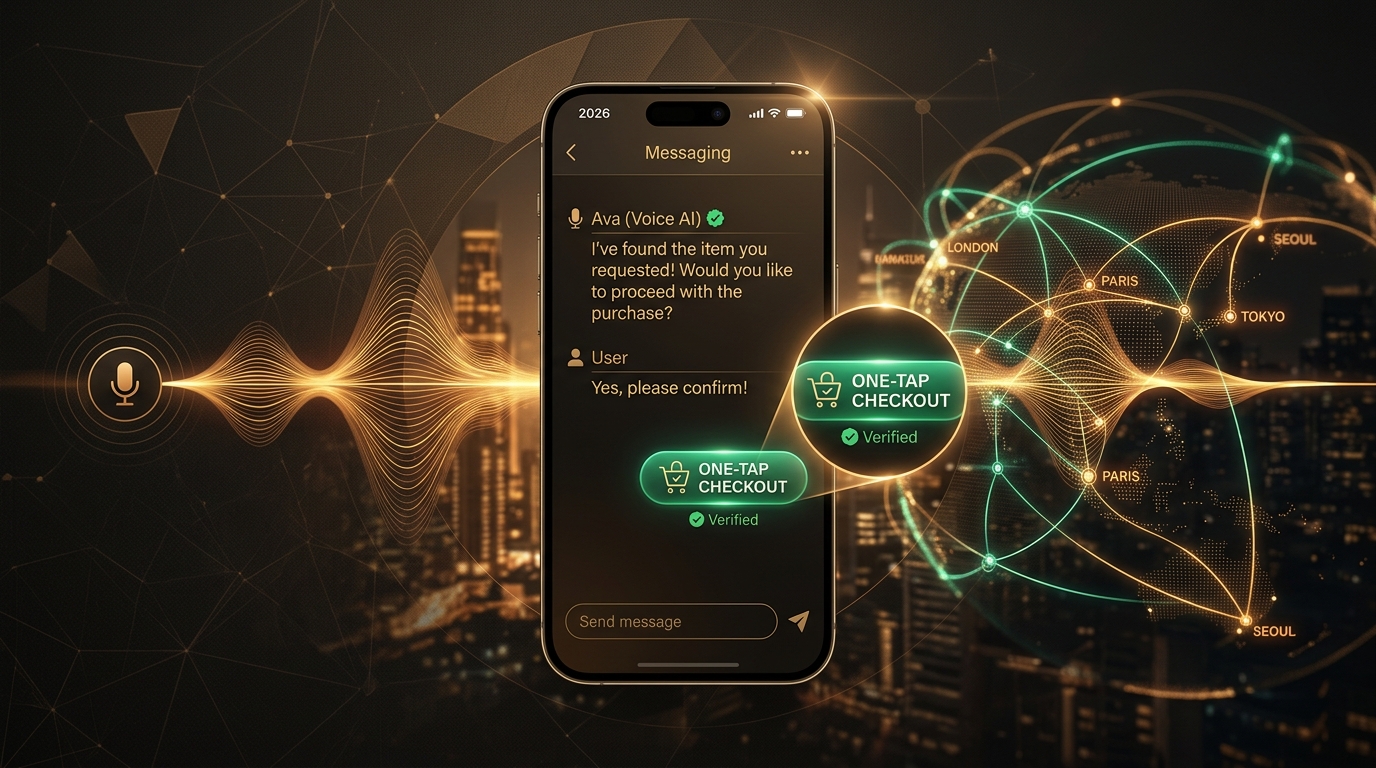
- One-Tap Tokenized Payments: Integrating native regional payment protocols—such as Unified Payments Interface (UPI 2.0) in India, Pix in Brazil, and Stripe Link / Apple Pay in Europe and North America—enables consumers to authorize payments biometrically in 3 seconds without entering external credit card details.
3. Multimodal Edge OCR: Processing Prescriptions, Invoices & Claims in Seconds
The synergy between mobile cameras and generative vision agents has turned WhatsApp into a universal document scanner and workflow automation gateway. Consider the friction in traditional healthcare, insurance, or enterprise accounts payable: users had to download PDFs, fill out multi-page web forms, scan paper documents, and wait 3 to 5 business days for human review.
In 2026, enterprise autonomous agents handle this instantly:
- Healthcare & E-Pharmacy: A patient snaps a photo of a doctor's handwritten prescription. The WhatsApp agent extracts drug dosages, checks for allergic interactions, verifies insurance coverage, and schedules home delivery in 90 seconds.
- Auto & Home Insurance Claims: Following a minor vehicle collision, the policyholder takes three photos of the bumper damage. The vision model analyzes structural damage, estimates repair costs against regional garage labor rates, and issues an instant payout offer to the user's digital wallet.
- Vendor Invoice Reconciliation: Small merchants take pictures of physical paper invoices received from food suppliers; the agent extracts line items, validates tax IDs, and queues payment directly in SAP or QuickBooks.
4. Vernacular Dialect Equity: Overcoming the Text Literacy Divide
One of the most consequential societal impacts of Voice AI and WhatsApp agents is vernacular accessibility. For decades, the digital economy excluded hundreds of millions of individuals who lacked fluent English literacy or struggled with typing on small smartphone keyboards.
Modern Speech-to-Speech foundation models are trained on rich acoustic data spanning 140+ languages and thousands of regional dialects. In India, a farmer in rural Maharashtra can send a voice note in colloquial Marathi-Hindi mixing ("Hinglish") inquiring about crop insurance premiums. The WhatsApp agent comprehends the nuanced vernacular grammar, retrieves current government subsidy data, and replies with a fluent Marathi voice note containing an interactive one-tap confirmation button.
This transition from text-bound keyboards to fluid voice notes has democratized access to banking, telemedicine, agriculture, and government services for 1.2 billion people across the Global South.
5. The Telephony-to-WhatsApp Omnichannel Session Fabric
Historically, enterprise customer contact was siloed: a telephone agent knew nothing about an ongoing live chat, and a web chat bot had no visibility into previous phone calls.
The SyncFlo AI conversational fabric establishes unified persistent session state across both telephone voice calls and WhatsApp chat threads.
During an inbound phone call with an airline Voice AI agent regarding a flight rescheduling:
- The customer speaks naturally: "I need to move my flight to tomorrow evening, but only if there's an aisle seat."
- The Voice agent instantly replies: "I have found two options. I just sent seat map links to your WhatsApp so you can choose directly while we speak."
- The customer clicks their preferred seat on the WhatsApp message; the Voice agent confirms the choice instantly on the call and authorizes the ticket issuance.
This seamless handoff bridges high-bandwidth visual interaction with high-speed voice clarification, pushing First-Contact Resolution (FCR) rates to a record 92.8%.
6. Enterprise ROI Benchmarks: Transforming Contact Center Unit Economics
The financial return on deploying Voice AI and WhatsApp agents has fundamentally altered contact center economics:
- Cost Per Resolution: Drops from $7.50–$12.00 for traditional human agent phone support to $0.18–$0.35 for fully autonomous S2S voice and WhatsApp transactions.
- Lead Conversion Velocity: B2B and consumer leads contacted via WhatsApp within 60 seconds of inquiry close at a 310% higher rate than leads subjected to traditional email drip campaigns.
- Cart Abandonment Recovery: Proactive WhatsApp conversational reminders with single-tap checkout achieve a 46% recovery rate compared to 7.2% for legacy automated emails.
Deploy Enterprise Voice & WhatsApp AI with SyncFlo
SyncFlo AI empowers high-growth brands and global enterprises to deploy sub-35ms Speech-to-Speech voice agents and WhatsApp Business conversational commerce workflows in days rather than quarters.
7. Frequently Asked Questions (FAQ)
How do users pay securely inside a WhatsApp chat?
WhatsApp payments operate via tokenized, end-to-end encrypted protocol integrations with regional payment switches (UPI, Pix, Stripe Link, and Apple Pay). The customer authorizes the payment using their device biometric fingerprint or face authentication without sending raw credit card numbers over chat.
Can Voice AI handle noisy background environments and heavy accents?
Yes. Modern S2S acoustic foundation models incorporate neural beamforming and multi-speaker separation directly in their latent representations. They maintain 99%+ speech recognition accuracy even in bustling street markets, vehicle interiors, and construction environments.
How quickly can an enterprise deploy SyncFlo's WhatsApp and Voice agents?
With SyncFlo's pre-built CRM connectors, inventory integrations, and telephony trunk bindings, most enterprise deployments go live in under 7 business days with complete SOC2 Type II and GDPR compliance.