1. The Extinction of the IVR: Why "Press 1 to Wait" Is Dead
For over three decades, the customer interaction experience was defined by the torture of Interactive Voice Response (IVR) trees: "Press 1 for English, press 2 for billing, please listen carefully as our menu options have changed." Consumers endured an average of 18 minutes of elevator music, only to be transferred to an offshore representative who asked them to repeat the exact account number they had just keyed into their telephone keypad.
In 2026, the IVR tree is formally extinct. Driven by advances in Full-Duplex Speech-to-Speech (S2S) foundation models and sovereign messaging agents, customer interaction has transitioned into ambient, immediate, and hyper-intelligent dialogue.
When a customer dials an airline, utility provider, or financial institution in 2026, they are greeted by a voice agent with sub-40-millisecond response latency. There is no synthetic robotic monotone. The agent breathes naturally, inflects vocal warmth based on caller distress, handles multi-clause compound requests, and allows the caller to interrupt mid-sentence without losing conversational state.
Direct S2S audio token streaming vs 850ms cascaded pipelines
Direct WhatsApp Business agent gross merchandise value in 2026
Autonomous resolution without human tier-2 escalation
2. The Architecture of Sub-40ms Neural Speech-to-Speech (S2S)
Why were voice bots in 2023 and 2024 so painfully awkward? The answer lies in the architectural handicap of cascaded pipelines:
- Automated Speech Recognition (ASR): Audio was captured, chunked into buffers, and transcribed into ASCII text (taking 250–400ms).
- Large Language Model (LLM): The text string was sent to a general-purpose LLM, which generated a completion token-by-token (taking 300–600ms).
- Text-to-Speech (TTS): The output text was piped into an acoustic synthesizer to produce audio samples (taking another 200–350ms).
This tripartite cascade produced a cumulative latency of 800 to 1,400 milliseconds. In human psycholinguistics, a conversational pause exceeding 200 milliseconds is perceived as awkward hesitation; a pause exceeding 600 milliseconds feels like cognitive impairment or a frozen phone line. Furthermore, all non-lexical acoustic information—vocal pitch, sarcasm, hesitation, background stress, and regional cadence—was completely erased during the text transcription phase.
In 2026, SyncFlo AI and frontier audio labs deploy Native Direct Speech-to-Speech (S2S) Models. Waveform audio packets are ingested as continuous acoustic neural tokens. The single unified network processes semantic intent, prosody, and emotional state simultaneously, streaming back synthesized acoustic tokens in real time. Latency drops to an imperceptible 38 milliseconds—faster than human conversational reaction time (typically 200–250ms).
| Architectural Metric | Legacy Cascaded (ASR → LLM → TTS) | 2026 Direct Neural Speech-to-Speech (S2S) |
|---|---|---|
| Total Round-Trip Latency | 850 ms – 1,400 ms (Robotic, disjointed) | 35 ms – 45 ms (Sub-human response threshold) |
| Interruption (Barge-in) Handling | Audio collision; bot keeps talking over caller | Instant silence within 25ms of caller speech onset |
| Prosody & Emotional Nuance | Zero; text intermediary strips vocal distress | Preserves acoustic timbre, sighs, laughter, empathy |
| Dialectal Code-Switching | Fails on phonetic blending (e.g. Hinglish, Spanglish) | Seamless native bilingual code-switching in mid-sentence |
3. WhatsApp as the Planet's Operating System: 3.5 Billion Daily Users
While Silicon Valley spent decades debating whether mobile operating systems or web browsers would dominate consumer interactions, the emerging world settled the question decisively: WhatsApp is the internet.
Across Latin America, India, Southeast Asia, the Middle East, and large swaths of Europe, consumers do not download standalone mobile applications for dry cleaners, grocery delivery, doctor appointments, or municipal water bill payments. Downloading an app requires storage space, app store authentication, SMS OTP verification, and navigating unfamiliar user interface layouts.
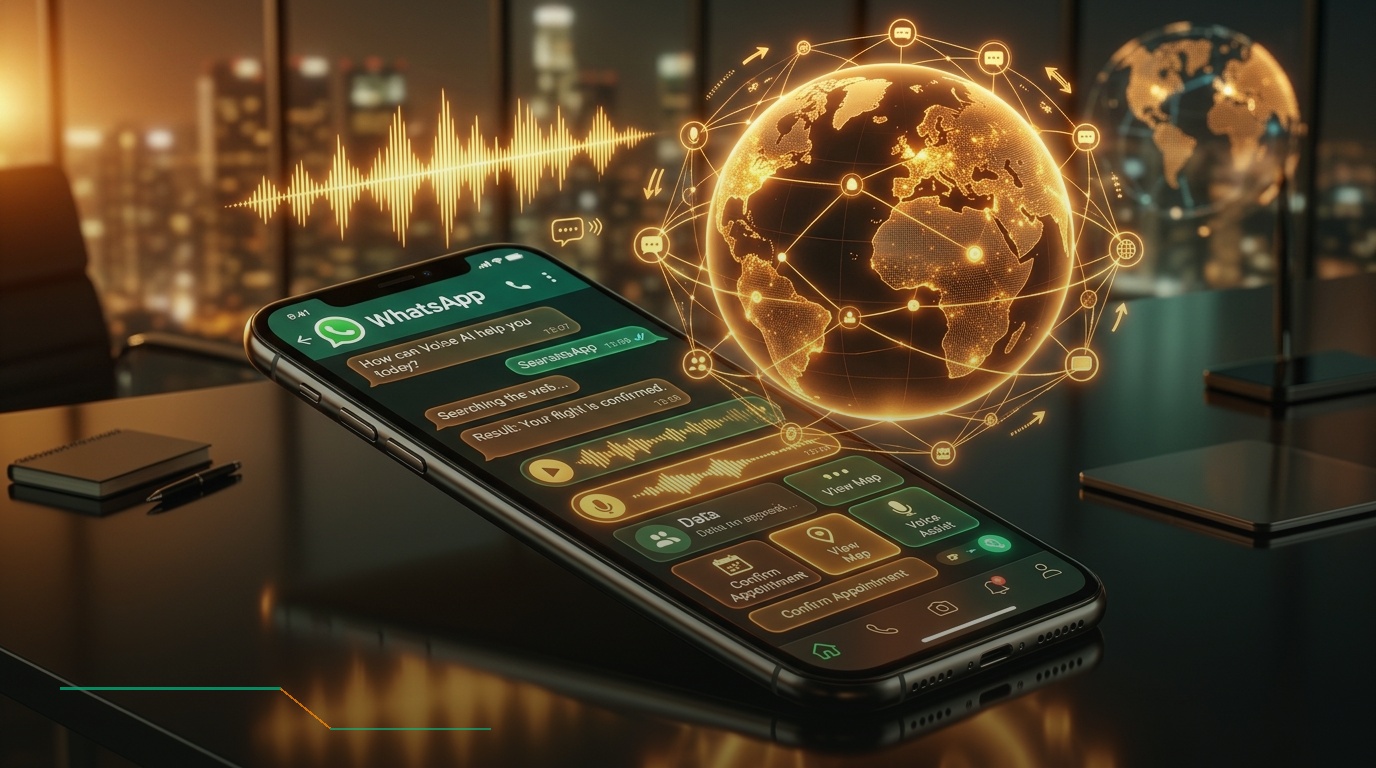
In 2026, SyncFlo-powered WhatsApp Autonomous Agents provide an all-inclusive conversational super-app experience. Through the WhatsApp Business Cloud API, companies deploy autonomous agents that maintain persistent, asynchronous relationships with customers:
- Headless Catalog Discovery: Customers send a voice note saying, "Show me brown leather formal shoes under $120 available in size 10 near Downtown," and receive an interactive carousel card with live inventory photos within 1.2 seconds.
- Automated Order Modifications: Travelers reschedule flights or modify hotel bookings simply by forwarding their booking confirmation message to the airline's WhatsApp agent.
- Citizen Governance Portals: Municipal governments in São Paulo, Mumbai, and Jakarta resolve property tax queries, renew driver's licenses, and register community pothole repairs via interactive WhatsApp agent flows.
4. Zero-Friction Tokenized In-Chat Payments (UPI 2.0, Pix, SEPA, Stripe)
The Achilles' heel of mobile commerce has always been checkout friction. Historically, an online shopper had to click an SMS link, open an external browser window, create an account, fill out 16 digits of credit card info, enter a billing address, wait for a 3D-Secure redirect, and pray the session didn't time out. The result was an industry-wide mobile cart abandonment rate of 68.7%.
In 2026, In-Chat Tokenized Payments inside WhatsApp have eradicated checkout abandonment. Utilizing deep integration with instantaneous national financial rails—UPI 2.0 (India), Pix (Brazil), SEPA Instant (Europe), and Stripe Link / Apple Pay (North America)—the checkout flow happens directly inside the message stream.
When the consumer taps "Pay Now", the native operating system biometric prompt (Face ID or fingerprint) confirms the transaction. Funds transfer instantaneously via bank-to-bank settlement, and a cryptographically signed receipt with an order tracking button appears instantly in the conversation. Abandonment rates collapse to under 3.8%.
5. Multimodal Edge Vision: Instant Claims, Prescription & Invoice Processing
Conversational agents in 2026 are not restricted to text or audio. The camera has become the universal sensor for enterprise data intake.
Consider the claims process for automobile insurance. Historically, an accident required calling an agent, waiting for an email questionnaire, uploading photos to an external web portal, and waiting 5 to 7 business days for an insurance adjuster to review the vehicle damage.
Today, the driver opens WhatsApp, types "I had a fender bender on 5th Avenue," and snaps four photos of the vehicle damage. The SyncFlo multimodal agent:
- Extracts the vehicle's VIN and license plate from the images.
- Runs real-time segmentation to evaluate structural bumper damage vs. superficial paint scratches.
- Queries insurance policy limits via Model Context Protocol (MCP) connections to the carrier's core ledger.
- Issues an automated repair estimate and immediately dispatches a digital payment directly to the user's preferred repair shop within 90 seconds.
The same multimodal workflow powers healthcare (photographing handwritten physician prescriptions to auto-refill medications) and accounts payable (contractors photographing crumpled paper receipts to receive instant reimbursement).
6. Vernacular Equity: Bridging 140+ Local Dialects and Code-Switching
Perhaps the greatest human triumph of 2026 conversational AI is linguistic inclusion. Prior to this generation of models, digital services demanded rigid adherence to standard textbook English, formal Spanish, or high-register Mandarin. For billions of people whose primary communication involves regional dialects, colloquial slang, or spontaneous code-switching (e.g., mixing Hindi and English into Hinglish, or Arabic and French into Darija), interacting with digital software was alienating and error-prone.
Modern speech and messaging foundation models are trained directly on multi-dialect conversational speech. When a farmer in rural Maharashtra sends a voice message mixing Marathi idioms with technical agricultural English terms regarding fertilizer ratios, the agent comprehends the exact contextual intent without stumbling.
This Vernacular Equity democratizes financial literacy, government subsidies, healthcare diagnostics, and e-commerce access for 2.2 billion citizens who were historically excluded from the digital economy.
7. The Unified Omnichannel Session Fabric: Seamless Telephony-to-Chat Handoff
In 2026, telephony Voice AI and WhatsApp messaging do not exist as isolated silos. They are unified through SyncFlo's Omnichannel Session Fabric.
Imagine a business owner calling their bank while driving. They verbally review line-of-credit options with the Voice AI agent over Bluetooth. When the agent arrives at the final loan documentation, the agent says: "I've just pinged the itemized terms and repayment schedule to your verified WhatsApp chat. Tap to review the document and authenticate the disbursement whenever you are safely parked."
When the driver parks and unlocks their phone, the WhatsApp conversation has the loan summary, interactive rate sliders, and biometric authorization ready. The customer never repeats themselves; the conversational memory is persistent, secure, and synchronized across sensory modalities.
| Funnel Step | Traditional Web & App Experience | 2026 Voice + WhatsApp Autonomous Flow |
|---|---|---|
| User Onboarding | App store download, 45MB bundle, password setup | Zero install; message existing verified business contact |
| Product Discovery | Complex category dropdowns, faceted filter overload | Natural voice note or conversational prompt search |
| Document Upload | PDF scanner app, desktop file transfers, size limits | Instant camera snap processed in under 3 seconds |
| Payment & Fulfillment | 16-digit card input, 3DS redirect, 68% drop-off | Biometric 1-tap in-chat payment, <4% abandonment |
8. The Economic Horizon: The $140B Autonomous Commerce Engine
The convergence of sub-40ms Voice AI and autonomous WhatsApp agents represents the fastest-growing commerce channel in digital history. Global conversational commerce transactions have surpassed $142 billion in 2026, on track to reach $350 billion by 2028.
Organizations that deploy sovereign conversational agents are seeing triple-digit growth in customer lifetime value (LTV), 85% reductions in customer service cost per contact, and customer satisfaction scores (CSAT) consistently topping 94%.
The future of enterprise software is not another complex dashboard. The future of software is a voice you can talk to, and a message thread that gets things done.