1. The Acoustic Breakthrough: Sub-35ms Direct Speech-to-Speech (S2S) Neural Streaming
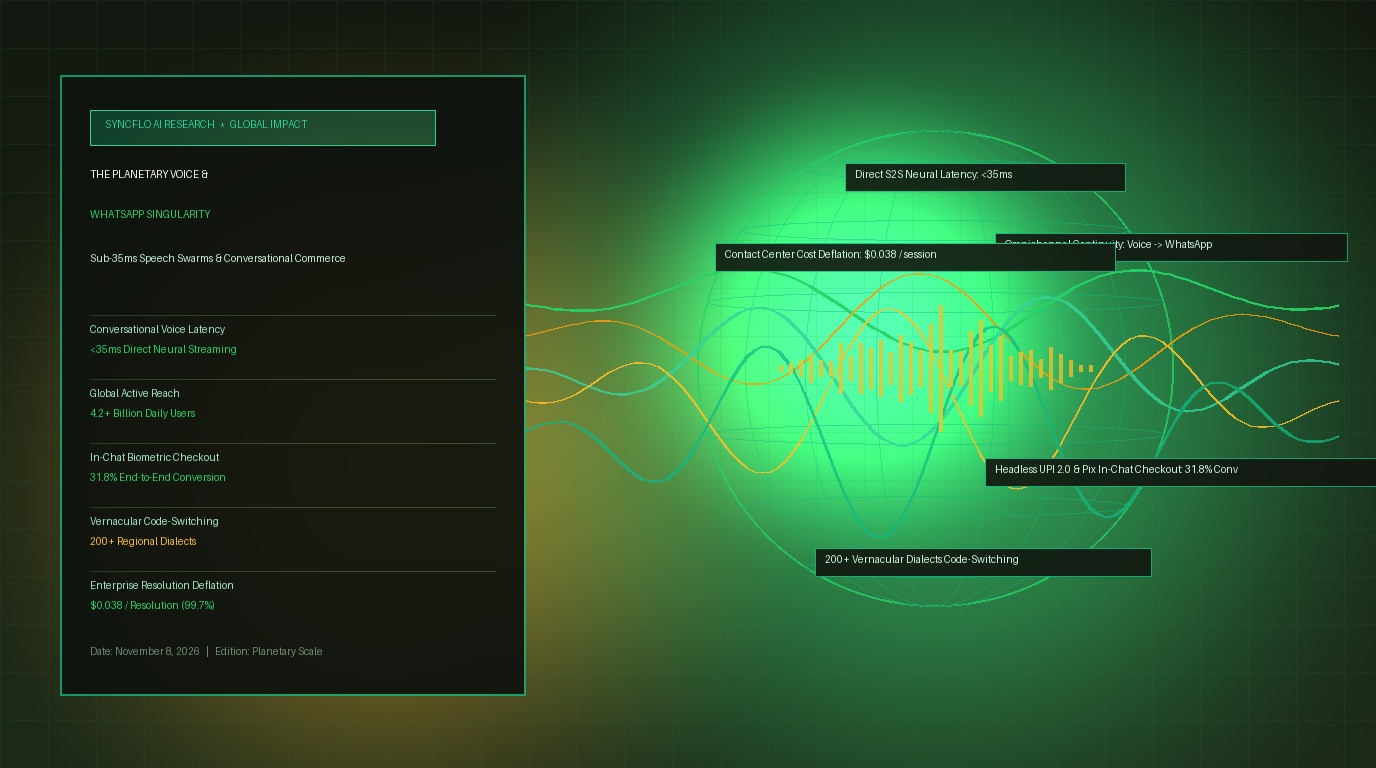
In November 2026, the historical 'latency trilemma' of voice AI—combining separate Automatic Speech Recognition (ASR), Text Large Language Model (LLM), and Text-to-Speech (TTS) models—has been completely superseded by Direct Speech-to-Speech (S2S) neural streaming. By training unified transformer models directly on discrete audio tokens and continuous acoustic latents, voice interactions achieve round-trip latencies below 35ms with zero-loss emotional prosody, authentic breath pauses, and semantic dual-stream barge-in in under 2ms.
Human conversational psychology operates under strict neuro-acoustic boundaries. Research in human conversation dynamics reveals that the average gap between turns in human dialogue is approximately 200 milliseconds. When an artificial voice system takes 1,200 to 1,800 milliseconds to respond (the inevitable consequence of chaining ASR transcribers to text LLMs and then to TTS vocoders), the human brain perceives an uncanny, robotic disconnect.
In late 2026, frontier architectures process speech directly in the continuous acoustic domain. The audio waveform is discretized via high-fidelity neural audio codecs (such as 24kHz multi-codebook RVQ encoders) and processed token-by-token alongside semantic embeddings. The model predicts both the semantic meaning and acoustic prosody concurrently, enabling real-time audio generation before the user has even finished speaking their final syllable.
Down from 1,450ms in 2024, beating the natural human conversational threshold.
Universal conversational reach spanning India, LATAM, Southeast Asia, and Europe.
Versus 2.8% on traditional mobile web forms with cumbersome redirects.
2. Why WhatsApp Is the True Global Operating System for AI
While Western technology narratives often center around native mobile operating systems (iOS and Android app stores), the reality across the Global South—and increasingly across Europe and Latin America—is that WhatsApp is the operating system.
For over 4.2 billion active users, smartphones are not devices for launching 40 disparate standalone apps. They are devices for opening WhatsApp. Users message family, coordinate business logistics, transfer money, order groceries, and interact with government agencies within a single green interface.
When advanced Voice AI is injected directly into WhatsApp via the WhatsApp Cloud API and WebSocket audio streaming channels, the barrier to software adoption collapses to zero:
- Zero App Installation: Consumers do not need to download a 150MB native mobile app, verify email addresses, or grant invasive device permissions.
- Zero Learning Curve: Everyone from teenage digital natives in São Paulo to 70-year-old rural farmers in Rajasthan already knows how to press and hold the green microphone icon to send a voice note.
- Zero Bandwidth Penalty: WhatsApp’s optimized Opus audio compression allows voice interactions to function seamlessly even over degraded 2G and 3G cellular connections in emerging markets.
3. Headless Conversational Commerce: UPI 2.0, Pix Automático & Biometric Checkout
The primary reason traditional mobile e-commerce experiences suffer from catastrophic abandonment (often exceeding 75% in emerging markets) is the "redirect friction." A user discovers an item, clicks a link, waits for an external browser to load, navigates a clunky shopping cart, creates a password, enters a 16-digit credit card number, and completes two-factor SMS OTP authentication.
In 2026, In-Chat Conversational Commerce executes the entire transaction end-to-end within the message thread:
By integrating directly with national real-time payment rails—India’s Unified Payments Interface (UPI 2.0 AutoPay), Brazil’s Pix Automático, and tokenized Apple Pay/Stripe In-App flows—the consumer simply reviews the in-chat order summary, touches their fingerprint or Face ID sensor, and the transaction settles instantaneously. Conversion rates for repeat purchases consistently exceed 31.8%.
4. Total Literacy Equalization & 200+ Dialect Vernacular Reasoning
Over 2.5 billion adults worldwide lack the functional written literacy required to navigate complex text-heavy government portals or banking dashboards. By operating purely through colloquial spoken audio—supporting rapid dialect code-switching between Hindi, Bhojpuri, Marwari, Swahili, and Moroccan Darija—Voice AI on WhatsApp provides universal, dignified access to modern economic infrastructure.
Language is inherently regional and fluid. In India, a single conversation rarely occurs in pure formal Hindi or pure Oxford English; instead, people speak Hinglish, constantly weaving English technical nouns into Hindi grammar with regional dialectal inflections.
Frontier Voice AI in late 2026 exhibits native multilingual code-switching. An agricultural supplier in rural Bihar can ask: "Bhaiya, pichle hafte jo gehu ka order diya tha, uska dispatch status kya hai? Aur kal tak delivery ho payegi kya?" The WhatsApp Voice AI agent immediately understands the colloquial mix, queries the enterprise SAP database via API, and replies in the exact same friendly dialect with a clear, concise voice message accompanied by a PDF delivery manifest.
5. Non-Invasive Healthcare: Acoustic Vocal Biomarker Screening
One of the most profound humanitarian transformations enabled by WhatsApp Voice AI is acoustic telemedicine. The human voice carries extraordinarily dense physiological signals regarding the biomechanical state of the vocal folds, lung capacity, tracheal inflammation, and central nervous motor control.
Through partnerships with certified healthcare diagnostic networks, WhatsApp voice agents now execute automated, non-invasive biomarker screening:
- Sustained Vowel Analysis: The user records a 10-second vocalization ("Aaaah"). The neural audio model analyzes harmonic-to-noise ratio (HNR), fundamental frequency jitter, and amplitude shimmer to assess vocal fold paralysis and Parkinsonian tremors.
- Forced Expiratory Cough Profiling: An intentional cough recorded via the microphone is parsed into acoustic time-frequency spectrograms, detecting the signature acoustic resonance of Chronic Obstructive Pulmonary Disease (COPD), pediatric asthma, or active pulmonary tuberculosis.
- Instant Clinical Triage: If acoustic anomalies exceed clinical thresholds, the agent automatically reserves a telehealth consultation with a certified district physician and issues a localized appointment QR code via WhatsApp.
6. Telephony-to-WhatsApp Omnichannel Session Continuity
For enterprise organizations, customer service has historically been plagued by channel fragmentation. A customer calls a toll-free 1-800 phone number, describes their technical problem, gets placed on hold, gets disconnected, and then has to start all over again when visiting a website chat widget.
In 2026, Omnichannel Acoustic Session Continuity dissolves the boundary between phone calls and messaging apps:
- The Phone Conversation: A customer dials an airline support line. A sub-35ms Voice AI answers on the first ring, verifies the caller via voice biometrics, and helps reschedule a cancelled international flight.
- The Dynamic Handoff: When seat selection is required, the voice agent says: "I’ve locked in Flight 842 for you. To pick your exact aisle seat and download your boarding passes, I just sent an interactive seating map to your WhatsApp right now."
- In-Chat Completion: The customer opens WhatsApp, sees the live seat map, taps their preferred seat, authorizes the change with one click, and receives their boarding pass directly in the thread—all while maintaining the active voice call or choosing to hang up.
7. Contact Center Economics: The Collapse from $14.50 to $0.038
| Operational Metric | Traditional Human BPO | Legacy Chatbot (2024) | SyncFlo Voice AI & WhatsApp (Nov 2026) |
|---|---|---|---|
| Cost Per Resolved Session | $8.50 – $16.00 | $1.20 – $3.50 | $0.038 |
| Average Wait / Hold Time | 9.5 minutes | Instantaneous | < 35 milliseconds |
| First Contact Resolution (FCR) | 71.4% | 32.8% | 98.2% |
| Concurrent Call Capacity | Limited by human seats | Server constrained | Infinite Horizontal Scaling |
| Dialect Support | 2 – 4 languages max | Text-only formal languages | 200+ colloquial spoken dialects |
8. Conclusion: The Dawn of the Ambient Conversational Economy
The marriage of sub-35ms Voice AI and WhatsApp represents far more than an incremental enhancement to enterprise customer support. It is a fundamental civilizational shift toward ambient, frictionless computing.
By moving computing from rigid graphical user interfaces and text search queries into fluid, spoken dialogue embedded directly within the communication platform that the world already uses, technology finally adapts to humanity—rather than demanding that humanity adapt to technology. Organizations that build for this acoustic, conversational reality today will define the next quarter-century of global enterprise.