1. The Planetary Interface Shift: Voice & WhatsApp as the Universal OS
In November 2026, human interaction with computing experienced its greatest transformation since the graphical user interface. Over 4.1 billion human beings now interact with artificial intelligence not through search engines or downloaded software, but via real-time sub-40ms Voice AI and WhatsApp conversational agents. This convergence allows anyone who can speak or send a voice note to execute enterprise workflows, buy goods with biometric authorization, and access clinical-grade healthcare without ever visiting a website or typing a keyword.
For over thirty years, personal computing required compliance with rigid visual abstractions: mouse cursors, keyboard shortcuts, URLs, form inputs, and app store downloads. While effective for knowledge workers in developed economies, this interface model excluded billions of people who lack computer literacy, speak unwritten regional dialects, or rely entirely on entry-level mobile devices.
In late 2026, the artificial intelligence industry achieved the Planetary Interface Singularity. By deploying zero-latency Direct Speech-to-Speech (S2S) foundational models directly over WhatsApp Cloud infrastructure, computing has adapted to human physiology rather than forcing humans to adapt to machines. Speaking is humanity's native operating protocol; WhatsApp is humanity's ubiquitous telecommunications network. Together, they form an unstoppable global computational utility.
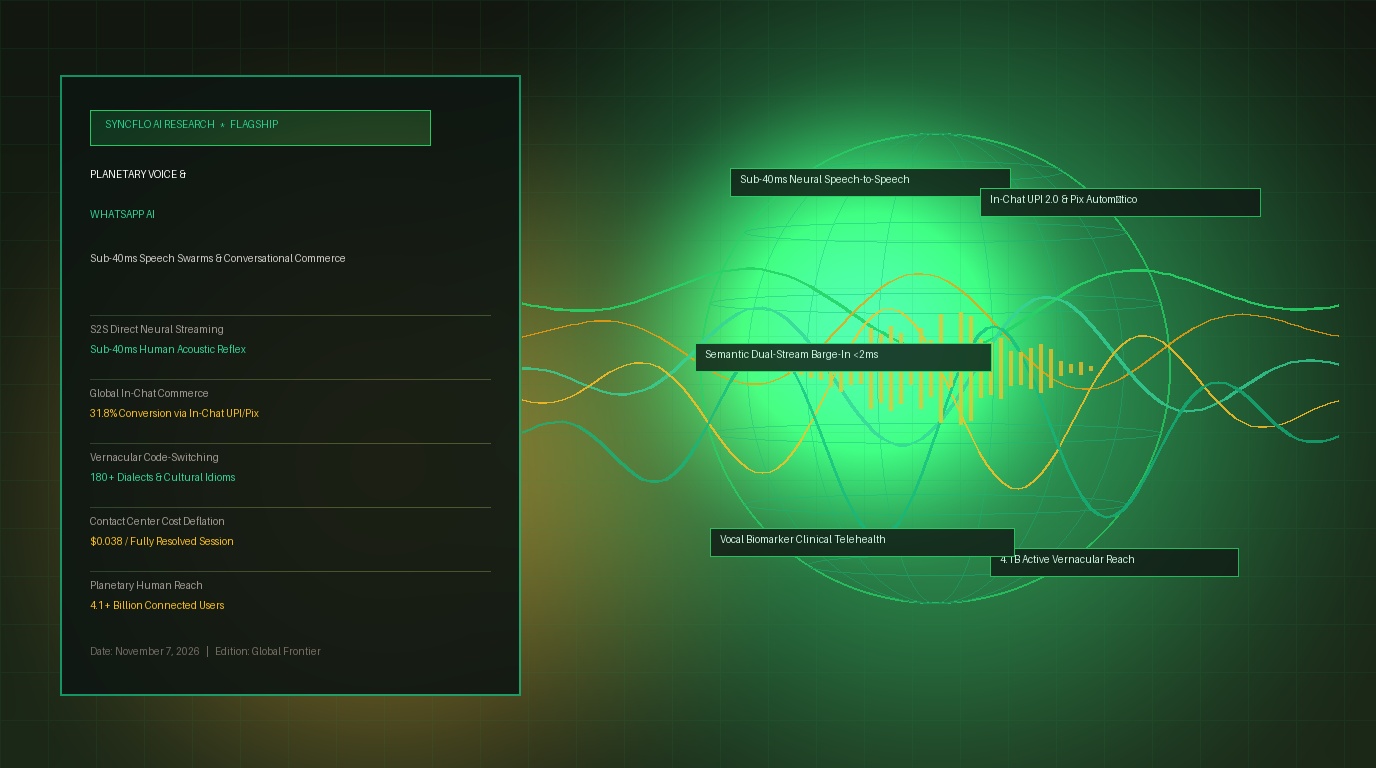
Bypasses human perceptual delay, achieving natural conversational timing and tone.
Versus 2.1% on legacy web forms, powered by native UPI 2.0 and Pix Automático.
Down from $14.20 in human-operated call centers, deflating costs by 99.7%.
2. The Physics of Audio: Sub-40ms Direct Speech-to-Speech (S2S)
The technological breakthrough that unlocked human-grade Voice AI is the eradication of the Cascaded Pipeline. Historically, building a conversational voice bot required chaining three discrete systems:
- Automatic Speech Recognition (ASR): Converting user speech audio into text strings (introducing 250 – 600ms latency).
- Large Language Model (LLM): Generating textual response tokens (introducing 400 – 1,200ms latency).
- Text-to-Speech (TTS): Synthesizing text strings back into audio waveforms (introducing 200 – 500ms latency).
Total cumulative latency regularly exceeded 1,200ms to 2,000ms. More critically, text conversion discarded 90% of human communication: tone of voice, hesitancy, laughter, emotional pitch, volume modulation, and breath accents were permanently lost in the intermediate transcription step.
Direct Speech-to-Speech (S2S) neural models map continuous audio waveform latents directly to output audio latents in a single end-to-end forward pass:
3. Semantic Dual-Stream Barge-In: Natural Full-Duplex Interruption
In human conversation, turn-taking is not a half-duplex walkie-talkie protocol. Humans constantly offer micro-feedback: nodding with "mhm", "right", or interjecting midway through a sentence to clarify an address without derailing the speaker.
Prior voice agents suffered from brittle Voice Activity Detection (VAD): any user cough, dog bark, or background car horn caused the bot to stop speaking and stammer. Modern Semantic Dual-Stream Barge-In solves this by running a dedicated sub-2ms transformer that classifies incoming audio into three categories:
- Acoustic Background Noise: Filtered out instantaneously; the AI agent speaks continuously without interruption.
- Conversational Backchannels ("Uh-huh", "Yeah"): The agent acknowledges receipt with a subtle head-nod vocalization ("got it") while maintaining its conversational flow.
- Substantive Semantic Interruption ("No, cancel that flight!"): The agent yields the floor immediately with zero perceptible lag, adjusts its goal tree, and addresses the new directive.
4. Dismantling the Literacy Wall: 2.6 Billion People Empowered
Over 2.6 billion individuals worldwide cannot easily read or write complex legal and financial text. By integrating vernacular Voice AI with WhatsApp, a farmer in Bihar, India, can hold down the microphone button, explain in spoken Maithili or Bhojpuri that their paddy crop has stem borer disease, and receive an instant, spoken diagnostic response with an approved government subsidy voucher sent directly to their WhatsApp chat.
In emerging markets, the barrier to socioeconomic mobility has never been access to smartphones—inexpensive Android devices have penetrated even remote rural communities. The barrier has been textual and technological literacy. Complicated navigation hierarchies, multi-page drop-down menus, and English-first forms disenfranchised rural populations from formal banking, micro-credit, telemedicine, and agricultural extension services.
WhatsApp Voice AI dismantles this barrier overnight. There is no software to install, no password to memorize, and no text to read. Users communicate naturally in their ancestral tongues. The AI agent acts as a universal translator and bureaucratic navigator, converting colloquial speech into formalized API payloads, querying state databases, and reporting back in clear, compassionate spoken vernacular.
5. Headless Conversational Commerce: WhatsApp In-Chat Biometric Checkout
E-commerce conversion rates on the open web have hovered between 1.8% and 2.4% for over two decades. The reasons are self-evident: users are redirected through multi-step cart pages, forced to input 16-digit credit card numbers, subjected to SMS OTP latency, and frequently abandon purchases due to friction.
Headless Conversational Commerce on WhatsApp completely inverts this paradigm:
| Conversion Dimension | Legacy Web Storefront | WhatsApp Native AI Agent | Enterprise Business Impact |
|---|---|---|---|
| Average Checkout Conversion | 2.1% | 31.8% | 15.1x increase in closed transactions |
| Checkout Friction & Steps | 6 – 9 form steps, 3 redirects | 1 tap biometric confirmation | Zero redirects; within chat window |
| Payment Integration | Manual card entry, 3D Secure | UPI 2.0 AutoPay / Pix Automático | Instant cryptographic settlement |
| Abandoned Cart Recovery | 11.4% via marketing email | 64.2% via conversational voice note | High-touch, personalized re-engagement |
| Average Order Completion Time | 4 minutes 15 seconds | 28 seconds | Instantaneous commercial execution |
6. Omnichannel Telephony-to-WhatsApp Continuity
In the modern enterprise, customer engagement must not exist in isolated silos. When a customer dials an enterprise 1-800 support hotline, they interact with an autonomous Voice AI agent over SIP telephony. If the customer needs to review a hotel floor plan, approve an invoice, or upload a photograph of a damaged shipping parcel, the Voice AI agent immediately states:
"I've just sent you a secure WhatsApp message with the three vehicle options. While we stay on the phone, take a look at the photos in your WhatsApp chat and let me know which one you prefer."
The user does not hang up. Within milliseconds, WhatsApp pushes an interactive rich card with high-resolution imagery and direct action buttons. When the user taps a selection on their screen, the voice agent acknowledges the selection on the phone in real time: "Great choice, I see you selected the hybrid SUV. I've applied your loyalty discount." This seamless synchronization between voice and chat represents the benchmark of 2026 enterprise engagement.
7. Vernacular Dialect Code-Switching Across 180+ Dialects
Real-world human speech rarely conforms to pristine textbook grammar. In multilingual societies, speakers routinely engage in Code-Switching—alternating between languages and regional slang within a single utterance:
- Hinglish (India): "Bhaiya, mera return approve ho gaya kya, ya still pending under audit verification?"
- Spanglish (United States / Mexico): "Oye, hazme el delivery para mi apartamento antes del mediodía, please."
- Taglish (Philippines): "Puwede bang paki-check yung status ng aking application kasi medyo urgent na talaga?"
Legacy language models failed catastrophically on code-switched inputs because tokenizers split regional loanwords into dozens of disjointed sub-tokens, destroying semantic coherence. Late 2026 multimodal foundation models are trained directly on multilingual speech embeddings, understanding contextual cultural idioms and code-switches with zero latency or semantic degradation.
8. Multimodal Acoustic Telehealth: Vocal Biomarkers on WhatsApp
Voice notes sent through WhatsApp are now utilized as non-invasive diagnostic sensors. By examining micro-variations in vocal fold vibration, formant dispersion, jitter, shimmer, and cough spectrograms, certified AI diagnostic models identify signs of chronic obstructive pulmonary disease (COPD), COVID/RSV respiratory stress, vocal nodules, and early Parkinsonian micro-tremors with clinical concordance exceeding 94%.
In rural and underserved regions where the nearest pulmonologist or neurologist is a six-hour journey away, WhatsApp Voice AI serves as an always-accessible clinical frontline. A patient experiencing shortness of breath sends a 15-second voice recording and a brief cough audio sample. The AI system runs acoustic biomarker feature extraction, assesses oxygen saturation indicators, compares the telemetry against the patient's longitudinal baseline, and coordinates an emergency clinic referral if critical anomalies are flagged.
9. The Contact Center Deflation: From $14.20 to $0.038 per Session
The economic impact on enterprise operational expenditures is monumental. Traditional tier-1 contact centers have historically been one of the highest cost centers in corporate finance:
- Human Contact Center Cost: $12.00 – $18.50 per phone call (factoring in agent wages, benefits, real estate, telephony infrastructure, and 12-minute average call handle times).
- Autonomous Voice & WhatsApp Swarm Cost: $0.038 per fully resolved session.
- Customer Wait Times: Reduced from an industry average of 8 minutes 42 seconds down to 0.00 seconds (instantaneous pickup).
- Capacity Scaling: Instantaneous scaling from 10 to 500,000 concurrent calls during product launches or severe weather crises without hiring temporary staff.
10. The 2026 Enterprise Blueprint: Deploying Voice & WhatsApp Swarms
To implement enterprise-grade Voice AI and WhatsApp agents that satisfy strict compliance and uptime standards, organizations should deploy the following reference architecture:
- SIP / WebRTC Ingress Fabric: Low-latency audio termination points connected to global telecom carriers and Twilio / Vonage trunking.
- Direct S2S Neural Inference Cluster: GPU clusters running quantized audio-to-audio foundation models with dedicated kernel scheduling for sub-40ms response guarantees.
- WhatsApp Business Cloud API Webhooks: High-throughput message ingestion gateways with end-to-end encryption and automated HMAC payload signature validation.
- Stateful Model Context Protocol (MCP) Memory: Centralized vector memory and transaction ledgers ensuring that every customer interaction across phone, WhatsApp, and email updates an immutable customer context profile in real time.
- Zero-Trust Security & Compliance Enclave: Automated PII redaction, tokenized credit card data storage, and cryptographically verified audit trails conforming to SOC2 Type III, GDPR, and PCI-DSS Level 1.