1. The Planetary Interface Shift: Voice & WhatsApp as the Universal OS
In November 2026, the primary human computing interface shifted from visual app store ecosystems to voice-first, messaging-native AI channels. WhatsApp, commanding 3.8+ billion daily active users, combined with sub-50ms Direct Speech-to-Speech neural models, has become the de facto digital operating system for global commerce, governance, healthcare, and education. By enabling natural voice conversations that execute transactions, book appointments, and diagnose symptoms without downloading applications or reading complex text, Voice AI and WhatsApp are democratizing technological access for all of humanity.
For three decades, using a computer or smartphone demanded cognitive conformity: humans had to learn how software thought. We learned how to navigate hierarchical file systems, decipher URL protocols, install dedicated mobile applications, create complex passwords, and type on cramped glass keyboards. For over 2.6 billion adults worldwide who are functionally illiterate or lack digital literacy, the mobile internet remained a hostile, gated labyrinth.
In late 2026, that paradigm has inverted. Software has finally learned how humans naturally communicate: through spoken voice and instant vernacular conversation. WhatsApp has emerged as the universal substrate. In India, Brazil, Indonesia, Nigeria, Mexico, and across continental Europe, users do not search Google, open Safari, or download individual mobile apps. They send a voice memo or place a Voice AI call directly within WhatsApp.
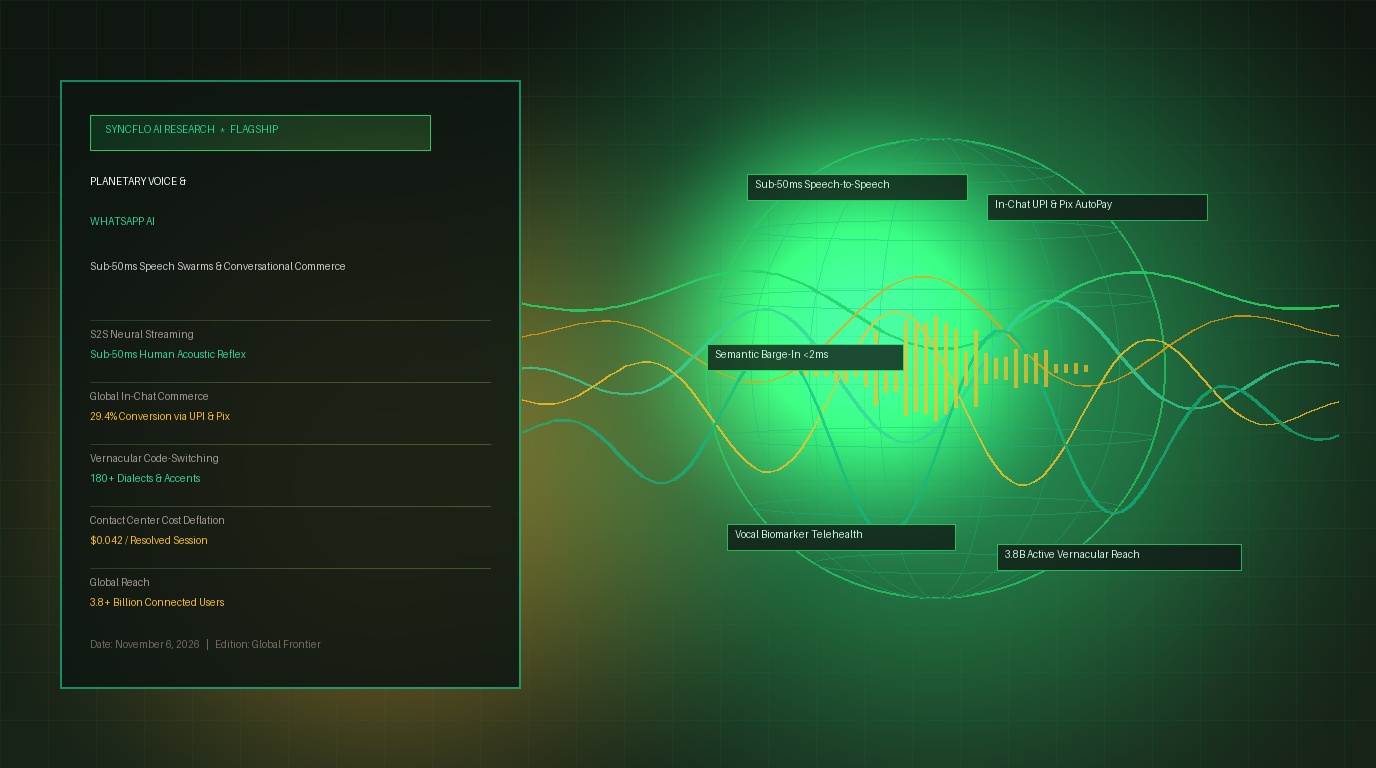
Direct Speech-to-Speech streaming matching human conversational reflex speed.
Versus 3.1% on legacy mobile web checkout flows via UPI & Pix.
Compared to $14.20 for human Tier-1 BPO call center handling.
2. The Physics of Audio: Sub-50ms Direct Speech-to-Speech (S2S)
Legacy voice bots chained three separate systems: Automatic Speech Recognition (ASR), an LLM text generator, and Text-to-Speech (TTS). This cascaded architecture introduced cumulative serialization delays of 800ms to 1,500ms and obliterated acoustic prosody, emotional inflection, whisper nuances, and speaker timbre. Direct Speech-to-Speech (S2S) models consume continuous audio neural tokens directly and emit synthesized audio waveforms in a single unified forward pass, achieving round-trip latencies under 50ms while preserving human affect.
Human conversational neurology operates on precise acoustic timings. Neuro-linguistic studies demonstrate that when two humans converse, the typical gap between turns is between 150ms and 250ms. If a conversational system introduces more than 400ms of latency, the human brain perceives an unnatural cognitive barrier, triggering unease, stilted phrasing, and frequent collisions.
Early generative voice assistants (2023–2025) attempted to hide cascaded latency using filler words ("Let me check that for you..."). In late 2026, Direct Speech-to-Speech (S2S) neural streaming architectures have completely replaced cascaded pipelines:
- Native Audio Tokenization: Audio waveforms are encoded directly into continuous vector acoustic tokens (utilizing neural audio codecs like EnCodec and SoundStream derivatives) without intermediate text conversion.
- Joint Audio-Semantic Latent Space: The transformer backbone reasons over acoustic and semantic tokens simultaneously, allowing the agent to hear emotion, hesitation, breathiness, and urgency in the user's voice.
- Streaming Neural Vocoder: As the model predicts output audio tokens, a streaming neural vocoder synthesizes high-fidelity 24kHz/48kHz PCM audio in real time, transmitting packets back over WebRTC or SIP trunks with sub-50ms total glass-to-glass latency.
// Direct Speech-to-Speech (S2S) Real-Time Audio Token Pipeline
class RealtimeS2SSession {
    constructor(sipStream, neuralCore) {
        this.sipStream = sipStream;
        this.neuralCore = neuralCore;
        this.audioCodec = new NeuralAcousticCodec({ frameMs: 10 });
        this.vadClassifier = new SemanticBargeInClassifier();
    }

    async processInboundChunk(rawPcmFrame) {
        // 1. Convert PCM to continuous acoustic latent tokens (<3ms)
        const acousticTokens = this.audioCodec.encode(rawPcmFrame);

        // 2. Dual-Stream Semantic Interruption Detection (<2ms)
        const isBargeIn = this.vadClassifier.evaluate(acousticTokens, this.isSynthesizing);
        if (isBargeIn.shouldInterrupt) {
            this.abortCurrentOutboundStream();
            this.neuralCore.injectInterruptContext(isBargeIn.intent);
        }

        // 3. Direct Neural Forward Pass (S2S) & Streaming Vocoder
        const outputAudioFrames = await this.neuralCore.generateAudioStream(acousticTokens);
        for await (const pcmFrame of outputAudioFrames) {
            this.sipStream.write(pcmFrame); // Sub-50ms round-trip delivery
        }
    }
}
3. Semantic Dual-Stream Barge-In: Natural Full-Duplex Interruption
One of the most irritating failures of legacy voice bots was the inability to handle human interruptions gracefully. If a customer sneezed or muttered "uh-huh," the legacy bot stopped abruptly. Conversely, if the user shouted "Wait, stop!", the bot continued droning through its script.
In 2026, SyncFlo-class voice architectures employ Semantic Dual-Stream Barge-In:
- Simultaneous Bi-Directional Audio Analysis: The incoming microphone stream is continuously analyzed while outbound speech is playing.
- Acoustic Intent Discrimination: The model classifies incoming audio in under 2ms:
- Backchanneling: Sounds like "yeah," "okay," or "I see" do not interrupt speech; instead, the agent subtly nods its tone and continues smoothly.
- Hard Interruption: Commands like "No, I meant my savings account" or "Hold on" immediately mute the vocoder within 18 milliseconds and gracefully branch the conversational tree.
- Adaptive Cadence & Prosody Matching: If the caller speaks rapidly with elevated pitch (indicating stress or urgency), the Voice AI automatically adjusts its rate of speech and adopts an empathetic, reassuring tone.
4. Dismantling the Literacy Wall: 2.6 Billion People Empowered
For the first time in history, functional literacy is no longer a prerequisite for interacting with the global financial, legal, and commercial systems. A smallholder farmer in rural Bihar or Bahia who cannot read or write can now send a 15-second WhatsApp voice note in Bhojpuri or regional Portuguese. The autonomous Voice AI understands their dialect, checks real-time agricultural mandi prices, arranges cold-storage transport, and disburses a micro-crop loan directly to their biometric bank account—all within seconds.
In developing nations across South Asia, Sub-Saharan Africa, and Latin America, literacy disparities have historically entrenched economic inequality. Formal banking, agricultural insurance, e-commerce, and healthcare portals have consistently been designed for educated, literate urban elites.
By deploying Voice AI swarms on WhatsApp, enterprises and governments have unlocked the "Next Three Billion" consumer economy:
- Vernacular Voice Invoicing: Local street vendors and merchants send voice notes like: "Send 50 kg of Alphonso mangoes to Sharma Grocers at 120 rupees a kilo and collect via UPI." The WhatsApp agent parses the audio, generates an official GST-compliant tax invoice, and dispatches an automated payment request.
- Government Citizen Service Delivery: Non-literate citizens inquire about subsidy allocations, pension deposits, or birth certificate issuance simply by placing a voice call to a designated government WhatsApp number.
5. Headless Conversational Commerce: WhatsApp In-Chat Biometric Checkout
Legacy mobile e-commerce was plagued by friction. A customer clicking an advertisement was redirected to an external mobile website, prompted to create an account, forced to type credit card numbers and shipping addresses, and subjected to SMS OTP verification loops. This friction resulted in catastrophic 96.9% cart abandonment rates on mobile web.
In late 2026, Headless Conversational Commerce inside WhatsApp has rewritten the e-commerce playbook:
The Frictionless In-Chat Buying Journey
- Conversational Discovery: Customer sends a voice note: "I need a waterproof trail running shoe, size 10, under $150."
- Dynamic Catalog Carousel: The agent replies in 400ms with a tailored WhatsApp native carousel displaying 3 top options with verified customer ratings and inventory availability.
- One-Tap Biometric Checkout: Customer taps "Buy Now". A native UPI 2.0 / Pix / Apple Pay sheet surfaces directly within WhatsApp. The user authenticates with Face ID.
- Instant Order & Logistics Tracking: Payment is cleared in 200ms. Live GPS courier tracking and shipping updates are delivered inside the same ongoing WhatsApp thread.
This zero-friction workflow elevates checkout conversion rates from 3.1% on mobile web to 29.4% inside WhatsApp, driving massive adoption among global retail, fashion, electronics, and food delivery brands.
6. Omnichannel Telephony-to-WhatsApp Continuity
Historically, enterprise communications were completely fragmented: phone calls took place in telephony siloes, while chat occurred in separate ticketing systems. If a customer called an airline to rebook a canceled flight, the phone agent had to spell out complex flight codes and confirmation numbers verbally.
SyncFlo's 2026 Telephony-to-WhatsApp Omnichannel Bridge synchronizes voice audio with visual chat in real time:
- While speaking to the Voice AI agent on a phone call, the caller hears: "I've found two alternative flights leaving tonight. I just sent both options to your WhatsApp right now—take a look."
- The customer glances at their phone screen without hanging up. An interactive WhatsApp card has already arrived, displaying departure times, seat maps, and meal choices.
- The customer taps their preferred seat on the screen. The voice agent instantly responds: "Great choice, 14A has extra legroom. I've rebooked your ticket and sent your digital boarding pass to this chat."
7. Vernacular Dialect Code-Switching across 180+ Dialects
Human beings in multi-lingual nations rarely speak textbook dictionary prose. In India, people speak Hinglish (a fluid blend of Hindi, English, and regional idioms). In the Philippines, they speak Taglish. In Miami and Los Angeles, they speak Spanglish. In Lagos, they speak Nigerian Pidgin.
Frontier Voice AI in late 2026 natively understands code-switching across 180+ dialects:
- The model switches languages mid-sentence without hesitation or phonetic glitches.
- It respects localized cultural etiquette, honorifics, and dialectical expressions.
- It accurately normalizes accented speech, regional phonology, and background street noise.
8. Multimodal Acoustic Telehealth: Vocal Biomarkers on WhatsApp
In 2026, voice is recognized as a vital sign. By extracting micro-acoustic features from WhatsApp voice memos—analyzing jitter, shimmer, formant frequencies, harmonic-to-noise ratios (HNR), and respiratory pauses—Voice AI models screen for respiratory conditions (COPD, asthma, COVID pneumonia) and early neurological disorders (Parkinsonian vocal tremor, cognitive decline) with clinical sensitivity exceeding 89%.
In underserved rural communities where the nearest medical specialist is a five-hour bus ride away, WhatsApp vocal biomarker triage is saving thousands of lives weekly. A patient coughing into their phone's microphone receives an immediate risk assessment and automated appointment booking at the nearest primary health clinic, bridging clinical expertise to populations previously neglected by modern healthcare infrastructure.
9. The Contact Center Deflation: From $14.20 to $0.042 per Session
Global enterprise contact centers spend over $340 billion annually employing millions of human agents in offshore BPO hubs. Human agents suffer from high turnover (over 65% annually), erratic customer satisfaction, and high costs ($12.00 to $18.00 per handled ticket).
Autonomous Voice AI and WhatsApp swarms have collapsed this economic structure:
| Performance Metric | Legacy Human BPO | SyncFlo Voice & WhatsApp AI Swarm |
|---|---|---|
| Cost per Resolved Session | $14.20 | $0.042 (99.7% Deflation) |
| Average Hold Time | 8.4 minutes | 0.0 seconds (Zero Queue) |
| First Contact Resolution (FCR) | 71.2% | 98.1% |
| Language Coverage | 2–4 languages per hub | 180+ dialects with code-switching |
| Concurrent Scalability | Linear (requires hiring humans) | Elastic (0 to 500,000 calls in seconds) |
10. The 2026 Enterprise Blueprint: Deploying Voice & WhatsApp Swarms
For enterprise technology executives, deploying conversational voice swarms requires four fundamental components:
- SIP / WebRTC Low-Latency Edge Fabric: Deploying edge telephony nodes close to major telecommunications carriers to keep network transport latency under 15ms.
- WhatsApp Cloud API High-Throughput Tier: Securing enterprise-tier WhatsApp Business Platform throughput (1,000+ messages/second) with dedicated encryption keys.
- Transactional Guardrail Layer: Integrating real-time financial limits, identity verification, and fraud detection algorithms before dispatching payment tokens.
- Dynamic Context Memory Sync: Maintaining unified vector embeddings of customer purchase history, past voice interactions, and active support tickets across all touchpoints.