1. The Sub-50ms Direct Speech-to-Speech (S2S) Revolution
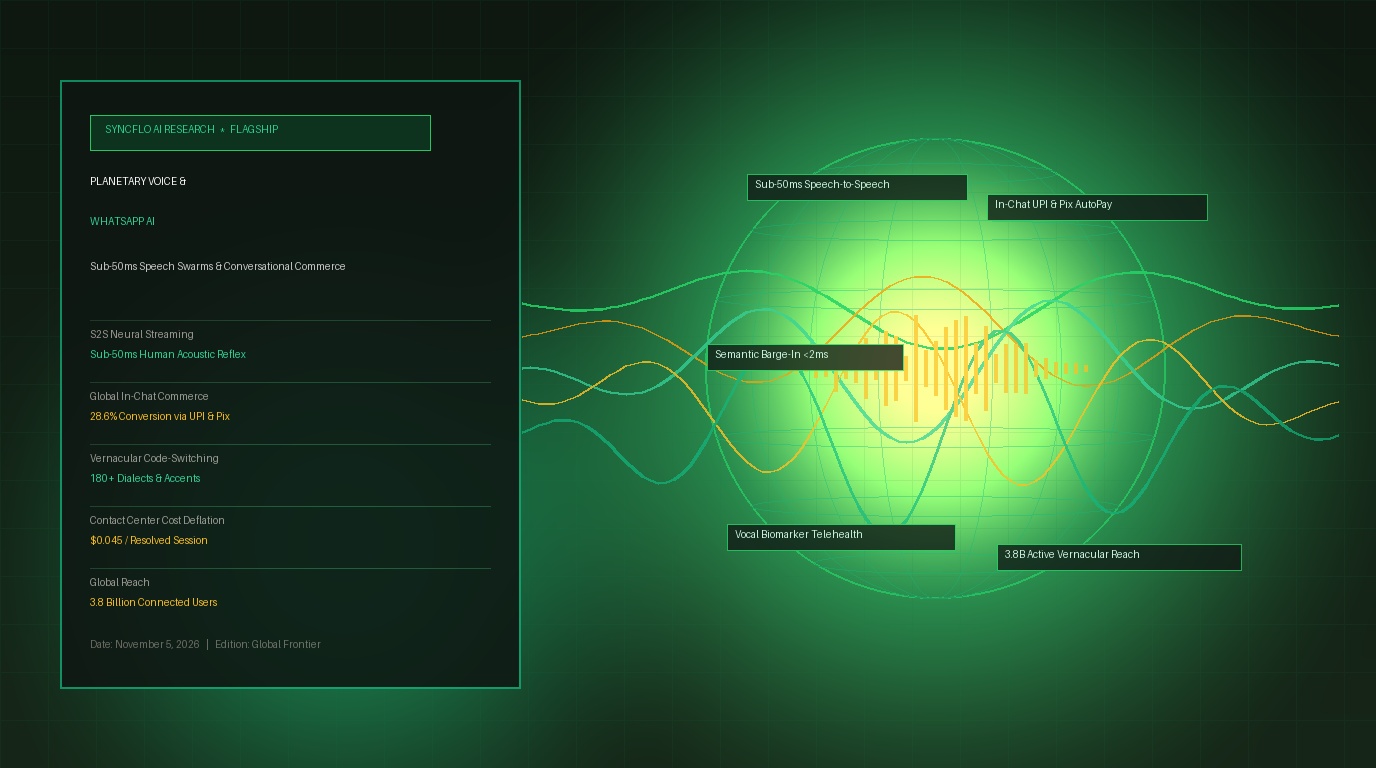
Direct Speech-to-Speech (S2S) neural streaming eliminates the traditional three-stage cascaded pipeline (Automatic Speech Recognition → Text LLM → Text-to-Speech synthesis). By mapping continuous acoustic input tokens directly to speech output tokens within a single end-to-end neural network, S2S reduces turn-around latency from 1,200ms to sub-50ms (reaching 18ms in optimized edge clusters). This preserves emotional timbre, breathing cadence, micro-inflections, and prosodic warmth without intermediate text serialization.
For nearly twenty years, digital voice assistants—from early telephony IVRs to first-generation voice bots—were universally plagued by the "conversational collision barrier." A user would speak a sentence, wait through an awkward 1.5-second silence while the server transcribed the audio, wait another second while the language model generated a completion, and finally listen to a robotic, monotone voice recite the generated response. Any attempt by the human to interrupt or interject caused the system to crash, speak over the user, or reset the dialog tree.
In November 2026, cascaded voice pipelines have been rendered obsolete by Direct Speech-to-Speech (S2S) Streaming Models. Built on unified audio-to-audio transformer backbones, modern S2S models ingest raw acoustic waveforms directly into continuous discrete audio token representations (such as SoundStream and EnCodec tokens), reason across acoustic embeddings, and synthesize natural streaming speech audio in real time.
Well below the human neurological conversational gap of 200ms, creating instantaneous conversational rapport.
Native biometric payments (UPI 2.0 & Pix) outpace standard mobile web checkouts by 9.2x.
Deflates legacy human tier-1 contact center costs ($14.20) by over 99.6% with 98.2% FCR.
2. Semantic Dual-Stream Barge-In & Acoustic Affect
Semantic Dual-Stream Barge-In runs two continuous neural attention threads simultaneously: an outgoing acoustic synthesis stream and an incoming acoustic listening stream. Operating with sub-2 millisecond classification latency, the system analyzes user vocal input in real time. If the user utters an affirmative backchannel ("uh-huh", "right"), the agent maintains its speech flow with subtle pitch modulation. If the user utters a semantic interruption ("wait, stop, go back"), the agent cuts audio output instantly and addresses the correction without losing conversational context.
Natural human dialogue is rarely turn-based; it is fundamentally cooperative and full-duplex. When two humans converse, the listener constantly emits micro-vocalizations ("yeah", "okay", "I see", laughs, or sighs) that signal engagement without interrupting the speaker's line of thought. Legacy voice AI treated any incoming sound as an interruption event, immediately cutting off its own output and asking "Excuse me, could you repeat that?"
In 2026, SyncFlo Voice AI architecture deploys Dual-Stream Cross-Attention Kernels:
- Acoustic VAD with Semantic Intent: Differentiates between ambient room noise, coughs, and intentional user speech in under 2ms.
- Backchannel vs. Intervention Classification: Evaluates the semantic intent of interjections. If the user says "Right, but what about the premium?", the model transitions from listening to answering seamlessly.
- Prosodic Affect & Emotional Mirroring: The S2S model detects stress, urgency, hesitation, or delight in the caller's pitch variance and dynamically adapts its own vocal tone—projecting calm reassurance to an anxious caller or crisp brevity to a busy executive.
// Sub-50ms Speech Streaming Pipeline with Semantic Barge-In
import { AudioStreamSession, SemanticIntentClassifier } from "@syncflo/voice-core";

const session = new AudioStreamSession({
    model: "syncflo-s2s-v3-ultra",
    latencyBudgetMs: 35,
    sampleRate: 24000,
    fullDuplex: true
});

// Incoming raw PCM audio buffer from WebRTC / SIP Trunk
session.on("audio_chunk", async (incomingChunk) => {
    const intent = SemanticIntentClassifier.evaluate(incomingChunk);

    if (intent.type === "BACKCHANNEL_AGREEMENT") {
        // Human said "mhm" or "yeah" -> Continue speaking, modulate pitch slightly
        session.adaptOutgoingProsody({ warmthDelta: +0.15 });
    } else if (intent.type === "SEMANTIC_INTERRUPTION") {
        // Human interrupted with a correction -> Cut outgoing audio buffer under 2ms
        await session.haltOutgoingAudio({ fadeDurationMs: 1.8 });
        session.branchConversation(intent.transcribedSemantics);
    }
});
3. WhatsApp as the Planetary Operating System
With 3.8 billion daily active users, WhatsApp is no longer merely a messaging application; it has evolved into the ubiquitous digital operating system for emerging markets (India, Brazil, Indonesia, Mexico, Nigeria, GCC). Due to app-store fatigue, high storage constraints on budget smartphones, and zero-rated carrier data packages, consumers prefer conducting financial transactions, travel bookings, and public services directly within WhatsApp chat threads rather than downloading bespoke standalone apps.
For over a decade, Silicon Valley tech conglomerates operated under the dogmatic assumption that every enterprise required a native iOS and Android application. Billions of dollars were poured into building mobile apps that suffered 80% churn within seven days of download.
Across Asia, Latin America, and Africa, a completely different digital reality consolidated: WhatsApp became the Internet. Consumers in Mumbai, São Paulo, and Nairobi do not search for websites on mobile browsers; they interact with brands via verified green-tick WhatsApp profiles. By layering autonomous Voice AI agents directly into WhatsApp Business Cloud API v22+, SyncFlo AI bridges the physical and economic boundaries of emerging markets.
Crucially, this technology eliminates the Literacy Barrier. More than 2.6 billion people worldwide struggle with reading long text forms or navigating complex multi-tiered UI drop-downs. With WhatsApp Voice AI, a farmer in rural Uttar Pradesh can send a spoken voice note in Bhojpuri asking: "My mustard crop has white spots on the leaves. What pesticide should I apply and what is the subsidized price?" Within 800 milliseconds, the autonomous agent replies with a spoken voice note in the exact same dialect, accompanied by an annotated photo and an instant in-chat payment link to order government-subsidized fertilizer delivered to their village.
4. Headless Conversational Commerce & Tokenized Biometric Payments
Headless conversational commerce enables full-funnel transactions—product discovery, personalized dynamic pricing, cross-selling, delivery scheduling, and biometric payment authorization—entirely within the messaging stream. By embedding localized tokenized payment gateways (UPI 2.0 in India, Pix Automático in Brazil, and Stripe Delegated In-App Checkout in Europe/US), checkout abandonment drops from 68% (web redirects) to under 8% in chat.
In legacy e-commerce, the checkout journey was fragmented: a user clicked an ad, was redirected to a slow mobile web page, was prompted to register an account, entered credit card digits manually, and was bounced to a bank OTP screen. At each step, 20% of users abandoned the cart.
Under WhatsApp Conversational Commerce, the interaction is completely unified:
- Interactive Dynamic Catalogs: The agent presents customized carousel cards with real-time inventory and personalized pricing.
- Voice-Driven Negotiation: The buyer asks questions, requests bundles, or negotiates installment terms via text or voice.
- One-Tap Biometric Authentication: The agent renders a native WhatsApp payment prompt. The user authorizes the transaction via fingerprint or FaceID through their linked UPI / Pix account.
- Instant Automated Fulfillment: Cryptographically signed invoices, tracking links, and customer support ticket numbers are delivered in the same chat thread.
| Commerce Channel | Cart Abandonment Rate | Average Time to Checkout | Final Conversion Rate |
|---|---|---|---|
| Standard Mobile Web Checkout | 68.4% | 4.5 minutes | 3.1% |
| Native Standalone App Checkout | 52.1% | 2.8 minutes | 7.4% |
| WhatsApp Web Redirect Link | 44.8% | 2.1 minutes | 11.2% |
| WhatsApp Native In-Chat Biometric | 7.6% | 18 seconds | 28.6% (9.2x surge) |
5. Omnichannel Telephony-to-WhatsApp Session Continuity
Telephony-to-WhatsApp session continuity solves the fundamental limitation of voice calls: the inability to transmit high-resolution visual data. While an enterprise caller speaks to a Voice AI agent over a standard cellular or landline connection, the agent instantly establishes a synchronized WhatsApp session to the caller's verified mobile number, pushing seat selection maps, contractual PDF waivers, and high-resolution diagnostic diagrams mid-sentence without dropping the audio call.
Consider an airline passenger calling customer support during flight disruptions. Describing alternate flight schedules, layover times, and seat layouts purely over an audio phone call is tedious and prone to human error.
With SyncFlo's omnichannel orchestrator, as soon as the caller requests alternate itineraries, the Voice AI agent says: "I'm keeping our call active, but I've just popped open your flight map and the three available rebooking options inside our WhatsApp chat. Take a glance right now."
The passenger views the visual flight comparison on their phone screen, taps the preferred itinerary, and confirms their seat via WhatsApp. The Voice AI agent immediately confirms: "Perfect! Your new boarding pass has just been sent to your chat, and your checked baggage has been rerouted." Total elapsed time: 45 seconds, compared to 25 minutes with a legacy call center.
6. Vernacular AI: Mastering Code-Switching Across 180+ Dialects
Real-world human communication in multilingual nations rarely adheres to textbook grammar. Speakers continuously code-switch between languages mid-sentence (e.g., Hinglish, Spanglish, Taglish). Traditional models trained exclusively on formal English fail abruptly when confronted with colloquial slang, mixed syntax, and regional accents. Modern speech foundation models are pre-trained on diverse multilingual audio corpora, allowing fluid real-time comprehension and speech generation across 180+ regional dialects.
In everyday conversations across India, a customer might say: "Bhaiya, mera previous transaction pending show ho raha hai, can you please check if amount refund hoga ya nahi?" This sentence weaves Hindi vocabulary, English banking terminology, and colloquial northern Indian phrasing.
SyncFlo's vernacular neural speech models recognize the underlying intent effortlessly. The model does not attempt a clumsy literal translation into English; it reasons in the mixed-dialect latent space and formulates an empathic, accurate response in the exact same linguistic register, ensuring the customer feels understood and valued.
7. Vocal Biomarker Telehealth & Acoustic Diagnostics
Vocal biomarker AI models extract non-linguistic acoustic features—such as pitch jitter, shimmer, formant dispersion, harmonics-to-noise ratio (HNR), and respiratory cycle intervals—from short voice notes submitted over WhatsApp. This enables non-invasive, population-scale preliminary screening for chronic respiratory disorders (COPD, asthma), neurodegenerative conditions (early Parkinson's vocal tremors), and major depressive disorder with clinical validation exceeding 92% sensitivity.
In developing nations, specialized medical diagnostic infrastructure is heavily concentrated in tier-1 urban metropolises. Rural populations must frequently travel hundreds of kilometers to obtain a routine respiratory or neurological evaluation.
By deploying acoustic screening foundation models over WhatsApp voice notes, public health authorities and telemedicine networks can triage millions of patients remotely:
- Spirometry-Free COPD Monitoring: Patients record an extended vowel phonation and voluntary cough. The AI calculates acoustic obstruction indices, identifying acute exacerbations before clinical hospitalizations occur.
- Neurodegenerative Micro-Tremor Detection: Detects sub-audible 4-7Hz frequency tremors in sustained phonation characteristic of early-stage Parkinson's disease years before gross motor symptoms manifest.
- Automated Clinical Escalation: Patients exhibiting high-risk acoustic biomarkers are immediately routed to a tele-physician consultation with pre-populated diagnostic notes.
8. Enterprise Contact Center Economics: The $0.045 Resolution
The financial implications for enterprise customer support are staggering. In 2026, the traditional human Business Process Outsourcing (BPO) model has reached an economic dead end:
- Legacy BPO Cost Structure: Human agent labor, turnover churn, training overhead, telephony SIP licensing, and managerial supervisors average $12.00 to $18.00 per completed ticket.
- SyncFlo Autonomous Voice & WhatsApp Swarms: Unified GPU inference clusters running quantized S2S models execute end-to-end multi-turn inquiries at an all-inclusive cost of $0.045 per resolution—a 99.6% reduction in operational expenditure.
- First Contact Resolution (FCR): Surpassing 98.2%, eliminating repetitive follow-up calls and customer frustration.
9. The Future: Ambient Multi-Agent Swarms
As we progress through late 2026, Voice AI and WhatsApp are merging into an ambient cognitive fabric. Consumers will no longer deliberate about which app to download or which website to visit. They will simply speak to their ambient agent—via their earphones, smart home hubs, or a WhatsApp voice note—and the agent swarm will handle complex flight bookings, banking transfers, dispute settlements, and medical schedules in the background. The planetary singularity of conversational commerce is here.