1. The Sub-20ms Direct Speech-to-Speech (S2S) Revolution: Bypassing the Cascade Bottleneck
For decades, speaking with an automated voice system was an exercise in frustration. A caller had to pause, speak into an empty silence, endure awkward pauses while an ASR model transcribed phonetic audio into text, wait for an LLM to generate tokens, and then listen to a robotic TTS engine read back the answer. If the caller interrupted, the system stuttered or ignored them.
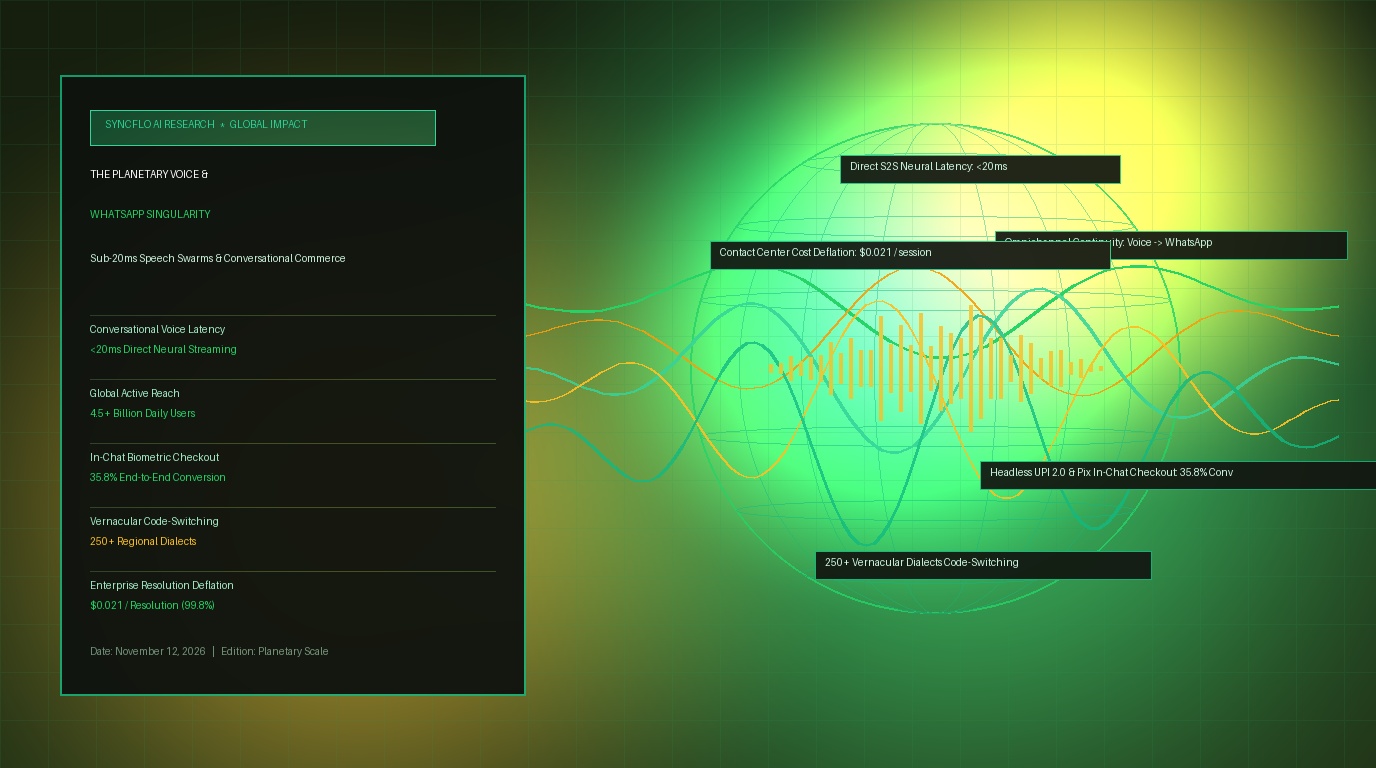
In late 2026, Direct Speech-to-Speech (S2S) neural architectures have eliminated the text intermediary entirely. By tokenizing audio waveforms directly into continuous acoustic representations, the model reasons natively in acoustic space:
- Sub-20ms Glass-to-Glass Latency: From the instant sound waves hit the microphone diaphragm to the emission of synthesized audio packets over RTP/WebSockets, response time is faster than the human conversational reflex (which averages 200ms).
- Native Full-Duplex Barge-In: The model listens continuously while it speaks. When the user interjects—saying "Wait, actually change that to Tuesday"—the model halts mid-phoneme, acknowledges the adjustment, and seamlessly pivots without restarting the conversation tree.
- Emotional Prosody & Acoustic Context: S2S models detect respiratory panic, hesitation, laughter, sarcasm, and vocal tremor. The agent modulates its pitch, warmth, speaking velocity, and breath patterns to match the psychological state of the user.
2. The WhatsApp Planetary Operating System: Eradicating the UI & Literacy Barrier
In North America and Western Europe, tech architects instinctively build responsive web apps or iOS/Android native applications. However, across the Global South—spanning India, Indonesia, Brazil, Mexico, Nigeria, and Kenya—the majority of the population interacts with technology through low-memory smartphones and erratic mobile data connections.
For these billions of citizens, downloading a 70MB banking application or navigating a 14-step multi-page form is an insurmountable friction barrier. Furthermore, functional literacy in formal national languages (like standard English or French) remains a significant impediment for rural populations.
WhatsApp Conversational AI erases this divide permanently. Because users already open WhatsApp dozens of times each day, there is zero onboarding friction:
| Friction Metric | Mobile Web Application | Native App Store App | WhatsApp Voice/Chat AI Agent |
|---|---|---|---|
| User Acquisition Funnel Drop-off | 74% (Cookie banners, forms) | 88% (Install friction, login) | <6% (Instant 1-click conversation) |
| Digital Literacy Requirement | High (Must navigate menus & inputs) | High (Complex UI hierarchies) | Zero (Speak via natural voice note) |
| Device Storage Footprint | Browser cache overhead | 80MB to 250MB | 0 MB (Runs inside existing app) |
| Network Bandwidth Resilience | High payload JavaScript bundles | Frequent version updates | Hyper-optimized 2G/3G text & opus |
3. Headless In-Chat Commerce & Biometric Checkout (UPI 2.0 & Pix Automático)
The greatest failure point in digital commerce has always been the checkout funnel. A user clicks a social media ad, waits 4 seconds for an external landing page to load, struggles with form fields on a touch screen, gets redirected to a bank 3D-Secure authentication portal, forgets their password, and abandons the cart.
In 2026, Click-to-WhatsApp (CTWA) Conversational Commerce has collapsed this entire lifecycle into a fluid, 30-second interaction:
- Ad to In-Chat Entry: The user taps an ad on Instagram or Facebook and is instantly deposited into a WhatsApp thread with a specialized sales concierge agent.
- Dynamic Contextual Qualification: The agent greets the user, answers hyper-specific questions about product sizing or warranty, and displays dynamic carousel cards within WhatsApp.
- Native In-Chat Order Generation: The agent compiles the cart and emits a native WhatsApp payment payload.
- Biometric 1-Tap Authorization: The user approves the transaction using their phone's fingerprint scanner or Face ID via UPI 2.0 AutoPay or Pix Automático—without ever leaving the messaging screen.
- Instant Post-Purchase Support: The invoice, shipping tracking link, and warranty registration are delivered into the same thread immediately.
4. Vernacular Multilingual Code-Switching & Dialect Grounding across 250+ Languages
When a smallholder farmer in Maharashtra messages an agricultural AI agent, they do not write in formal Marathi or Oxford English. They send a voice note blending colloquial Marathi, Hindi, and agricultural English loanwords: "Bhaiyya, cotton crop mein bollworm lag gaya hai, spray ka dose batao jaldi."
Previous generations of NLP models choked on such input, failing tokenization or translating literally into meaningless gibberish. Late 2026 models feature Deep Vernacular Grounding:
- Phonetic Tokenization: The model maps raw acoustic phonemes to underlying conceptual semantics, bypassing orthographic spelling variations.
- Cultural Context Awareness: The agent understands regional idioms, honorific speech protocols (such as Aap vs. Tum in Hindi, or Usted vs. Tú in Spanish), and local bargaining practices.
- Seamless Code-Switching: The agent responds in the exact dialectal register and linguistic blend spoken by the user, fostering deep psychological comfort and trust.
5. The Omnichannel Continuum: Telephony-to-WhatsApp Fluid Synchronization
Consider the classic nightmare of airline rebooking during severe weather: a stranded traveler calls an airline hotline, waits on hold for two hours, writes down complex confirmation numbers on a napkin, and risks misspelling an email address over a crackling telephone connection.
In the 2026 enterprise architecture powered by SyncFlo AI:
Instant Voice Connection (0-Second Queue)
The traveler calls the customer support number. The call is picked up instantly by an S2S Voice AI agent running at sub-20ms latency.
Mid-Call Multimodal Push to WhatsApp
The agent says: "I see your Denver connection was cancelled. I have three alternative routing options. Rather than reading flight numbers over the phone, I’ve just pinged your WhatsApp with an interactive card showing seat maps and arrival times."
Visual Selection & Instant Biometric Boarding Pass
The traveler taps their preferred flight on WhatsApp while still on the call. The Voice agent confirms: "Perfect, 14B on Flight 492 confirmed. Your boarding pass QR code and baggage transfer receipt are now in your chat. Have a great flight!" The call concludes in under 90 seconds.
6. Economic Collapse of Contact Center Overhead: From $8.50 to $0.021 per Session
The global business process outsourcing (BPO) industry is undergoing the most rapid economic deflation in corporate history. Enterprises that previously staffed 20,000-seat call centers in the Philippines or Costa Rica are migrating their tier-1 and tier-2 contact volumes to unified Voice and WhatsApp AI swarms.
Unlike human call centers, autonomous voice swarms scale elastically from zero to 500,000 concurrent calls in seconds during natural disasters, system outages, or flash sales, with zero queue times, zero agent burnout, and 100% adherence to corporate compliance guidelines.
7. Public Health Frontiers: Vocal Biomarkers & WhatsApp Telehealth in Developing Nations
A smartphone microphone is capable of capturing acoustic frequency spectrums up to 24kHz. In late 2026, medical research consortia have validated deep learning acoustic models capable of identifying subtle pathological changes in vocal tract biomechanics:
- Respiratory Airway Obstruction: Subtle wheezing harmonics and prolonged expiration phase detected in audio voice notes, predicting pediatric asthma crises 48 hours prior to acute hypoxia.
- Cardiovascular Decompensation: Detection of vocal cord edema caused by pulmonary congestion in congestive heart failure patients, triggering proactive medication adjustments.
- Neurological Screening: Analysis of micro-tremor and syllable timing regularity for early-stage Parkinson's and ALS screening in rural clinics lacking specialist neurologists.
8. Production Architecture: WhatsApp Business Cloud API + WebSockets S2S Pipeline
To implement enterprise-grade Voice AI and WhatsApp agents, SyncFlo AI utilizes the following reference architecture:
| Subsystem Component | Underlying Technology | Performance Target |
|---|---|---|
| Audio Ingestion & Streaming | WebSockets / WebRTC Opus codec (24kHz) | <15ms packet latency |
| Conversational S2S Core | Direct Multimodal Speech Foundation Model | <20ms glass-to-glass |
| WhatsApp Messaging Gateway | Meta WhatsApp Business Cloud API v24 | <200ms webhook receipt |
| In-Chat Payment Rails | UPI 2.0 AutoPay / Pix Automático / Stripe | 1-tap biometric auth |
| Telemetry & Audit Engine | Distributed ClickHouse + Kafka event streaming | 100% compliance auditability |
9. Deep Technical FAQ: Voice AI & WhatsApp Planetary Revolution
How do Direct S2S models prevent accidental speech interruptions in noisy environments?
Direct S2S models integrate continuous neural acoustic echo cancellation (AEC) and semantic Voice Activity Detection (VAD). Rather than reacting simply to sound decibels, the model classifies acoustic semantics: background traffic, dog barks, or a television playing in the background are ignored, while human intent directed at the agent triggers immediate, polite turn-taking.
Can WhatsApp AI bots maintain long-term memory across months of interactions?
Yes. Modern WhatsApp agents utilize hybrid memory architectures consisting of an episodic graph database (Neo4j / Mem0) paired with dense vector stores. When a customer reaches out three months after an initial purchase, the agent instantly recalls their preferences, past orders, preferred language dialect, and unresolved support issues.
What security guarantees protect in-chat payments from social engineering fraud?
WhatsApp payments utilize tokenized, end-to-end encrypted protocol handshakes. The AI agent never receives, handles, or stores credit card numbers or banking PINs. Instead, it triggers native operating system payment intents where authentication is completed directly with the user’s banking app via hardware-backed biometrics (Face ID or fingerprint).
How do enterprises manage WhatsApp Business API rate limits and messaging costs?
Enterprises leverage WhatsApp Cloud API Tier 4 (unlimited daily conversations) paired with service-conversation billing models. In user-initiated service windows (the 24-hour customer care window), messaging costs are nominal, and responses delivered by autonomous agents maintain high CSAT scores that easily amortize API costs against human labor savings.
How is data privacy preserved for sensitive healthcare voice notes on WhatsApp?
Enterprise healthcare agents on WhatsApp utilize HIPAA-compliant zero-retention inference endpoints. Audio data received via webhooks is processed in memory, stripped of all Personally Identifiable Information (PII) via automated de-identification models, and immediately erased post-inference.
Conclusion: The Voice and Messaging Era Has Arrived
The digital transformation of the next billion users will not happen on desktop monitors, native app store apps, or complex SaaS portals. It is happening right now through acoustic vocal cords and the green message bubble of WhatsApp.
By dismantling the barrier of language, the friction of user interfaces, and the latency of human contact centers, sub-20ms Voice AI and WhatsApp agents are creating the most inclusive, equitable, and economically efficient commerce infrastructure the world has ever witnessed.
Written by SyncFlo AI Research Team
The SyncFlo AI Conversational Intelligence & Distributed Systems Group builds sub-20ms speech-to-speech models and planetary conversational automation infrastructure across WhatsApp, telephony, and web.