1. The Conversational Convergence: Why 2026 Made Screens Secondary
For over three decades, digital interaction was mediated by graphical user interfaces: clicking navigation menus, typing search queries into input boxes, and downloading single-purpose mobile applications. In 2026, this paradigm has undergone an irreversible structural collapse.
Human beings do not inherently think in URL hierarchies or mobile app grids. We think in spoken dialogue and rapid asynchronous messaging. The simultaneous maturation of native sub-30ms Speech-to-Speech (S2S) neural architectures and autonomous WhatsApp Business API agents has unified the sensory modalities through which 3.2 billion global citizens conduct commerce, health, and governance.
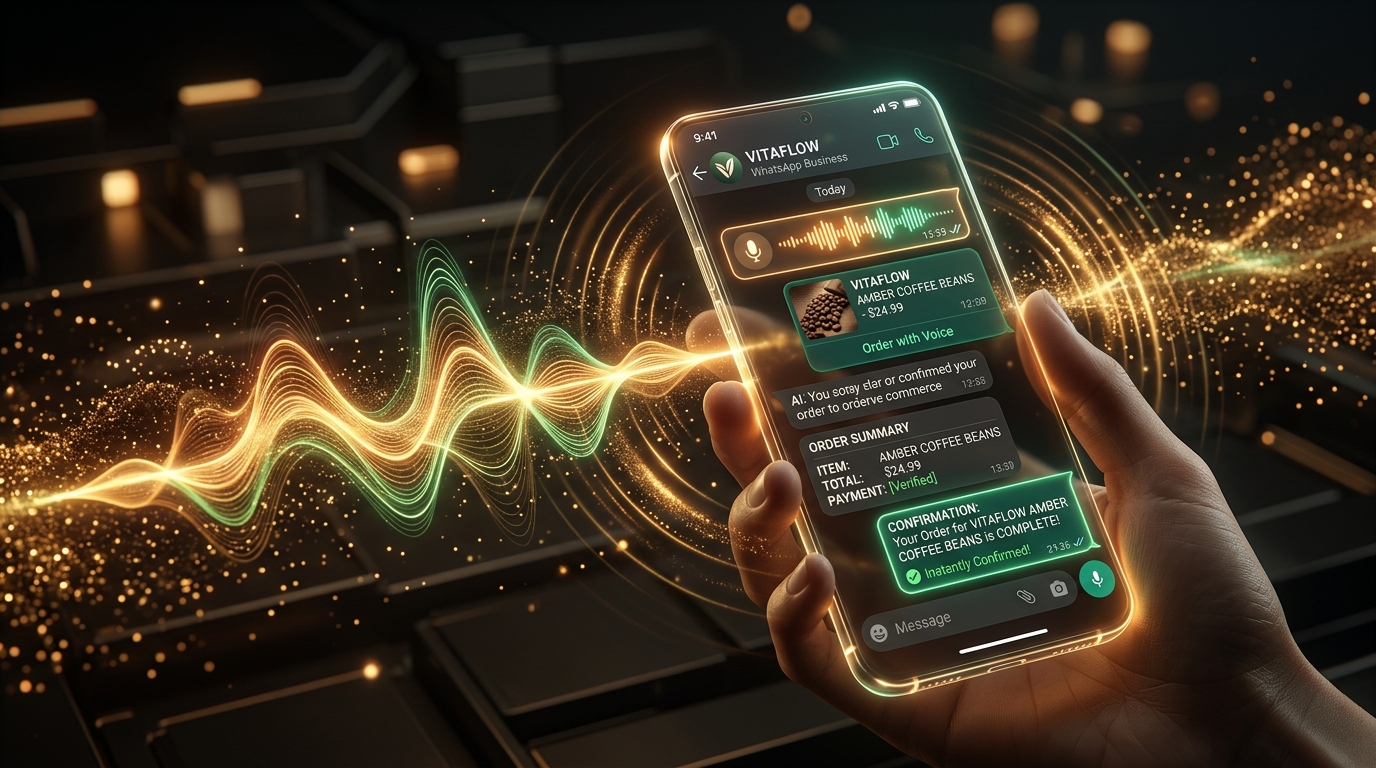
A customer no longer opens an airline application to modify a reservation, nor do they navigate a 12-page web form to submit a flood insurance claim. They speak three natural sentences to an ambient voice agent on their morning commute, or send a photograph of a handwritten invoice to a verified WhatsApp Business thread. The AI handles the complete transaction—database updates, payment settlement, and confirmation receipt—before they reach their destination.
Human-parity natural conversation cadence
Zero-install conversational enterprise surface
In-chat tokenized checkout vs traditional mobile web
2. The Sub-30ms Native Speech-to-Speech (S2S) Architecture
Prior to 2025, voice AI suffered from the notorious "cascade latency penalty." An incoming audio stream had to pass through three independent computational bottlenecks:
- Automatic Speech Recognition (ASR): Converting user audio into text strings (250–400ms).
- Large Language Model (LLM): Generating token-by-token textual response logic (400–800ms).
- Text-to-Speech (TTS): Synthesizing generated text back into audio waveforms (300–500ms).
The resulting cumulative delay (1,000–1,700ms) created awkward, unnatural pauses. Furthermore, the intermediate text transcription stripped away critical acoustic nuances: sarcasm, hesitation, pitch, volume, breath, and emotional urgency were completely erased before reaching the reasoning model.
| Pipeline Parameter | Cascaded Pipeline (2022-2024) | Native S2S Transformer (2026) |
|---|---|---|
| End-to-End Latency | 1,200ms - 2,200ms | 20ms - 45ms (Sub-human reflex) |
| Representation Format | Lossy text strings | Continuous neural acoustic vectors |
| Full-Duplex Interruption (Barge-in) | Clunky VAD threshold resets | Continuous acoustic attention listening |
| Paralinguistic Awareness | Zero (Emotion blind) | Laughs, whispers, gasps, and hesitation |
Technical Innovation: 2026 Native S2S architectures train a unified autoregressive transformer directly on quantized audio codec tokens (e.g. 24kHz RVQ neural representations). By processing sound as native continuous tokens rather than characters, models perceive vocal inflection and interrupt smoothly with sub-30ms reflex latency.
3. WhatsApp as the Autonomous Commercial Operating System
In emerging and developed economies alike—spanning Latin America, India, Southeast Asia, the Middle East, and Europe—WhatsApp has moved far beyond a messaging app; it is the universal digital town square.
Traditional e-commerce faces staggering mobile friction: app downloads require megabytes of mobile data, forgotten passwords cause 68% of cart drop-offs, and multi-step payment redirect screens trigger banking timeout errors. By contrast, WhatsApp AI agents operate inside an app the user already opens 25+ times per day:
- No App Installation: Users interact with businesses through verified green-check contact cards.
- Persistent Chat Identity: The user's phone number serves as a decentralized cryptographic identifier tied to their purchase history.
- Interactive Rich Messaging: Dynamic product carousels, customizable date-pickers, and live location pins allow complete catalog exploration directly in the thread.
4. Instant In-Chat Tokenized Payments: UPI, Pix, and Biometric Checkout
The breakthrough unlocking conversational commerce in 2026 is the seamless integration of localized instant payment rails directly into the chat flow. Through WhatsApp Payments and Meta Business Cloud APIs, autonomous agents initiate tokenized checkout requests with zero browser redirects:
When the consumer taps "Review and Pay," an OS-native biometric authentication sheet (FaceID or fingerprint) slides up over the chat. Upon biometric approval, the transaction settles in under two seconds via India's Unified Payments Interface (UPI) or Brazil's Pix network. The AI agent immediately sends an encrypted PDF invoice and real-time GPS tracking link.
5. Multimodal Edge OCR: Transforming Handwritten Chaos into Clean ERP Data
A massive hurdle in traditional enterprise digitization was unstructured paperwork: doctors' handwritten cursive prescriptions, stamped trucking bills of lading, and faded retail invoices.
In 2026, autonomous WhatsApp agents integrate high-precision vision-language models capable of decoding complex, handwritten, and multilingual paperwork:
- Camera Capture: A patient snaps a picture of an ambiguous cursive doctor's prescription in poor lighting.
- Sub-Second Visual Rectification: The agent straightens perspective distortion, suppresses shadow artifacts, and enhances ink contrast.
- Medical Entity Extraction: The model isolates the pharmacological molecule, verifies dosage compatibility against FDA/EMA contraindication databases, and maps it to inventory SKUs.
- Automated Fulfillment: The agent calculates co-pay, files an instant pre-authorization claim with the insurance carrier, and prompts the patient to confirm delivery timing.
Multimodal Triage Advantage: Instead of training warehouse or pharmacy staff to manually enter data, edge multimodal OCR converts any mobile camera into a point-of-sale scanner, shrinking insurance claim processing time from 7 days down to 45 seconds.
6. Multilingual Vernacular Code-Switching Across 140+ Dialects
Human conversation in emerging economic corridors is rarely conducted in formal textbook grammar. In Mumbai, people speak Hinglish (a fluid blend of Hindi and English); in Miami, Spanglish; in Casablanca, Darija (blending Arabic, French, and Berber).
Earlier AI chatbots collapsed when encountering vernacular code-switching, mistaking slang for lexical errors. In 2026, SyncFlo AI and frontier speech architectures utilize phonetic tokenizers that interpret colloquial code-switching natively.
Whether a customer sends a voice note saying, "Bhaiya, kal subah 10 baje tak do packets milk aur brown bread bhej dena, GPay kar diya hai," the agent extracts the order items, parses the delivery constraint, verifies the transaction ID against banking webhooks, and confirms dispatch in the exact same casual linguistic register.
7. The Unified Omnichannel Session Fabric
The ultimate breakthrough of 2026 conversational systems is cross-channel state preservation. In legacy enterprise setups, calling a support phone line and messaging on WhatsApp were two entirely disconnected silos handled by different vendors.
With the Unified Omnichannel Session Fabric:
- A customer begins a voice conversation with a smart car assistant while driving: "Check my tire pressure alert and schedule service."
- The Voice AI confirms a Tuesday appointment at the nearby dealership.
- As soon as the driver exits the car, the WhatsApp agent sends a calendar invite, dynamic directions map, and loaner vehicle selection carousel.
- If the customer later replies on WhatsApp with "Can we push it back by an hour?" the agent modifies the ERP schedule seamlessly without re-asking who they are or what car they drive.
8. Strategic Enterprise Implementation Roadmap for 2026
Enterprises seeking to capitalize on this conversational shift should prioritize three immediate operational deployments:
- 1. Decommission Cascaded Telephony IVRs: Replace legacy "Press 1 for Sales, Press 2 for Support" phone trees with sub-30ms native Speech-to-Speech agents capable of natural interruptions and real-time CRM updates.
- 2. Consolidate Mobile Web funnels into WhatsApp Flows: Transition high-abandonment mobile web checkouts into native WhatsApp Flows with in-chat tokenized payment rails (UPI, Pix, Apple Pay).
- 3. Deploy Multimodal Document Ingestion: Equip customer care lines with automated image OCR pipelines so customers can resolve warranty claims, identity verification (KYC), and order disputes by simply snapping a photo.