
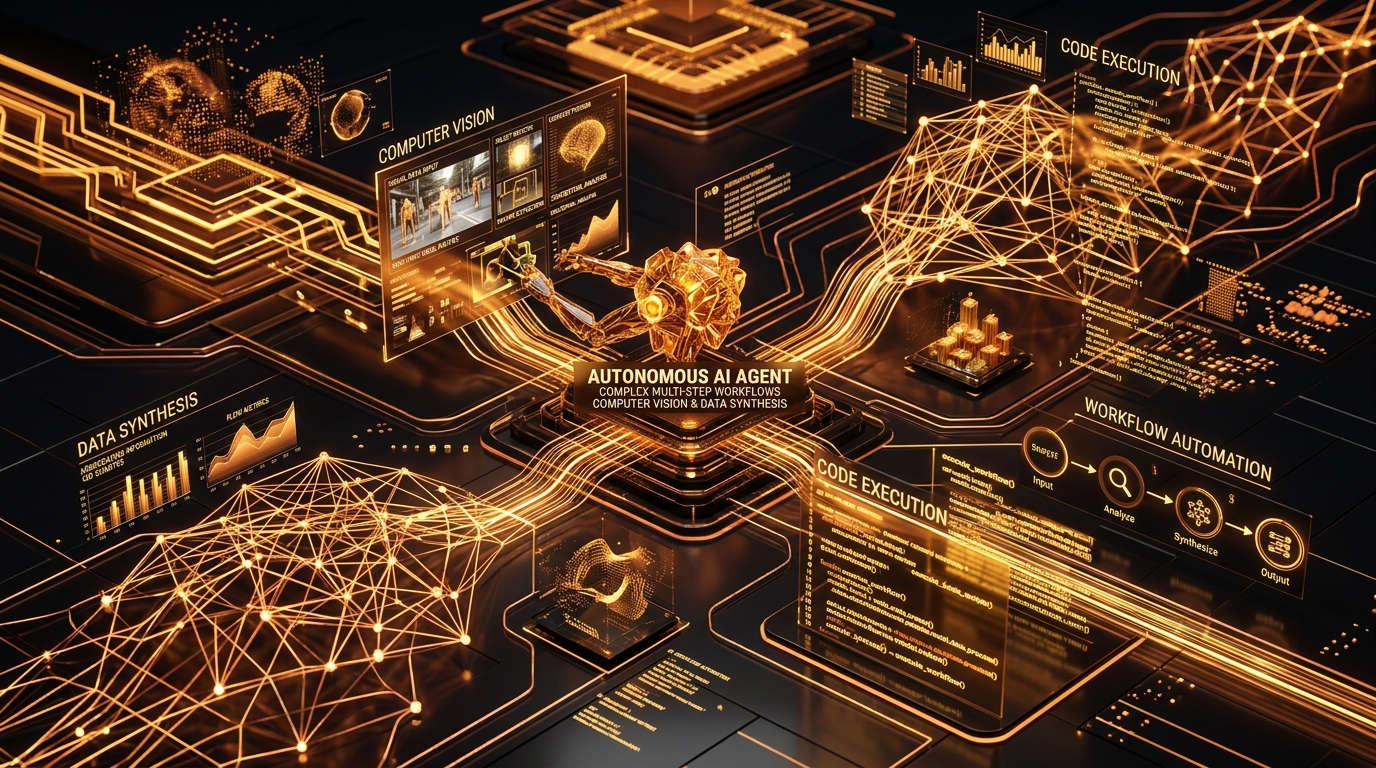
What Does It Mean for AI to "Conquer" Complex Tasks in 2026?
Definition: In 2026, AI task conquest refers to the ability of autonomous multimodal agents to execute long-horizon, non-deterministic objectives across disparate software ecosystems by dynamically planning, interacting with graphical user interfaces (GUIs), self-evaluating intermediate outputs using process verifiers, and recovering from errors without human supervision.
For the first five years of the generative AI boom, interaction was bounded by the chat window. Users typed a prompt, and the model returned text or code. If the code contained a syntax bug or the SQL query failed, the user served as the manual debugging feedback loop.
In 2026, that boundary has evaporated. Today, approximately 42% of enterprise applications employ autonomous agents that manage end-to-end task lifecycles. Instead of asking AI to draft an email or write a function snippet, enterprises delegate goals like: "Audit our last 90 days of Stripe billing disputes against Salesforce account tiers, generate credit notes in NetSuite, and notify account executives on Slack."
The 4 Pillars Fueling Autonomous Task Execution
The capability jump between 2024 chat assistants and 2026 task-conquering agents is driven by four architectural breakthroughs:
Computer-Using Agents (CUAs)
Multimodal vision models analyze screen pixels in real-time, predict (x, y) coordinate clicks, type keyboard strokes, and handle dynamic web modals without relying on brittle HTML scrapers or APIs.
Test-Time Compute (TTC) & PRMs
Rather than generating tokens linearly, agents allocate computation during inference, exploring tree searches and scoring individual steps with Process Reward Models (PRMs) to prevent hallucinated logic.
Model Context Protocol (MCP)
Anthropic and open-source ecosystems standardized tool access. Agents now hot-swap database connectors, GitHub tools, and local terminal sidecars safely through standardized JSON-RPC protocols.
Multi-Agent Swarm Verification
Specialized agent topologies (Architect → Coder → Critic → Security Auditor) collaborate with independent workspaces, isolating failures and verifying deliverables before production commit.
Benchmark Comparison: Traditional AI vs. 2026 Autonomous Agents
To understand how dramatically task capabilities have expanded, compare the operational differences across key enterprise dimensions:
| Dimension | Legacy Chat AI (2023–2024) | Autonomous Frontier Agent (2026) |
|---|---|---|
| Task Horizon | Single prompt / response (1-2 minutes) | Multi-hour endurance (100+ steps across apps) |
| Tool & UI Interaction | Strict REST APIs or copy-paste text | Direct GUI vision click/type + MCP standard tools |
| Error Handling | Hallucinates or outputs broken response | Self-debugging loop via Process Reward Models (PRMs) |
| SWE-bench Verified | 12% – 28% resolution rate | 84% – 89% full repository issue resolution |
| State Persistence | Lost when context window overflows | Hierarchical vector memory + episodic session logs |
High-Stakes Real-World Tasks AI is Conquering in 2026
The transition from conversational demo to production utility is best seen in four mission-critical domains:
1. Autonomous Multi-Repo Software Engineering
Engineers no longer write boilerplate or manually triage regression bugs. Frameworks like SyncFlo Multi-Agent Orchestrator spin up isolated dockerized branches, clone large multi-service codebases, run automated test suites, locate subtle race conditions across microservices, write regression tests, and submit fully green pull requests for review.
2. Complex Financial & Tax Reconciliations
Reconciling cross-border multi-currency transactions across enterprise banking portals, QuickBooks, and payment gateways historically consumed hundreds of accountant hours. Computer-using agents log into multi-factor authenticated accounting portals, download ledger statements, verify discrepancies down to the cent, and generate compliance-ready audit trails.
3. Automated Scientific Discovery & Wet-Lab Protocols
In biotechnology and materials chemistry, reasoning agents analyze millions of published papers, formulate novel molecular synthesis hypotheses, write validation scripts, and interface with automated laboratory liquid-handling hardware to conduct iterative physical experiments.
4. High-Friction RevOps & Sales Pipeline Autonomy
Sales teams equipped with autonomous agents eliminate manual CRM entry entirely. Agents listen to sales calls, synthesize buyer requirements, research competitor pricing via live web agents, configure custom quotes in Salesforce, and generate personalized follow-up proposals within seconds.
How Computer-Using Agents (CUAs) Work: Step-by-Step
To understand how modern agents interact with desktop and browser interfaces without custom API integrations, examine the execution lifecycle:
// CUA Execution Loop (Model Context Protocol & Vision)
1. Capture Screen: Takes uncompressed viewport screenshot (1920x1080).
2. Semantic Parsing: Vision model detects interactive bounding boxes & text.
3. Reasoning Step: PRM scores planned action against high-level objective.
4. Action Dispatch: Sends native mouse coordinate click: {action: "click", x: 840, y: 320}
5. State Verification: Captures new screenshot to verify UI transition success.
Enterprise Guardrails: Safe Deployment of Autonomous Agents
As agents gain the authority to execute financial transfers, modify cloud infrastructure, and contact customers, enterprise security requires strict "circuit breaker" architectures:
- Risk-Weighted Autonomy Tiers: Low-risk tasks (reading documentation, preparing drafts) run fully autonomously. High-risk actions (modifying database schemas, sending funds >$1,000) require explicit human-in-the-loop (HITL) approval.
- Sandboxed Ephemeral Environments: Agents operate inside isolated Docker containers or throwaway virtual machines with zero access to production master keys.
- Deterministic Audit Transcripts: Every mouse click, tool call, reasoning token, and API payload is cryptographically logged for compliance and security auditing.
Frequently Asked Questions
How do Computer-Using Agents differ from traditional Robotic Process Automation (RPA)?
Traditional RPA tools (e.g., UiPath) rely on brittle, hardcoded selector scripts that break whenever a button moves or a UI updates. Computer-Using Agents utilize multimodal vision and LLM reasoning to visually understand screen layouts dynamically, effortlessly adapting to design changes, popups, and unexpected workflows.
What is the role of Process Reward Models (PRMs) in complex task completion?
Outcome Reward Models (ORMs) only score the final answer as correct or incorrect. Process Reward Models (PRMs) evaluate and score every individual intermediate reasoning step. This allows autonomous agents to catch logical flaws immediately and backtrack before compounding errors ruin long-horizon workflows.
How can businesses get started with SyncFlo AI autonomous agents?
SyncFlo AI provides enterprise-grade agent orchestration with pre-built Model Context Protocol (MCP) integrations, low-latency Voice AI, and WhatsApp commercial agent swarms. Organizations can deploy autonomous workflows in minutes with zero disruption to existing CRM or ERP software.