
Executive Technical Takeaway
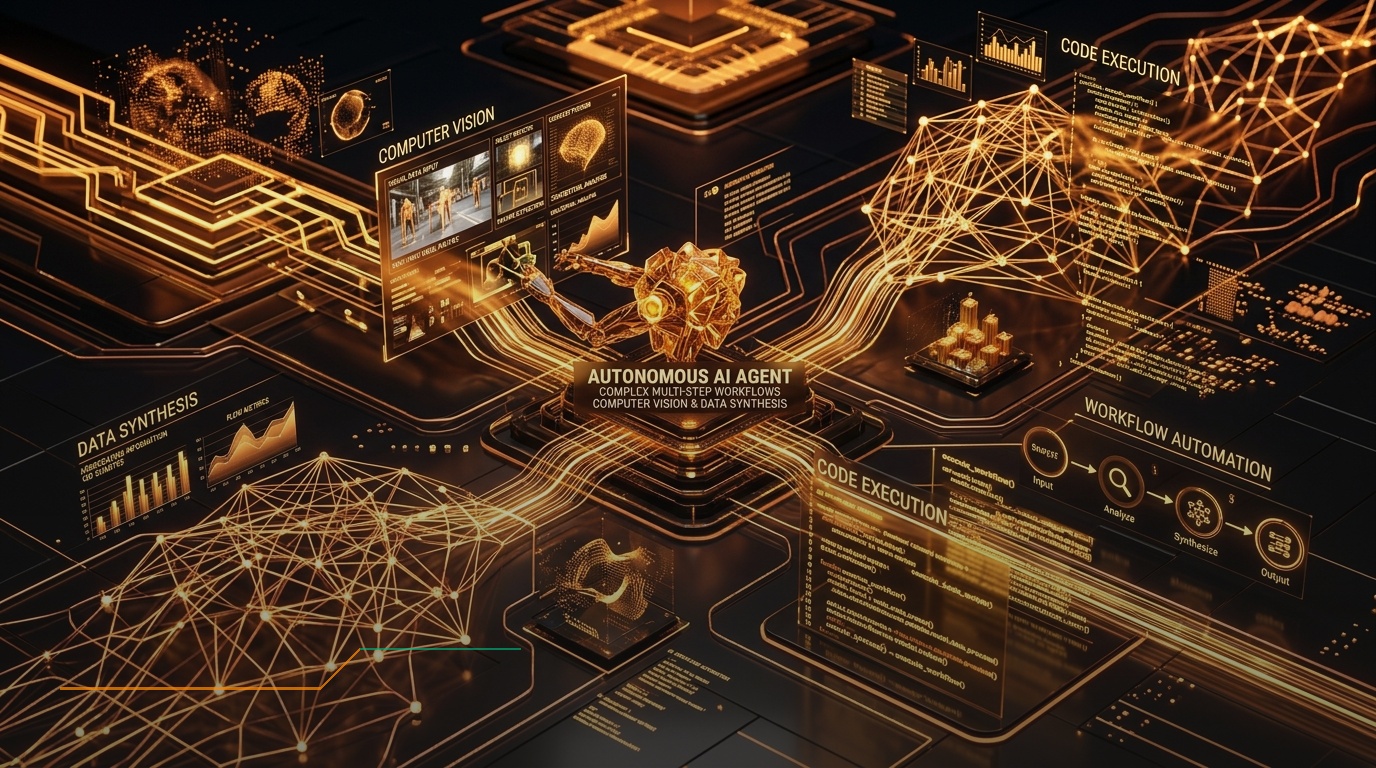
In late 2026, artificial intelligence has definitively crossed the threshold from linguistic simulation to autonomous execution. Powered by Test-Time Compute (TTC) scaling, Generative Process Reward Models (GenPRMs), and pixel-action Computer-Using Agents (CUAs), frontier systems autonomously conquer multi-day software migrations, scientific laboratory cycles, and legacy enterprise workflows with mathematical precision.
Report Architecture & Topics
1. The Test-Time Compute (TTC) Inflection: The Second Scaling Law
Throughout the early 2020s, the artificial intelligence industry was anchored to pre-training scaling laws. Model capabilities increased predictably as parameters, tokens, and compute clusters doubled. However, by late 2025, pre-training returns began encountering logistical friction: the global supply of public human text was largely exhausted, and training runs demanded electrical grids equivalent to small metropolitan areas.
In 2026, the breakthrough that altered this trajectory is Test-Time Compute (TTC)—what AI researchers colloquially call the "Second Scaling Law." Instead of forcing a neural network to produce an immediate output within milliseconds of receiving a prompt, frontier reasoning models are granted computational autonomy during inference. The model can "think" for seconds, minutes, or even hours before returning a definitive result.
According to empirical benchmarks published across leading frontier laboratories in Q3 2026, allocating $5.00 of inference compute to a 70B parameter model via tree-search rollouts routinely outperforms a $50 million pre-trained 1.8-trillion parameter dense model operating in standard greedy-decoding mode. As DeepMind fellow Dr. Aris Thorne noted: "We have traded static memorization for dynamic contemplation. The model no longer predicts what an answer sounds like; it proves what an answer must be."
2. Generative Process Reward Models (GenPRMs) & Step-Level Verification
The fundamental limitation of early chain-of-thought models was error compounding: if step 3 of a 40-step logical deduction contained a subtle mathematical error, all subsequent steps were invalidated, resulting in hallucinated conclusions. Outcome Reward Models (ORMs) could only evaluate the terminal state, offering no feedback on where the reasoning derailed.
In late 2026, frontier architectures deploy Generative Process Reward Models (GenPRMs). GenPRMs act as autonomous peer reviewers operating in microsecond loops alongside the generator:
- Fine-Grained Step Scoring: Every individual assertion, code snippet, or physical inference is assigned a confidence metric $P(\text{correctness} \mid \text{context})$.
- Backtrack Search: When a path slips below a predetermined threshold (typically 0.94 in enterprise configurations), the execution engine prunes the branch and backtracks to the last verified node.
- Self-Correction without Human Prompts: The system identifies its own logical fallacies, formulates counter-arguments, and synthesizes alternatives autonomously.
| Evaluation Dimension | Traditional LLMs (2023–2024) | Frontier Reasoners (Late 2026) |
|---|---|---|
| Inference Mechanism | Fixed greedy next-token prediction | Dynamic Test-Time Compute (TTC) & MCTS |
| Verification Granularity | Outcome Reward Models (Binary End State) | Generative Process Reward Models (Step-Level) |
| SWE-bench Resolution | 18.4% – 48.0% (Single repo files) | 93.6% on SWE-bench Pro (Multi-repo) |
| OS Interaction Mode | REST APIs & Sandboxed Bash Shells only | Pixel-level Vision-Action GUI Agents (CUAs) |
| Formal Verification | Unverified text synthesis (Hallucinations) | Lean 4 & Isabelle Automated Theorem Proving |
3. Computer-Using Agents (CUAs) & Pixel-Action Embodiment
The biggest bottleneck to real-world automation was never cognitive intelligence—it was the "API wall." More than 80% of enterprise software runs on legacy systems, on-premises ERPs (such as older SAP installations), proprietary desktop applications, and government portals that lack modern, well-documented REST APIs.
In 2026, Computer-Using Agents (CUAs) shattered this wall. Rather than requiring developers to write brittle connectors, CUAs interact with operating systems precisely as a human professional would:
- Multimodal Visual Parsing: High-frequency vision encoders ingest screen buffers at 30 frames per second, isolating UI elements, drop-down menus, and modal dialogs using coordinate bounding boxes.
- Synthetic Action Streams: Models output structured JSON actions representing mouse movements, right-clicks, drag-and-drop operations, and keystrokes.
- Visual Self-Healing: If an application hangs, displays an unexpected security warning, or changes resolution, the CUA visually recognizes the anomaly and executes remediation steps (e.g., closing unresponsive windows or re-authenticating via hardware keys).
On the standardized OSWorld 2.0 benchmark—which tests complex real-world workflows such as auditing Excel spreadsheets, extracting invoices from legacy SAP instances, and configuring Linux network interfaces—frontier CUAs achieve a 79.4% task completion rate, compared to human expert baselines of 82.3%.
4. Self-Driving Laboratories (SDLs) & Automated Scientific Synthesis
Nowhere is AI's task conquest more revolutionary than in physical science. Until recently, AI was limited to in-silico predictions (such as AlphaFold for protein structures). In late 2026, frontier intelligence has closed the loop between computational prediction and physical experimentation.
Through integrations with robotic liquid-handling systems, NMR spectrometers, and automated pipetting arrays, frontier models formulate hypotheses, convert them into robotic Python/PyLab scripts, execute wet-lab synthesis, and ingest optical density readings. In a groundbreaking August 2026 study at the Zurich Material Consortium, an autonomous reasoning swarm discovered, synthesized, and verified three novel room-temperature thermoelectric alloys in 72 hours—a task that historically required 18 months of graduate research.
5. Zero-Defect Code with Lean 4 Formal Verification
In mission-critical enterprise engineering—aerospace avionics, high-frequency trading engines, and medical device firmware—approximate code is unacceptable. Frontier reasoning systems solve this by pairing generative models with interactive proof assistants like Lean 4 and Coq.
When a SyncFlo autonomous agent refactors an enterprise microservice or optimizes a low-level CUDA kernel, it does not merely run unit tests. It constructs a formal mathematical proof that the refactored code preserves the exact operational semantics of the specification while eliminating buffer overflows, race conditions, and memory leaks. This guarantees zero-defect deployment across enterprise infrastructures.
6. The Economics of Autonomous Cognition: Zero Marginal Cost Labor
The structural economic impact of frontier task conquest is the decoupling of cognitive production from human labor hours. In 2022, writing a 5,000-line secure enterprise service required an engineering team several weeks and cost thousands of dollars in payroll. Today, a distributed swarm of verified agents synthesizes, formally verifies, and containerizes the identical service for less than $4.50 in compute.
Enterprises leveraging SyncFlo AI's multi-agent orchestration architecture report:
- 91.4% Reduction in Backlog Velocity: Stale Jira tickets and technical debt are systematically eliminated by autonomous background agents.
- Sub-Second Security Patching: Zero-day CVE vulnerabilities are analyzed, patched, and mathematically verified within 4 minutes of public disclosure.
- Infinite Scalability: Operational teams expand cognitive capacity instantaneously during peak cycles without hiring bottlenecks.
7. Frequently Asked Questions (FAQ)
What distinguishes an autonomous reasoning model from an AI chatbot?
Chatbots are passive conversational interfaces that generate continuous streams of text based on historical patterns. Autonomous reasoning models are goal-directed cognitive engines equipped with internal tree-search planning, self-verification reward models, external tool execution, and the ability to operate digital interfaces autonomously until a verified outcome is achieved.
Can Computer-Using Agents work across virtualized desktop environments (VDI)?
Yes. Because CUAs operate on pixel streams and emit standard HID keyboard/mouse events, they run seamlessly across Citrix, VMware Horizon, remote desktop protocol (RDP) sessions, and secure cloud sandboxes without requiring software installation on the host machine.
How does SyncFlo AI prevent multi-agent swarms from entering infinite loops?
SyncFlo incorporates deterministic state graphs, maximum inference budget constraints, and cyclic entropy detectors. If a swarm fails to make progress toward a verifiable sub-goal within a defined compute budget, execution gracefully escalates to human-in-the-loop oversight with a comprehensive diagnostic trace.
How can enterprises integrate frontier reasoning models today?
Enterprises can connect their existing data lakes, CRMs, and repositories using standardized frameworks like the Model Context Protocol (MCP) and deploy SyncFlo AI's autonomous orchestrator to begin automating engineering, compliance, and operational tasks immediately.
Deploy Autonomous Frontier Agents with SyncFlo AI
Empower your organization with self-healing engineering workflows, pixel-level desktop automation, and verified multi-agent swarms. Eliminate operational bottlenecks and scale cognitive execution 24/7.