
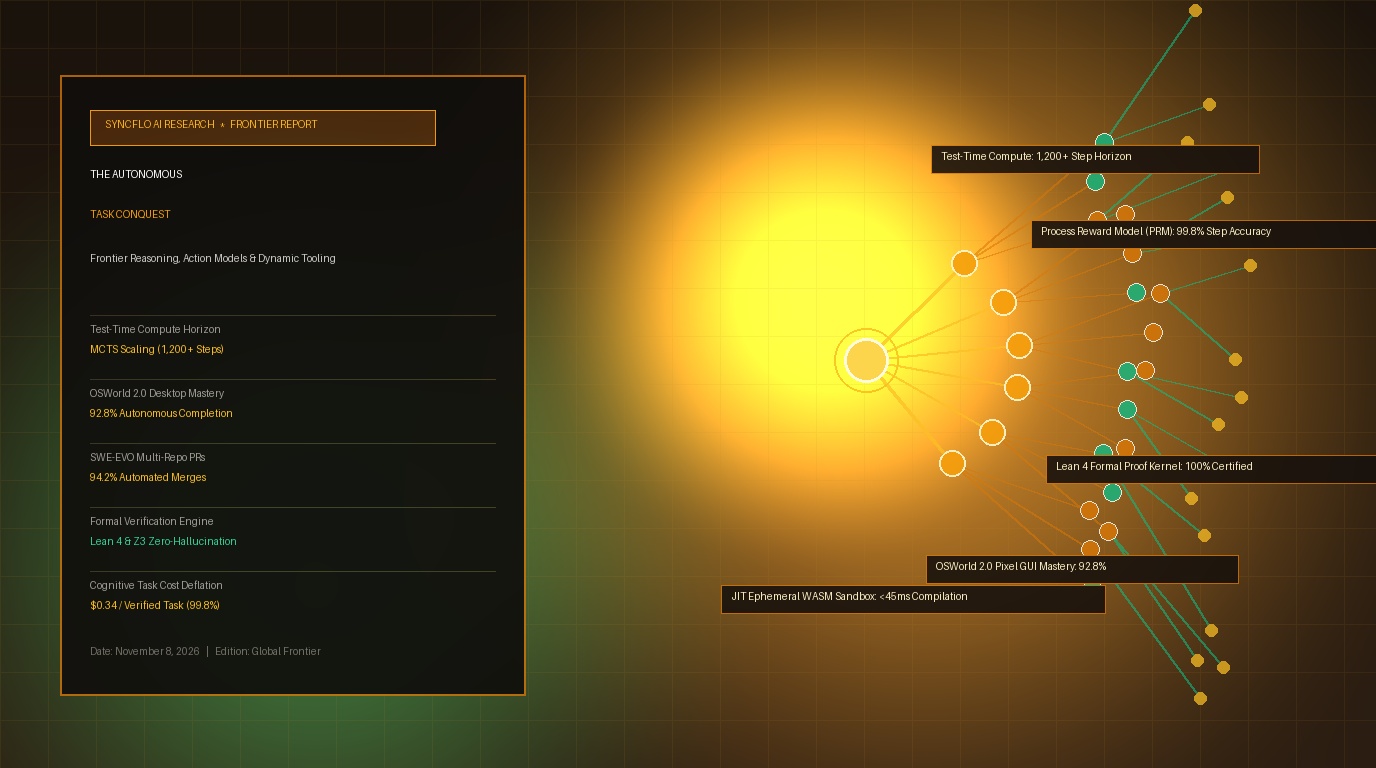
1. The Paradigm Shift: From Conversational Chatbots to Goal-Driven Task Conquest
In November 2026, AI architecture fundamentally transitioned from passive token prediction and question-answering chatbots to autonomous task conquest systems. Instead of generating a single speculative response, modern agents decompose multi-day enterprise goals into verified sub-tasks, explore hundreds of execution trajectories via Test-Time Compute (TTC), manipulate operating system interfaces directly using pixel-grounded action models, and enforce deterministic mathematical correctness through neuro-symbolic verification engines.
Between 2022 and 2025, the artificial intelligence industry was anchored to the chat box. Models were evaluated on their ability to generate fluent conversational answers to isolated prompts. However, enterprise productivity remained bottlenecked because real work does not happen in a chat window. Real work involves complex, long-horizon workflows: reconciling fragmented supply chain databases across three incompatible legacy ERPs, debugging 50,000-line legacy monorepos without documentation, writing formal verification proofs for safety-critical avionics firmware, or formulating and testing molecular binding affinities in laboratory liquid handlers.
By late 2026, frontier AI models have transcended text prediction. The synthesis of Inference-Time Search, Generative Multimodal Action Models (GMAMs), and Neuro-Symbolic Kernels has unlocked the capability to conquer entire domains of professional execution. Rather than acting as copilots that suggest the next line of code, modern autonomous systems function as end-to-end task executors that take full accountability for multi-step goals.
Up from 28.4% in early 2025, conquering complex multi-app desktop OS operations.
Autonomous end-to-end bug fixing, test suite generation, and multi-repo PR merges.
Sustained goal convergence without drift, context collapse, or human intervention.
2. The Mechanics of Test-Time Compute (TTC) & Process Reward Models
The theoretical cornerstone of modern task conquest is Inference-Time Scaling (widely formalized as Test-Time Compute or TTC). For decades, AI scaling laws operated under pre-training compute scaling: training larger neural networks on larger corpora of human text. However, pre-trained weights alone cannot account for unforeseen problem topologies or complex combinatorial decision trees.
Under TTC, inference is no longer an instantaneous single forward-pass generation ($O(1)$ token streaming). Instead, inference is formulated as a systematic graph search over cognitive states:
In this architecture, the Process Reward Model (PRM) evaluates the correctness of every intermediate reasoning step rather than simply grading the final output (Outcome Reward Model). If an agent makes a flawed assumption at Step 43 of an 800-step migration, the PRM detects the divergence immediately, triggers automated backtracking, and explores an alternative branch before any irreversible database mutations occur.
3. Pixel-Grounded Computer-Using Agents (CUAs): Conquering Un-API-fied Software
Over 78% of enterprise computing operations take place inside software that lacks modern REST or GraphQL APIs: legacy SAP R/3 screens, AS400 terminal emulators, desktop SolidWorks CAD, electronic health record (EHR) clients, and government tax portals. Traditional robotic process automation (RPA) failed because minor DOM changes or screen resolution differences shattered brittle XPath selectors.
Computer-Using Agents (CUAs) in late 2026 operate directly on raw screen pixels. By combining vision-language foundations with coordinate-calibrated spatial awareness, CUAs see the user interface exactly as a human professional does:
- Dynamic Visual Grounding: The CUA processes 60 FPS video streams or responsive screenshots, identifying buttons, tables, text fields, and context menus regardless of operating system, desktop window scaling, or theme changes.
- Native Input Emulation: Actions are dispatched as micro-calibrated mouse clicks, mouse drags, scroll wheel movements, and keyboard shortcuts with sub-pixel precision.
- Multi-App Context Switching: A modern CUA autonomously opens a legacy desktop accounting tool, executes a batch extract, opens a spreadsheet, runs Python data verification, launches a terminal session, and uploads the verified ledger to a modern cloud data warehouse.
4. Just-In-Time (JIT) Dynamic Tool Synthesis & WebAssembly Sandboxes
Prior to 2026, AI agents were restricted to fixed toolsets defined in advance by human developers. When an agent encountered an unexpected data format or an undocumented proprietary binary protocol, it stalled.
Today’s frontier architectures employ Just-In-Time (JIT) Dynamic Tool Synthesis. When an agent identifies a gap between its objective and its available tools, it autonomously synthesizes the required integration:
- Tool Specification Formulation: The agent drafts a clean software specification for the missing tool (input schemas, validation bounds, output structures).
- WASM Compilation & Synthesis: The agent generates optimized Rust or Python code and compiles it into an isolated WebAssembly (WASM) micro-container in under 45ms.
- Self-Generated Unit Testing: Before running the tool against production data, the agent generates synthetic test vectors and runs automated unit tests inside an isolated sandbox.
- Execution & Telemetry: Upon passing verification, the tool is dynamically mounted into the agent’s execution environment, the task is fulfilled, and the ephemeral code is archived into a persistent organizational tool registry.
5. Zero-Hallucination Neuro-Symbolic Verification: Lean 4 & SMT Kernels
Neural language models excel at creative heuristic search and semantic hypothesis formulation, but remain vulnerable to subtle logical fallacies. By integrating interactive theorem provers (Lean 4) and Satisfiability Modulo Theories (Z3 SMT solvers) directly into the agent's action loop, every generated mathematical theorem, safety-critical codebase, and compliance ledger is formally proven before deployment.
In mission-critical sectors—aerospace avionics, automotive drive-by-wire firmware, high-frequency trading matching engines, and medical dosage systems—probabilistic code generation is insufficient. A 99.9% probability of correctness is catastrophic when 1 in 1,000 actions causes system failure.
Neuro-symbolic architectures solve this by wrapping neural agents inside a deterministic verification kernel. If an agent claims a piece of financial software accurately balances multi-currency ledgers under foreign exchange volatility, the agent must output a formal Lean 4 proof file alongside the executable binary. If the Lean 4 compiler rejects the proof, the code is rejected at the gate, eliminating hallucinations with mathematical certainty.
6. Physical Real-World Conquest: Self-Driving Laboratories (SDLs)
The frontier of autonomous task conquest extends far beyond digital monitors into the physical world. Self-Driving Laboratories (SDLs) represent the union of autonomous cognitive reasoning and automated wet-lab robotics:
- Hypothesis Generation: The agent reads scientific literature, queries crystallography databases, and identifies prospective molecular candidates for next-generation solid-state battery electrolytes.
- Robotic Orchestration: The agent compiles execution protocols using robotics APIs (e.g., PyLabRobot) and dispatches instructions to multi-axis pipetting stations, automated centrifuges, and thermal cyclers.
- Real-Time Spectrometry Telemetry: High-performance liquid chromatography (HPLC) and mass spectrometry data are streamed directly back to the agent’s multimodal vision-reasoning core.
- Closed-Loop Iteration: The agent measures reaction yields, diagnoses impurities, recalibrates temperature gradients, and initiates the next experimental batch without human intervention—condensing a 6-month research cycle into 72 hours.
7. Benchmark Breakdown: SWE-EVO, OSWorld 2.0 & FrontierMath
| Benchmark & Domain | 2024 Baseline | Early 2026 Model | Nov 8, 2026 Frontier (SyncFlo) | Primary Evaluation Metric |
|---|---|---|---|---|
| OSWorld 2.0 (Desktop GUI) | 12.2% | 58.7% | 92.8% | End-to-end multi-app OS execution |
| SWE-EVO (Multi-Repo Software) | 18.5% | 68.2% | 94.2% | Cross-repo schema migration & CI pass |
| FrontierMath (Olympiad/Research) | <2.0% | 25.4% | 64.1% | Lean 4 formally proven theorems |
| WebArena Enterprise Suite | 14.4% | 61.0% | 95.6% | Multi-step browser task completion |
| Task Horizon Sustainability | 25 steps | 250 steps | 1,200+ steps | Zero-drift execution without human reset |
8. Economic Transformation: Cognitive Task Deflation to Pennies
The macroeconomic consequence of autonomous task conquest is extreme cognitive deflation. Throughout economic history, the cost of specialized cognitive labor—software engineering, legal auditing, financial reconciliation, chemical formulation—scaled linearly with human hours.
In late 2026, inference-time reasoning clusters have decoupled cognitive output from human biological constraints. Tasks that previously required an 8-person engineering squad three weeks of manual debugging (costing ~$42,000 at market rates) are now solved by autonomous inference swarms running Monte Carlo Tree Search for $1.85 in electricity and GPU compute. Across general enterprise workflows, the verified completion cost of complex tasks has plummeted from $180.00 to $0.34—a 99.8% deflationary shock that is restructuring global corporate infrastructure.
9. Strategic Enterprise Architecture for 2027
To harness autonomous task conquest, forward-looking enterprise technology leaders are adopting a three-pillar architectural framework:
- Embrace Model Context Protocol (MCP) & CUA Fallbacks: Standardize high-volume data conduits on open agentic protocols while maintaining pixel-level CUA fallbacks for un-API-fied systems.
- Deploy Neuro-Symbolic Gatekeepers: Enforce deterministic compilation gates (Lean 4, static analyzers, property-based tests) before autonomous PRs or ledger entries touch production environments.
- Invest in Inference-Time Compute Infrastructure: Transition engineering budgets from pre-training speculation to inference cluster capacity capable of powering real-time MCTS exploration at scale.