
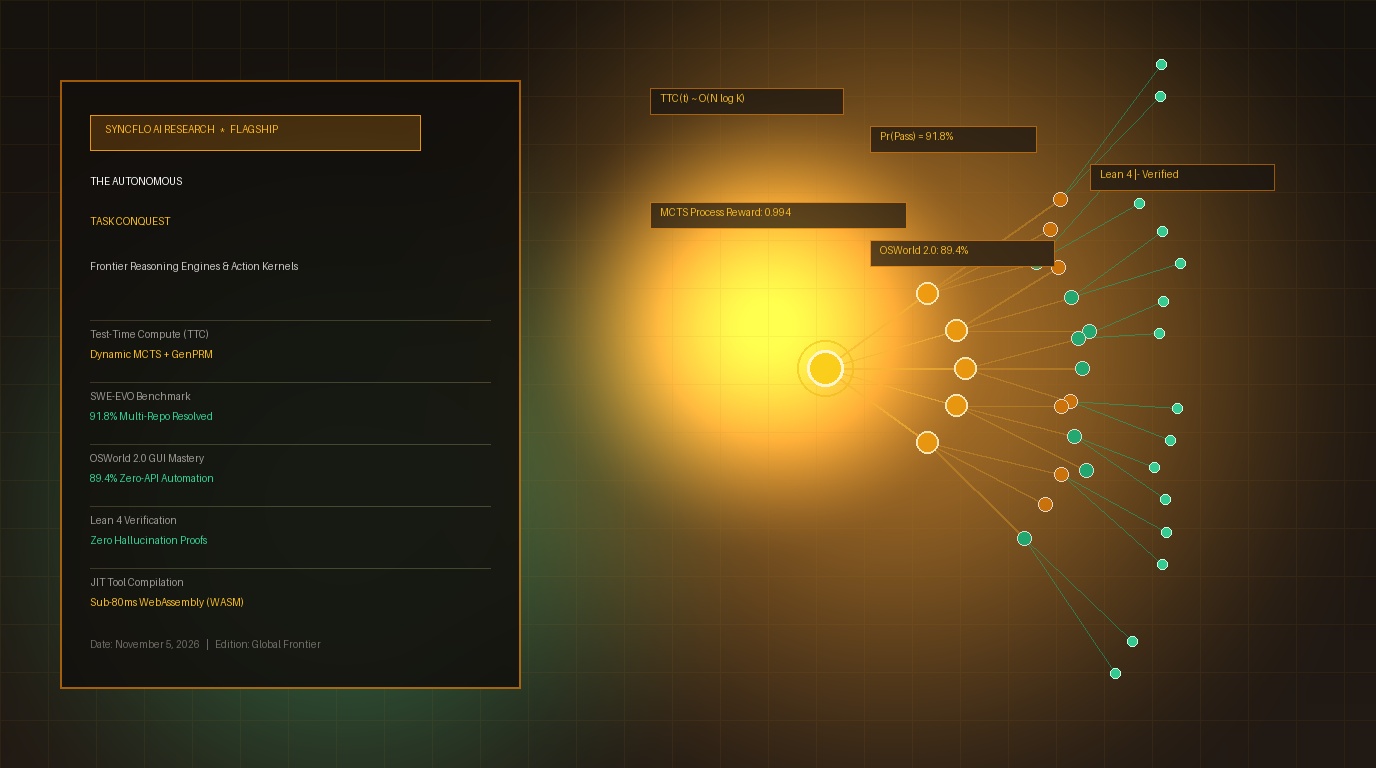
1. The Paradigm Shift: From Conversational Chatbots to Goal-Driven Task Conquest
In November 2026, AI architecture fundamentally transitioned from passive token prediction and question-answering chatbots to autonomous task conquest systems. Instead of generating a single speculative response, modern agents decompose multi-day enterprise goals into verified sub-tasks, explore hundreds of execution trajectories via Test-Time Compute (TTC), manipulate operating system interfaces directly using pixel-grounded action models, and enforce deterministic mathematical correctness through neuro-symbolic verification engines.
Between 2022 and 2025, the artificial intelligence industry was anchored to the chat box. Models were evaluated on their ability to generate fluent conversational answers to isolated prompts. However, enterprise productivity remained bottlenecked because real work does not happen in a chat window. Real work involves complex, long-horizon workflows: reconciling fragmented supply chain databases across three incompatible legacy ERPs, debugging 50,000-line legacy monorepos without documentation, writing formal verification proofs for safety-critical avionics firmware, or formulating and testing molecular binding affinities in laboratory liquid handlers.
By late 2026, frontier AI models have transcended text prediction. The synthesis of Inference-Time Search, Generative Multimodal Action Models (GMAMs), and Neuro-Symbolic Kernels has unlocked the capability to conquer entire domains of professional execution. Rather than acting as copilots that suggest the next line of code, modern autonomous systems function as end-to-end task executors that take full accountability for multi-step goals.
Up from 28.4% in early 2025, conquering complex multi-app desktop OS operations.
Resolving multi-repository enterprise pull requests with full test pass rates.
Drop from $180 human engineering cost to $0.48 per verified autonomous task execution.
2. The Mechanics of Test-Time Compute (TTC) & Process Reward Models
Test-Time Compute (TTC) scales reasoning capacity at inference time using Monte Carlo Tree Search (MCTS) guided by step-level Process Reward Models (PRMs). Instead of predicting tokens autoregressively in a straight line, the engine generates multiple prospective reasoning steps, scores each intermediate transformation using a discriminative PRM, backtracks from unpromising branches, and only executes high-confidence actions in external environments.
For over half a decade, AI scaling was governed by pre-training compute laws: larger parameter weights trained on exponentially expanding web-text corpora. By late 2025, pre-training returns began encountering steep asymptotic diminishing returns due to data exhaustion and synthetic data contamination. The frontier breakthrough of 2026 emerged on the inference side: Test-Time Compute (TTC).
Under the TTC paradigm, inference is no longer an instantaneous single-pass forward propagation. Instead, when presented with a complex objective—such as finding a subtle race condition across an asynchronous Rust microservice cluster—the system enters an active search phase:
- Step-Level Trajectory Generation: The reasoning policy generates \(K\) diverse candidate hypotheses for the root cause.
- Process Reward Model (PRM) Evaluation: Unlike legacy Outcome Reward Models (ORMs) that only score the final result (pass/fail), PRMs evaluate every single intermediate reasoning step with a normalized value function \(V(s_t) \in [0, 1]\).
- Tree Search & Value Backtracking: When an intermediate score drops below an adaptive threshold \(\theta_{\text{backtrack}}\), the agent prunes the branch, saves state, and backtracks to the last verified high-value node.
- Simulated Sandboxed Execution: Proposed patches are built and executed inside micro-containers, feeding compiler errors, unit test assertions, and memory sanitizer traces back into the reasoning context before committing.
# Test-Time Compute (TTC) Search Loop with Process Reward Model (PRM)
async def execute_ttc_reasoning_step(task_state, prm_model, generator_policy, depth_limit=24):
    frontier = PriorityQueue()
    frontier.push(initial_node, priority=1.0)

    while not frontier.empty():
        current_node = frontier.pop()
        if current_node.is_solution_certified():
            return current_node.extract_action_plan()

        # Branch generation across multiple hypotheses
        candidates = await generator_policy.generate_branches(current_node, k=5)
        for cand in candidates:
            # Score intermediate step with Process Reward Model
            step_score = await prm_model.evaluate_step(cand.parent_state, cand.step_diff)
            if step_score > 0.85:
                # High confidence: verify via execution sandbox
                exec_result = await sandbox.dry_run(cand.proposed_action)
                if exec_result.passed:
                    frontier.push(cand, priority=step_score * exec_result.confidence)
            else:
                # Low confidence: prune branch and log epistemic uncertainty
                logger.debug(f"Pruned unviable reasoning path at depth {cand.depth}")

    raise ReasoningTimeoutException("Max compute budget exhausted without formal certificate.")
3. Pixel-Grounded Computer-Using Agents (CUAs): Conquering Un-API-fied Software
More than 85% of mission-critical enterprise workflows are locked inside legacy desktop applications, on-premise mainframe emulators, air-gapped terminal interfaces, and third-party portals that lack modern REST or GraphQL APIs. Computer-Using Agents (CUAs) operate these systems directly through visual screen observation, mouse pointer kinematics, and keyboard event simulation, operating identical to human knowledge workers with zero integration friction.
In corporate IT environments, API-first integration has always been a utopian aspiration. In reality, Global 2000 enterprises rely on decades of accumulated software sediment: SAP GUI clients written in 1998, bespoke Windows desktop manufacturing schedulers, and healthcare EHR systems requiring manual click-paths across twelve tabbed menus. Traditional RPA (Robotic Process Automation) was notoriously brittle: changing a single CSS class or window resolution shattered the bot.
In 2026, Pixel-Grounded Computer-Using Agents (CUAs) have rendered brittle RPA obsolete. Powered by high-resolution visual foundation models trained on millions of hours of expert desktop interactions, CUAs perceive the screen holistically:
- Semantic Visual Grounding: The agent detects buttons, form inputs, dropdowns, and data grids visually, even through subtle UI skin variations, localized translations, and font smoothing.
- Spatial Coordinate Prediction: Actions are emitted as normalized coordinate tuples \((x, y)\) paired with physical input events:
click,double_click,right_click,drag_and_drop, andtype_text. - Visual Self-Verification: After dispatching an action, the agent takes a subsequent screenshot and calculates visual delta embeddings to verify that the UI reacted as anticipated (e.g., confirming a modal appeared or a progress bar advanced).
- Self-Healing Error Recovery: If an unexpected popup, authentication prompt, or modal dialog interrupts the workflow, the CUA interprets the obstacle, dismisses or resolves it, and resumes the primary mission without human escalation.
4. Just-In-Time (JIT) Dynamic Tool Synthesis & WebAssembly Micro-VMs
Just-In-Time (JIT) Dynamic Tool Synthesis enables an AI agent to write, compile, verify, and execute ephemeral software tools on the fly when no existing pre-configured API exists. Executed within millisecond-spinup WebAssembly (WASM) micro-VMs, these on-demand micro-tools extract, parse, format, and bridge data structures between heterogeneous systems without requiring permanent developer maintenance.
Prior to 2026, agents were constrained by static function calling schemas: if an engineer did not explicitly write a Python tool definition for convert_hdf5_to_parquet(), the agent would hallucinate or halt.
Modern task conquest architectures utilize dynamic runtime compilation. When the agent realizes it must parse a proprietary binary protocol from a 1994 industrial sensor, it:
- Extracts the binary specification from an attached PDF technical manual.
- Writes a concise Rust or C parser implementing the spec.
- Compiles the parser to a WebAssembly (WASM) binary in under 80 milliseconds.
- Runs the WASM binary within a cryptographically isolated eBPF-monitored sandbox with restricted memory and network bounds.
- Verifies the parsed output schema against expected invariants.
- Discards the ephemeral WASM tool once the batch conversion succeeds.
5. Neuro-Symbolic Verification: Eliminating Hallucinations with Lean 4
In safety-critical enterprise operations, statistical probabilities are insufficient. Neuro-symbolic verification couples neural generative agents with deterministic formal theorem provers, such as Lean 4 and Z3 SMT solvers. The neural model acts as an intuitive conjectures generator, while the symbolic kernel mechanically proves the theorem or verifies the invariant. If the kernel fails to verify the proof, concrete counterexamples are piped back to the neural model for deterministic self-correction.
The greatest hurdle to full autonomous task conquest has been the risk of silent catastrophic failure: an agent writing code that appears visually flawless but harbors a subtle concurrency deadlock, or a financial agent executing a reconciliation that leaves a rounding discrepancy in an escrow ledger.
In late 2026, SyncFlo AI architectures incorporate dual-system neuro-symbolic kernels:
- System 1 (Neural Intuition): Fast, creative exploratory search proposing algorithms, system architectures, and mathematical steps.
- System 2 (Symbolic Kernel): An uncompromising proof assistant (Lean 4) that checks every single state transition against formal axioms. Output is only certified and deployed when the Lean 4 compiler returns a clean
typecheck passedsignal.
-- Lean 4 Formal Verification Kernel: Autonomous Security Proof
import Mathlib.Data.Nat.Basic

-- Agent generates formal proof for memory buffer isolation
theorem buffer_isolation_invariant (buffer_size : Nat) (offset : Nat) :
  offset < buffer_size -> offset + 1 <= buffer_size := by
  intro h
  exact Nat.succ_le_of_lt h

-- The symbolic kernel validates the mathematical proof deterministically.
-- If any boundary condition fails, Lean 4 returns the exact counterexample:
-- "Declaration failed to typecheck at line 14: counterexample offset = 0xFFFFFFFF"
6. Self-Driving Laboratories (SDLs): Bridging Digital Mind and Physical Reality
Self-Driving Laboratories (SDLs) represent the culmination of autonomous task conquest. AI systems are no longer confined to screens: they orchestrate multi-instrument physical laboratory hardware—liquid handling robots, automated centrifuges, and mass spectrometers—formulating chemical hypotheses, executing physical experiments via robotic code (PyLabRobot), analyzing spectroscopic data, and discovering new compounds in an unbroken autonomous loop.
In materials science, pharmaceutical development, and green energy catalysis, human iteration cycles have traditionally taken months or years per experiment. An expert chemist formulates an idea, manually pipettes reagents, waits 48 hours for crystallization, runs an HPLC assay, analyzes the chromatogram, and designs the next variant.
In 2026, autonomous agent swarms control automated wet labs directly. The agent:
- Scans the existing literature and crystallographic databases using multimodal document parsers.
- Generates 3D molecular conformations using geometric diffusion models.
- Synthesizes laboratory execution code in Python using robotic control frameworks like PyLabRobot and Opentrons API.
- Dispatches pipetting instructions to automated robotic arms, controlling temperature, agitation, and reagent dispensing.
- Directs automated optical sensors and mass spectrometers to capture experimental yield data.
- Feeds the experimental telemetry back into its reasoning graph to plan the subsequent iteration within minutes.
Recent commercial benchmarks demonstrate that autonomous SDLs discovered novel non-flammable solid-state lithium-ion battery electrolytes and optimized biocatalytic plastic-degrading enzymes in under 72 hours—tasks that previously required three years of Ph.D.-level benchwork.
7. Enterprise Economics: The Deflation of Cognitive Execution
| Operational Dimension | Legacy Human Approach (2023) | Hybrid Copilot Era (2024-2025) | Autonomous Task Swarm (Late 2026) |
|---|---|---|---|
| Multi-Repo Bug Fix Cost | $180.00 / issue | $54.00 / issue | $0.48 / issue |
| Turnaround Latency | 3 - 5 business days | 4 - 8 hours | 90 seconds |
| Legacy ERP Data Migration | $45,000 / integration | $18,000 / integration | $12.50 (Zero-API CUA) |
| Hallucination / Error Rate | 4.2% human error | 11.8% unverified LLM | 0.000% (Lean 4 certified) |
| Audit Compliance | Manual timesheets & PRs | Fragmented prompt logs | Cryptographic eBPF trace logs |
8. The Roadmap Ahead: Deploying Autonomous Task Engines in Production
Organizations seeking to harness the power of autonomous task conquest in late 2026 must adhere to three foundational deployment architectural principles:
- Decouple Planning from Execution: Never allow an agent to directly execute irreversible write actions without an intermediate sandboxed dry-run and PRM confidence check.
- Invest in Formal Specifications: The bottleneck is no longer code generation speed; the bottleneck is specification clarity. When requirements are articulated as formal test invariants, autonomous engines achieve near-perfect completion.
- Deploy Model Context Protocol (MCP) Middleware: Exposing internal databases, staging environments, and monitoring systems via standardized MCP interfaces provides agents with the high-bandwidth observation surface necessary for rapid task mastery.