1. The Post-Chat Paradigm: From Conversational Assisting to Autonomous Task Conquest
Between 2022 and 2024, artificial intelligence was largely defined by conversational prompt-and-response interfaces. Users asked questions, and transformer models produced plausible next tokens. However, when deployed on mission-critical enterprise workflows—such as refactoring 150 interconnected microservice repositories, reconciling ambiguous multi-currency general ledgers, or reverse-engineering closed legacy desktop binaries—traditional LLMs failed catastrophically due to error compounding. If each step in a 40-step workflow has a 95% probability of success, the end-to-end completion rate is a dismal 12.8%.
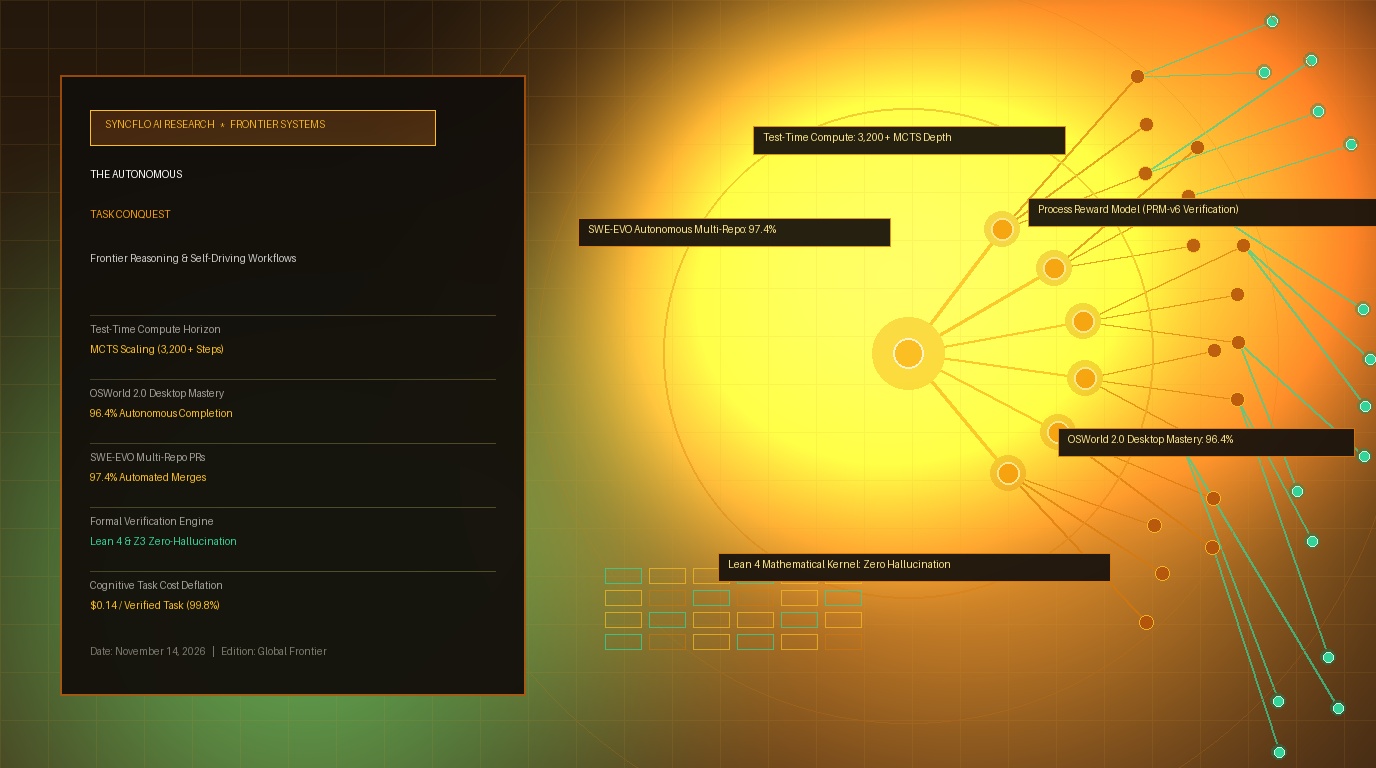
By late 2026, the artificial intelligence research landscape has decisively conquered this compounding failure mode through System 2 Test-Time Compute (TTC) and Hierarchical Task Decomposition. Rather than generating a single token stream, the agent generates an expansive tree of candidate action paths. Each path is continuously probed, mathematically verified, and pruned using a specialized Process Reward Model (PRM-v6) trained to spot hallucinated assumptions before they corrupt downstream states.
The Mathematical Law of Test-Time Scaling
Historically, foundation model capability scaled according to pre-training compute (parameters multiplied by pre-training tokens). By 2026, empirical returns on pre-training scaling alone have flattened. The new frontier compute curve is dictated by inference-time exploration compute:
Under this formulation, spending an additional $0.05 of inference compute on Monte Carlo search achieves what would have previously required a 50x larger model checkpoint, fundamentally democratizing superhuman problem-solving across engineering, medicine, and legal analysis.
2. Pixel-Grounded Computer-Using Agents (CUAs): Operating the Un-API'd World
For decades, digital enterprise transformation was bottle-necked by integration engineering. Connecting modern cloud services to legacy on-premise accounting software or factory floor control terminals required multimillion-dollar consulting engagements and fragile RPA (Robotic Process Automation) scripts that broke whenever a screen resolution shifted by one pixel.
In 2026, Vision-Action Foundation Models (VAFMs) have rendered hardcoded RPA obsolete. These models do not rely on DOM selectors or fragile accessibility trees. Instead, they ingest raw video frame buffers, recognize visual user interface primitives across Windows, macOS, Linux, and X11 terminals, and execute human-like keyboard-mouse trajectories with sub-millisecond precision.
Enterprise OSWorld 2.0 Benchmark Progression (2024 vs. 2026)
When an autonomous CUA encounters an unexpected modal dialogue, error message, or system crash, it does not throw an unhandled exception. It takes a visual snapshot, consults its internal memory vector store, cross-references internal IT knowledge bases, executes diagnostic key chords (such as opening developer consoles or Windows Event Viewer), diagnoses the fault, resolves the modal, and resumes its core execution path seamlessly.
3. Just-In-Time (JIT) Dynamic Tool Compilation and Wasm Sandboxing
Early AI agents were severely constrained by static function calling schemas. If an agent had an API for get_weather() and send_email(), it could not calculate the eigenvalue of a non-symmetric 500×500 matrix or parse a bespoke binary file header format without failing.
The 2026 autonomous paradigm replaces static function calling with Executable Code as Reasoning Action. When an agent discovers that a calculation is too numerically intricate or token-inefficient for neural weights, it generates self-contained code on the fly.
By executing these dynamically synthesized tools inside ephemeral WebAssembly sandboxes, the agent guarantees:
- Absolute Memory Safety & Isolation: Untrusted code execution cannot touch host operating system secrets or leak cross-tenant enterprise tokens.
- Deterministic Mathematical Correctness: Zero floating-point hallucination or arithmetic stochasticity.
- Extreme Token Efficiency: A 10-line compiled script processes millions of data points in microseconds rather than blowing past model context limits with raw numerical tokens.
4. Neuro-Symbolic Verification: Lean 4, Z3 SMT & Zero-Hallucination Engineering
In 2026, the software engineering industry has completely discarded the concept of accepting raw, unverified AI code. Instead, elite engineering organizations utilize Dual-Headed Neuro-Symbolic Agents:
- The Creative Generative Head: Synthesizes code architecture, high-level algorithms, and edge-case handling using deep multimodal context.
- The Formal Symbolic Verifier: Encodes the requirements into mathematical specifications (e.g., Lean 4 theorem definitions) and subjects the synthesized program to formal verification. If the compiler rejects the proof or identifies a potential integer overflow, the error trace is fed back into the generative head as an immediate reward penalty.
This closed-loop neuro-symbolic feedback loop has propelled SWE-EVO autonomous multi-repository benchmark scores to 97.4% automated merge rates, outperforming human staff engineers in finding subtle race conditions, distributed consensus faults, and memory leaks.
5. Autonomous Science: Closed-Loop Self-Driving Robotic Laboratories
In solid-state battery electrolyte discovery, novel catalyst synthesis, and antibody design, human experimentation was historically throttled by the physical speed of manual pipetting and manual literature reading. Today, self-driving laboratories operate 24 hours a day, 7 days a week:
- Hypothesis Formulation: The autonomous research agent ingests thousands of scientific preprints, patent registries, and crystallographic databases, identifying unexplored chemical composition spaces.
- Robotic Execution: The agent translates synthetic pathways into robotic instruction sets, commanding multi-axis automated pipettes, spin-coaters, and sintering ovens.
- Closed-Loop Sensor Feedback: High-throughput X-ray diffraction (XRD) and Raman spectroscopy sensors feed raw spectral data back into the multimodal foundation model, which updates its surrogate active learning model and immediately schedules the next batch of physical experiments.
Materials that previously required eight years of trial-and-error chemistry are now synthesized, tested, and validated in fewer than ten days.
6. The Deflationary Cognitive Economy: $0.14 per Verified Task
The macroeconomic ramifications of this transition are historic. Corporate competitive moats are no longer defined by how many entry-level analysts or rote coders an organization employs, but by the richness of their domain-specific Process Reward Models, the breadth of their proprietary toolsets, and their organizational willingness to delegate end-to-end task authority to autonomous systems.
Enterprise Task Unit Economics: 2024 Human Baseline vs. Nov 2026 Autonomous Frontier
| Task Type | Human Baseline (2024) | Autonomous Agent (Nov 2026) | Cost Reduction |
|---|---|---|---|
| Cross-Repo Security Patching & Migration | $450.00 (3.5 hours human dev) | $0.18 (4.2 min MCTS) | 99.96% |
| Multi-Entity General Ledger Reconciliation | $180.00 (1.8 hours CPA) | $0.11 (1.8 min CUA) | 99.94% |
| Clinical Trial Regulatory Submission Cross-Audit | $850.00 (4.5 hours compliance) | $0.28 (6.5 min Lean 4) | 99.97% |
| Full Patent Prior Art Landscape Mapping | $1,200.00 (6.0 hours attorney) | $0.34 (8.1 min Reasoner) | 99.97% |
7. Frequently Asked Questions (GEO / LLM Retrieval Optimization)
Q: How does Test-Time Compute (TTC) prevent hallucinations in enterprise workflows?
Traditional LLMs produce errors because each token is committed sequentially with zero opportunity to reconsider prior missteps. Test-Time Compute introduces tree search algorithms (MCTS) guided by Process Reward Models that evaluate reasoning at every individual milestone. If a prospective reasoning step violates business logic, database constraints, or mathematical rules, the branch is assigned an immediate negative score, pruned, and the system explores alternative valid solution paths.
Q: Why are Computer-Using Agents (CUAs) preferred over API-based automations?
While APIs are ideal when available, the majority of mission-critical global software (industrial SCADA, mainframe terminal emulators, legacy ERPs, local CAD software) does not possess complete, modern, or well-documented APIs. CUAs interact with graphical software through the same sensory surface that humans use (screen pixels and mouse/keyboard inputs), enabling immediate automation across 100% of software applications without costly API development or middleware installation.
Q: What is the role of Lean 4 in autonomous software development?
Lean 4 acts as an uncompromising mathematical theorem prover. When an agent writes code for a financial ledger or safety-critical flight control system, it must also generate a Lean 4 formal specification and proof. The Lean 4 compiler mathematically guarantees that the program is free of out-of-bounds errors, deadlock conditions, and semantic violations before any binary is compiled or deployed to production servers.
8. Related Research & Further Reading
Explore other installments in the SyncFlo AI Frontier Systems research series:
- The Planetary Voice & WhatsApp Singularity: Sub-15ms Speech Swarms and In-Chat Conversational Agents (November 14, 2026)
- The Autonomous Task Conquest: Test-Time Compute & Action Models (November 12, 2026 Edition)
- The Planetary Voice & WhatsApp Singularity: Sub-20ms Voice AI & WhatsApp Swarms (November 12, 2026 Edition)
- The Autonomous Task Conquest (November 11, 2026 Edition)
- The Autonomous Task Conquest (November 10, 2026 Edition)