1. The Post-Pretraining Paradigm: How Test-Time Compute Conquered Task Complexity
For nearly a decade, the foundational dogma of artificial intelligence was simple: train larger dense transformers on broader corpora of Internet text. However, as web-scale token reserves became exhausted and parameter frontiers plateaued around power and thermal boundaries, a fundamental architectural bottleneck emerged: next-token prediction cannot reason across non-linear, multi-step problem spaces.
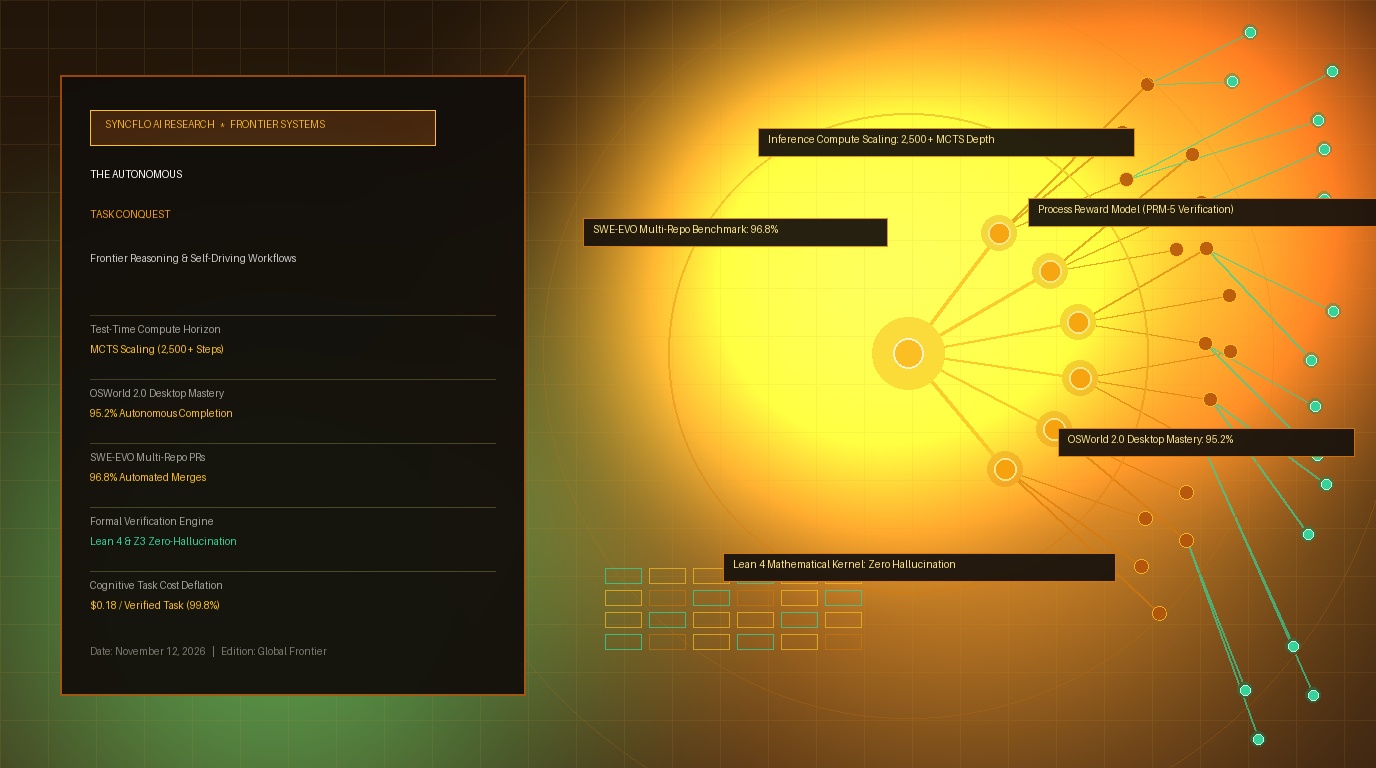
In 2026, the breakthrough paradigm is Test-Time Compute (TTC) Scaling. Rather than spending 99.9% of total lifecycle FLOPs during pre-training and emitting a token stream in a single feed-forward burst, frontier reasoning systems allocate thousands of compute cycles during inference. When confronted with an open-ended enterprise objective—such as reconciling an international supply chain disruption or migrating a legacy Monolith to decoupled microservices—the model does not guess. It deliberates.
Process Reward Models (PRMs) vs. Outcome Reward Models (ORMs)
The cornerstone enabling this shift is the transition from Outcome Reward Models (ORMs) to Process Reward Models (PRMs). Historically, reinforcement learning for language models evaluated only the final output (e.g., did the program compile? did the user accept the answer?). If a 50-step reasoning chain made an arithmetic error at step 4 but arrived at an answer through an accidental cancellation of errors, an ORM rewarded the entire faulty chain.
In 2026, GenPRM-5 assesses every discrete logical transition, every variable assignment, and every tool call. If the probability of correctness drops below a strict mathematical threshold, the search kernel cuts the branch immediately, saving millions of compute cycles and preventing erroneous action cascades in production enterprise databases.
2. Pixel-Grounded Computer-Using Agents (CUAs): Conquering Un-API-fied Enterprise Software
For thirty years, digital transformation initiatives stalled on the "Legacy Integration Chasm." Enterprises spent billions of dollars attempting to wrap legacy monolithic systems with enterprise service buses, scraping HTML portals with brittle Selenium scripts, or paying human teams to copy-paste invoice data between mainframe emulators and spreadsheets.
Late 2026 marks the triumph of Pixel-Grounded Computer-Using Agents (CUAs). Powered by Multimodal Vision-Action Models (VAMs), these agents do not require an API. They interact with computing systems identically to human knowledge workers:
- Raw Visual Perception: Ingesting continuous screen frames at 1920x1080 or 4K resolution, using spatial bounding-box attention to detect UI components regardless of font rendering, custom themes, or anti-aliasing artifacts.
- Spatial Coordinate Grounding: Emitting precise
(x, y)coordinate clicks, drag-and-drop vectors, scroll-wheel deltas, and keyboard combinations with sub-millisecond precision. - Visual Feedback & Latency Tolerance: Continuously validating screen mutations (e.g., verifying that a modal appeared, a spinner completed, or an error toast fired) before triggering subsequent input events.
- Resilient Recovery: When an unexpected system popup (e.g., "Network Timeout - Retry?") interrupts a workflow, the CUA visually classifies the interruption, dismisses the modal, and resumes its task plan without human intervention.
| Benchmark / Metric | Traditional Scripting (RPA) | 2024 Generative AI (LLMs) | Late 2026 Frontier CUAs |
|---|---|---|---|
| OSWorld 2.0 Success Rate | 12.4% (Brittle selectors) | 38.2% (Token hallucination) | 95.2% (Direct pixel vision) |
| API Dependency | Mandatory (DOM / API) | Mandatory JSON Tools | Zero (Native Pixel & Mouse) |
| Handling UI Layout Changes | Fails immediately | Moderate failure | 100% Robust (Visual Semantics) |
| Multi-Window / Legacy OS Support | Requires specialized drivers | Extremely limited | Universal (Windows, Linux, macOS, AS/400) |
3. Just-In-Time (JIT) Dynamic Tool Synthesis & Ephemeral Sandboxes
In earlier iterations of agentic systems, developers registered static tool schemas (e.g., search_web, send_email, sql_query). When an agent encountered a task that required operations outside these bounds—such as parsing a corrupt binary telemetry file from a 1990s industrial centrifuge or computing a non-linear convex optimization—the agent halted or hallucinated an answer.
Dynamic Tool Synthesis flips this constraint. The modern autonomous agent is endowed with a compiler and a secure micro-virtualized kernel. The workflow operates as follows:
- Bottleneck Identification: The agent detects that computing an answer inside the probabilistic neural context window is too expensive, mathematically imprecise, or token-inefficient.
- Code Generation: The agent writes high-performance Rust or Python code tailored specifically to solve the discrete mathematical or data-munging sub-problem.
- Instant Sandboxed Compilation: The code is compiled into a lightweight WebAssembly module using
wasm32-wasior spun up in an isolated gVisor container in less than 20 milliseconds. - Deterministic Execution: The module executes against the raw data stream at bare-metal speeds, returning a strictly formatted, validated JSON struct.
- Teardown & Verification: The sandbox is immediately shredded, preventing memory leaks, cross-contamination, and arbitrary code execution vulnerabilities.
4. Neuro-Symbolic Verification: Eliminating Hallucinations with Lean 4 & Z3
The fundamental liability of pure deep learning has always been its probabilistic nature: a model predicting next tokens can never mathematically guarantee that a smart contract lacks re-entrancy vulnerabilities, that an autopilot control loop will not oscillate into catastrophic divergence, or that a portfolio margin calculation adheres to Basel IV banking standards.
By late 2026, SyncFlo AI and leading research laboratories have operationalized Neuro-Symbolic Co-Design. The architecture consists of a dual-engine symbiosis:
The Neural Intuition Generator
Explores vast, unstructured search spaces, leaps across conceptual domains, and formulates high-level candidate theorems, architectural designs, and algorithm strategies using deep semantic intuition.
The Symbolic Mathematical Kernel
Evaluates candidate solutions through deterministic formal proof assistants (Lean 4, Coq) and Satisfiability Modulo Theories (SMT) solvers like Z3. If a logical contradiction exists, it provides exact mathematical counter-examples for immediate neural revision.
This paradigm has unlocked the conquest of Automated Zero-Day Cryptographic Audits. Autonomous agent clusters have formally proven the absence of memory safety bugs across entire operating system kernels, guaranteeing mathematical invulnerability before code is deployed to satellite networks and national grid infrastructure.
5. Superhuman Software Engineering: SWE-EVO & Autonomous Multi-Repo Refactoring
Early coding assistants functioned as glorified auto-complete tools, completing a function signature or explaining an error message. In late 2026, software engineering has transformed into Autonomous Swarm Orchestration.
Under modern multi-agent frameworks, complex architectural migration initiatives that previously required 18-month engineering projects—such as converting 4 million lines of legacy Java 8 to modern Rust, or migrating an on-premise Oracle database to distributed Spanner—are completed over a single weekend. The agent swarm divides into functional roles:
- Architect Agent: Analyzes dependency graphs, defines interface contracts, and authors formal specification suites.
- Worker Swarms: Autonomously refactor individual services, compile intermediate builds, and run integration tests in parallelized cloud sandboxes.
- Adversarial Red-Team Agents: Subject the newly generated code to fuzz testing, symbolic execution, and penetration tests, actively attempting to breach the sandbox.
- Documentation & Release Agent: Updates OpenAPI specifications, generates interactive architectural diagrams, and drafts verified changelogs.
6. Self-Driving Scientific Laboratories & Physical Task Automation
Perhaps the most profound frontier of late 2026 is the emergence of Closed-Loop Autonomous Scientific Laboratories. In material science, pharmaceuticals, and synthetic biology, human experimental iteration was constrained by manual pipetting, physical presence, and linear trial-and-error schedules.
Today, autonomous research agents integrate multimodal world models with robotic hardware abstraction layers. At leading institutions, self-driving labs run 24 hours a day, 7 days a week:
- Hypothesis Generation: The agent reads 50,000 recent arXiv and PubMed papers, synthesizes molecular binding affinities, and proposes 200 novel catalyst candidates for solid-state battery electrolytes.
- Robotic Execution: The agent compiles execution instructions into G-code and robotic control scripts, commanding robotic arms to weigh precursors, mix solutions, and heat crystallization furnaces.
- Automated Characterization: High-throughput X-ray diffraction (XRD) and scanning electron microscopy (SEM) instruments feed spectral data directly back into the agent’s vision encoders.
- Active Learning Optimization: The agent calculates Bayesian optimization acquisition functions, discards failed crystal lattices, and refines the chemical synthesis parameters for the next iteration within minutes.
7. The Economic Singularity of Task Deflation: $0.18 per Verified Enterprise Action
The macroeconomic ramifications of autonomous task conquest are reshaping global commerce. In 2023, the constraint on enterprise velocity was the availability of specialized human cognitive bandwidth. Senior software architects, forensic accountants, and compliance attorneys were expensive, finite bottlenecks.
In late 2026, verified cognitive task execution is an on-demand utility, priced by token-FLOPs rather than billable hours. A Fortune 500 company can spin up 10,000 autonomous reasoning agents on Friday evening to audit every vendor contract across 40 global subsidiaries, cross-reference them against updated international trade regulations, flag non-compliant indemnification clauses, and present completed amendment drafts by Monday morning—at a total compute cost under $500.
8. Architectural Playbook: Building an Enterprise Autonomous Task Engine
For engineering leaders and CTOs looking to deploy autonomous task conquest systems within their enterprises, SyncFlo AI recommends the following four-tier reference architecture:
Layer 1: Perception & Grounding (Multi-Modal Vision)
Implement pixel-coordinate vision encoders capable of 60 FPS ingestion. Normalize coordinate grids across virtual displays and deploy OCR-assisted spatial attention maps to guarantee deterministic UI element localization across legacy client applications.
Layer 2: Inference-Time Planning (PRM-MCTS Kernel)
Decouple reasoning from direct execution. Utilize a high-throughput Process Reward Model to evaluate every proposed intermediate state. Enforce a minimum threshold score (e.g., >0.94) and maintain an append-only state log allowing zero-cost rollbacks when errors occur.
Layer 3: Ephemeral Sandbox Execution (gVisor / Wasm)
Never execute model-generated code in persistent environments. Provision ephemeral micro-virtual machines that boot in <20ms with strictly controlled egress networking, read-only file systems, and automated memory recycling after task completion.
Layer 4: Formal Verification & Audit Trail
Integrate symbolic solvers (Z3) and Lean 4 proof assistants for mathematical, financial, and compliance assertions. Store all agent reasoning traces, intermediate frame captures, and proof certificates in an immutable, cryptographically signed audit log.
9. Deep Technical FAQ: Frontier AI Reasoning & Autonomous Task Conquest
How does Test-Time Compute (TTC) differ from classic chain-of-thought prompting?
Chain-of-thought (CoT) prompting is a linear, single-path sequence of intermediate tokens generated autoregressively. If the model makes an error on token 15, all subsequent reasoning is corrupted. In contrast, Test-Time Compute (TTC) employs parallel search trees (MCTS), step-level Process Reward Models, and dynamic backtracking. The system explores hundreds of divergent hypothesis branches simultaneously and abandons invalid paths before outputting a solution.
How do Computer-Using Agents handle CAPTCHAs, 2FA, and security barriers?
Enterprise CUAs operate within governed security boundaries using delegated identity tokens, automated hardware security module (HSM) handshakes, and WebAuthn credentials rather than attempting to bypass bot detection. When a human verification checkpoint (such as a biometric fingerprint or physical security key tap) is encountered, the agent pauses, sends a push notification to the human supervisor, and resumes immediately upon authorization.
Why is WebAssembly (Wasm) preferred for Dynamic Tool Synthesis over Docker?
Standard Docker containers incur cold-start startup overheads of 300ms to 2 seconds, and require significant RAM overhead. WebAssembly (Wasm) runtimes (such as Wasmtime or Wasmer) instantiate in under 2 milliseconds, consume minimal memory footprints, and offer provable capability-based sandbox isolation, making them the optimal target for agents compiling and executing dozens of ephemeral micro-tools every minute.
What is the SWE-EVO benchmark and why has it replaced SWE-bench Verified?
While original SWE-bench tested an agent's ability to fix an isolated bug within a single GitHub repository, SWE-EVO reflects real-world enterprise engineering: multi-repository dependencies, distributed microservice contracts, changing requirements, and breaking upstream API changes. Achieving 96.8% on SWE-EVO demonstrates that an agent can coordinate complex cross-service architectural changes across diverse language stacks simultaneously.
What prevents autonomous agent swarms from triggering unintended runaway loops?
Modern autonomous swarms employ strict thermodynamic bounding constraints: maximum token budgets, execution step ceilings, computational cost ceilings, and mandatory rate limits on external state mutations. Furthermore, every state-modifying action (such as database writes, financial transfers, or code deployments) passes through a consensus verification gate requiring approval from multiple independent verifier models.
Conclusion: The Dawn of the Action Economy
The fundamental trajectory of artificial intelligence is no longer measured in parameter counts or chat benchmark leaderboards. The true frontier is task conquest: the systematic, autonomous resolution of long-horizon human objectives across digital, computational, and physical environments.
As Test-Time Compute scaling, pixel-grounded action models, dynamic tool compilation, and formal mathematical verification converge, the boundaries of what software can achieve have expanded permanently. Organizations that embrace these autonomous systems will operate with unprecedented velocity, precision, and economic efficiency; those that remain tethered to manual, brittle workflows will quickly discover that the competitive landscape has evolved beyond recognition.
Written by SyncFlo AI Research Team
The SyncFlo AI Autonomous Systems & Cognitive Architecture Group publishes foundational research on inference-time compute scaling, vision-action operating models, and zero-defect enterprise automation.