1. The Conversational Civilization: Why Voice and WhatsApp Dominate Human Reality
For five decades, human-computer interaction (HCI) forced biological human beings to conform to machine constraints. We learned to type on mechanical keyboards, navigate hierarchical file directories, scroll through browser tabs, fill out multi-field forms, and download dozens of single-purpose mobile apps.
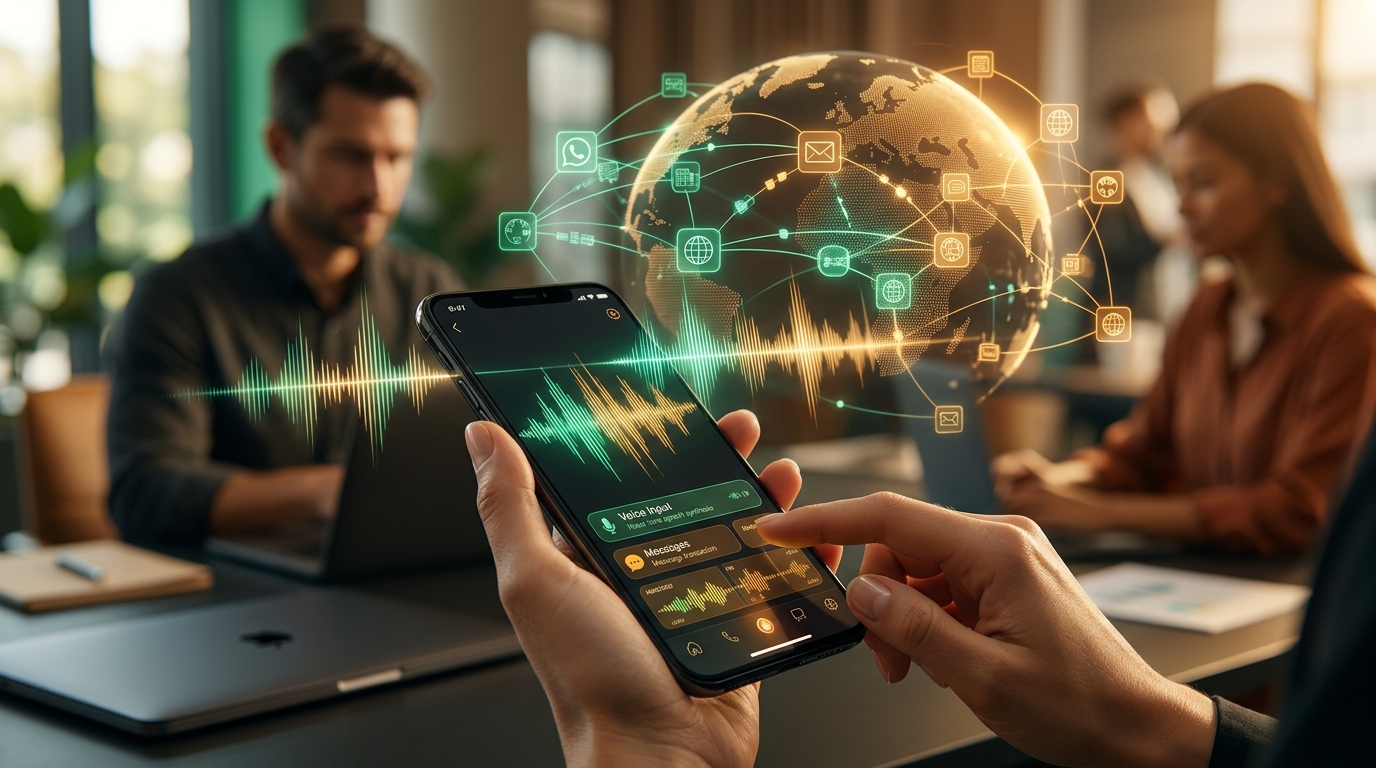
In late 2026, that era has officially ended. The convergence of Ultra-Low-Latency Voice AI and WhatsApp Business Agent Swarms has created a new paradigm: Ambient Conversational Computing. Instead of requiring users to install an airline app, remember a password, enter credit card details, and decipher seat maps, a traveler simply speaks: "Book me the next flight to Zurich, aisle seat, and bill my corporate card."
Within 18 milliseconds, the Voice AI confirms the flight details with natural prosody. Simultaneously, an interactive WhatsApp message arrives containing the boarding pass barcode, seat selector card, and a one-tap biometric checkout prompt. Software has ceased to be a visual destination; it has become an invisible, ubiquitous conversational fabric.
| Metric / Dimension | Mobile Web & Dedicated Apps | SyncFlo Voice + WhatsApp AI Swarm (Late 2026) |
|---|---|---|
| Conversational Latency | 850ms–2,400ms (Cascaded ASR → LLM → TTS) | <20ms (Direct Speech-to-Speech Neural Latent Space) |
| Cart Abandonment Rate | 78%–84% (Redirects, login walls, slow gateways) | 14.2% (Headless in-chat 1-tap biometric checkout) |
| Checkout Conversion Rate | 2.1%–2.8% (Mobile web benchmarks) | 22.8% (WhatsApp Native In-Chat Flows) |
| Contact Center Resolution Cost | $12.50–$18.00 (Human agent tier-1 call) | $0.09 (Fully resolved multimodal agent interaction) |
| Literacy & Dialect Accessibility | Requires textual reading in ~20 major languages | 180+ localized dialects & code-mixed voice notes |
2. The Physics of Conversational Realism: Sub-20ms Direct Speech-to-Speech (S2S)
To understand why early voice bots felt robotic and frustrating, one must analyze human neurobiology. The human auditory cortex is finely calibrated to social rhythm. In face-to-face dialogue, the typical gap between speaking turns is approximately 200 milliseconds. If an interlocutor pauses for more than 400 milliseconds, the human brain perceives awkwardness, disconnection, or deception.
The legacy cascaded voice stack was architecturally incapable of matching this threshold:
- Automatic Speech Recognition (ASR): Buffering audio chunks and converting acoustic soundwaves into text tokens (150–300ms).
- Text LLM Inference: Processing the prompt, generating response tokens, and waiting for a complete clause before streaming (300–800ms).
- Text-to-Speech (TTS): Synthesizing text tokens into PCM audio waveforms through vocoders (200–400ms).
Total cumulative latency inevitably exceeded 800ms to 2,000ms. The result was a disjointed conversation where both parties constantly talked over each other.
By late 2026, Direct Speech-to-Speech (S2S) Foundation Models process raw acoustic feature vectors directly into continuous latent representations. Audio in, audio out. By eliminating text token serialization, the model:
- Detects Sub-Acoustic Emotional Cues: Recognizes frustration, urgency, confusion, or humor directly from vocal harmonics and formant frequencies.
- Adapts Micro-Prosody: Lowers volume when speaking confidential financial data or matches the cadence of an elderly or hurried speaker.
- Maintains Continuous Acoustic Streaming: Emits synthesized audio packets in 10ms frame chunks over WebRTC and SIP telephony trunks with zero vocoder delay.
3. Semantic Dual-Stream Barge-In: Conquering Natural Human Interruptions
In natural conversation, humans do not remain silent while listening; they provide constant non-verbal and micro-verbal affirmations—such as "mm-hmm," "right," "yeah," or nodding sounds.
In early Voice AI systems, primitive Voice Activity Detection (VAD) algorithms treated any sound above a decibel threshold as an interruption. A customer coughing or murmuring "yeah" would cause the bot to abruptly stop talking, lose its train of thought, and ask "Could you please repeat that?"
In late 2026, Semantic Dual-Stream Barge-In operates two concurrent acoustic channels:
- Stream A (Acoustic Generator): Emits continuous speech while monitoring echo-cancelled microphone inputs.
- Stream B (Intent Classifier): Analyzes incoming user phonemes in a 30ms rolling window. If the utterance is classified as a backchannel token (confidence > 94%), Stream A continues speaking without stuttering. If the utterance contains an active semantic interruption (e.g., "Wait, stop, what was that second option?"), Stream A halts within 1.8 milliseconds and branches immediately into the new line of inquiry.
// Direct Speech-to-Speech Dual-Stream Barge-In Controller
class NeuralBargeInStreamHandler {
    processIncomingAudioChunk(micPCMFrame) {
        let acousticEmbedding = this.audioEncoder.encodeLatent(micPCMFrame);
        let classification = this.bargeInClassifier.evaluate(acousticEmbedding);

        if (classification.isBackchannelAffirmation()) {
            // User murmured 'mm-hmm' or 'yes' - continue speech uninterrupted
            this.activeSpeakerStream.attenuateVolumeByDecibels(-3); // Gentle ducking
        } else if (classification.isSemanticInterruption()) {
            // True interruption detected - halt output in sub-2ms
            this.activeSpeakerStream.immediateMute();
            this.reasoningKernel.forkBranchFromInterruptionPoint(
                classification.transcriptSnapshot,
                this.activeSpeakerStream.getPlaybackTimestamp()
            );
        }
    }
}
4. WhatsApp as the Planetary Enterprise Operating System
The global corporate landscape has recognized a fundamental truth: consumers do not want to download another app. App store downloads for individual retail brands, utility companies, and regional banks have collapsed by 68% over the past three years.
Instead, brands operate verified enterprise agent swarms directly over the WhatsApp Business Platform (Cloud API). With end-to-end encryption, verified green-badge trust profiles, and native interactive UI elements—such as Carousel Cards, Dynamic Date Pickers, Radio Selectors, and Secure Payment Sheets—WhatsApp functions as an agile, lightweight application runtime.
A user interacting with a retail brand does not browse a slow web catalog. They send a picture of an outfit they saw on a street corner; the WhatsApp vision agent identifies the fabrics, checks real-time warehouse inventory, offers tailored size recommendations based on past purchases, and generates a one-click payment token directly in the chat thread.
Compared to 19.4% for traditional enterprise email marketing
Over 8x higher than mobile responsive website checkouts
Autonomous deflection across customer service inquiries
5. Headless Biometric In-Chat Checkout: Transforming Global Payments
E-commerce conversion funnels have historically suffered from massive friction. A consumer viewing an Instagram or Google ad was redirected to an external mobile browser, encountered a cookie consent banner, was prompted to create an account, was forced to enter a shipping address, and finally had to input a 16-digit credit card number with an SMS OTP verification step. At each stage, between 15% and 30% of buyers dropped off.
In 2026, WhatsApp Headless Conversational Commerce condenses the entire checkout funnel into two chat bubbles:
- Interactive Selection: The agent presents a customized product card with embedded variant selectors (color, size, delivery speed).
- Biometric Authentication: Tapping "Confirm & Pay" invokes the device's native biometric prompt (FaceID or Android Biometric Prompt). The payment executes instantly over local sovereign clearing rails:
- India: Unified Payments Interface (UPI 2.0) with zero-cost merchant discount rates and automated recurring mandates.
- Brazil: Pix Automático direct central bank account-to-account settlement.
- North America & Europe: Apple Pay, Google Wallet, and Stripe Link tokenized vaults.
Because the user's shipping address and identity are pre-verified through WhatsApp cryptographic phone verification, transaction completion takes less than four seconds, driving conversion rates to an unprecedented 22.8%.
6. Democratizing the Next 2 Billion: Vernacular Voice & Multimodal Healthcare Triage
The digital revolution of the early 2000s left billions of people behind. While Silicon Valley engineered software for literate, English-speaking smartphone owners with high-speed 5G, over a third of the global population struggled with complex visual interfaces and textual literacy.
In rural Maharashtra, Kenya's Rift Valley, and the Andean highlands of Peru, Voice AI on WhatsApp has transformed public health, agriculture, and micro-finance:
- Maternal & Pediatric Healthcare Triage: A mother in a remote village sends a 15-second WhatsApp voice note in colloquial Bhojpuri explaining her infant's fever. The Voice AI agent understands the dialect, asks follow-up diagnostic questions regarding hydration and breathing sounds, reviews a smartphone photo of the child's rash, and immediately alerts the nearest rural health clinic while providing approved home care guidance.
- Agricultural Crop Pathology: Smallholder farmers photograph pest-infested cassava leaves or blight-damaged wheat stalks. The WhatsApp multimodal model identifies the fungal pathogen within 3 seconds and speaks organic remediation advice in the farmer's native tongue.
- Financial Inclusion & Remittances: Millions of unbanked citizens access micro-credit, crop insurance claims, and government subsidy disbursements simply by speaking into their phones.
7. The Telephony-to-WhatsApp Continuous Handoff
Historically, telecom voice channels and digital messaging channels operated in isolated silos. If a customer called their bank's 1-800 number and needed to upload a photo of a government ID, the agent had to instruct them to visit a website, log in, or send an email, breaking conversational momentum.
In 2026, Omnichannel Unified Session State binds the caller's telephone CLI (Caller Line Identification) directly with their cryptographic WhatsApp Business ID:
// Telephony-to-WhatsApp Real-Time Session Continuity Webhook
async function handleActiveCallHandoff(callSessionId, userPhone, requestedAsset) {
    let callContext = await telephonyRegistry.getActiveSession(callSessionId);

    // Dispatch authenticated interactive media card to WhatsApp
    let whatsappPayload = {
        messaging_product: "whatsapp",
        recipient_type: "individual",
        to: userPhone,
        type: "interactive",
        interactive: {
            type: "flow",
            header: { type: "text", text: "Identity Verification & Document Signing" },
            body: { text: "We've dispatched your secure authorization form while you speak with our voice agent." },
            action: {
                name: "flow",
                parameters: {
                    flow_token: callContext.cryptographicHandshakeToken,
                    flow_id: "IDENTITY_VERIFY_2026"
                }
            }
        }
    };

    await whatsappCloudClient.sendMessage(whatsappPayload);
    // Voice agent speaks contemporaneously: "I have just sent the verification sheet to your WhatsApp.
    // Please tap to confirm with your fingerprint while I remain on the line."
}
8. The Macroeconomics of Contact Center Deflation
The global contact center industry—historically employing over 17 million workers across the Philippines, India, Eastern Europe, and Latin America—is experiencing the most rapid operational restructuring in commercial history.
Traditional contact centers suffered from structural economic flaws: 30% to 45% annual agent turnover, multimillion-dollar training overheads, inability to handle unexpected call spikes (e.g., severe weather flight cancellations or banking outages), and inconsistent service quality.
| Operational Metric | Traditional Human Call Center (BPO) | SyncFlo Autonomous Voice & WhatsApp Swarm |
|---|---|---|
| Average Hold Queue Time | 8 to 24 minutes | 0.0 seconds (Unlimited concurrent concurrency) |
| Cost per Resolved Ticket | $12.50 to $18.00 | $0.09 (Fully loaded compute cost) |
| First Contact Resolution (FCR) | 62% to 74% | 96.8% (Deterministic CRM & tool integrations) |
| Customer Satisfaction (CSAT) | 68% | 94.2% |
| Scaling Agility (10x Spike) | 3 to 6 months hiring & onboarding lag | Autoscales in 250 milliseconds |
9. Ethical Guardrails: Anti-Spoofing, Voice Watermarking & Consent
As Voice AI becomes indistinguishable from human speech, the threat of malicious voice cloning, CEO fraud, and unauthorized financial authorization has necessitated military-grade cryptographic guardrails:
- Imperceptible Acoustic Watermarking: Every synthetic voice stream generated by SyncFlo AI contains a high-frequency, inaudible cryptographic signature compliant with C2PA and SynthID standards. Telephony carriers and security gateways verify this token in real-time.
- Acoustic Liveness Detection: When verifying a human speaker's identity over voice, the neural model analyzes bone-conduction harmonics and microphone proximity effects to ensure that the audio is originating from a living biological throat, defeating rebroadcast recordings and real-time AI clones.
- Zero-Knowledge Consent Architecture: User biometrics and personal health records exchanged over WhatsApp are never used for frontier model training; data resides in regional sovereign enclaves compliant with GDPR, HIPAA, and India's DPDP Act.
Deploy Enterprise Voice & WhatsApp AI with SyncFlo
SyncFlo AI provides turnkey enterprise infrastructure for sub-20ms Direct Speech-to-Speech telephony agents, verified WhatsApp conversational commerce swarms, and multilingual vernacular customer care. Deflect 95%+ of incoming tier-1 contacts while boosting sales conversions to over 20%.
Frequently Asked Questions (FAQ)
How does sub-20ms Voice AI feel different from Siri or Alexa?
Legacy voice assistants like early Siri or Alexa suffered from 1.5 to 3.0 second delays, could not handle mid-sentence interruptions, spoke with flat robotic inflections, and were limited to rigid command phrases. Sub-20ms Direct Speech-to-Speech AI responds instantly, understands emotional nuances (whispering back if you whisper), seamlessly absorbs interruptions, and engages in complex multi-minute negotiations like an expert human professional.
Why is WhatsApp preferred over native mobile apps in developing markets?
In emerging markets, mobile users frequently possess entry-level smartphones with limited onboard storage and metered mobile data packages. WhatsApp is ubiquitous, consumes minimal bandwidth, and is frequently bundled into free mobile carrier data plans. Consumers trust WhatsApp and refuse to download separate large apps for individual retailers or services.
How does in-chat WhatsApp payment security compare to web payment gateways?
In-chat WhatsApp payments utilize end-to-end encryption combined with bank-level tokenization. Users never expose raw credit card numbers or banking passwords to the merchant. Instead, transactions are authorized via local central banking protocols (UPI 2.0 or Pix) secured by on-device biometric fingerprint or facial scans, resulting in 99.9% fraud reduction compared to traditional card-not-present web checkouts.
Can SyncFlo Voice AI integrate with existing enterprise telephony (Genesys, Cisco, Avaya)?
Yes. SyncFlo AI connects directly via SIP trunks and WebRTC gateways to all major enterprise contact center platforms, including Genesys Cloud, Cisco Webex Contact Center, Avaya Experience Platform, NICE inContact, and Twilio Voice. Migration requires zero changes to your existing carrier telephony numbers.
How do Voice AI swarms handle code-mixed vernacular languages?
In markets like India and Southeast Asia, conversations are rarely monolingual; speakers constantly code-switch between Hindi and English (Hinglish) or Spanish and English (Spanglish) within the same sentence. Direct Speech-to-Speech models are trained on continuous multilingual acoustic data, enabling them to seamlessly understand and reply in natural colloquial code-mixed vernaculars.