1. The Demise of Cascaded Voice Bots: The Sub-45ms Direct S2S Era
For over a decade, interactive voice response (IVR) systems and early conversational bots were an exercise in mutual frustration. Users endured robotic voices, awkward pauses, and the requirement to "press 1 for billing or speak in short, simple sentences." The architectural root cause was the three-tier cascaded pipeline:
- Automatic Speech Recognition (ASR): Transcribed incoming human audio into text chunks (introducing 300ms–600ms latency).
- Text-based LLM: Processed the transcribed text and generated output tokens sequentially (introducing 400ms–800ms latency).
- Text-to-Speech (TTS): Synthesized the generated text back into an audio waveform (adding another 300ms–600ms latency).
The total latency of this legacy loop consistently hovered between 1,200ms and 2,500ms. In human conversation, any response delay exceeding 200ms feels unnatural; delays beyond 700ms feel jarring. Furthermore, text transcription permanently stripped away critical acoustic data: emotional distress, hesitation, breath inflection, vocal pitch, and background ambient context.
In 2026, Direct Speech-to-Speech (S2S) neural acoustic models have completely superseded the cascaded paradigm. Direct S2S models ingest raw audio waveform tokens directly into the neural transformer and stream synthesized audio waveforms out at the physical layer, achieving end-to-end response latencies under 45 milliseconds.
| Metric / Capability | Legacy Cascaded Pipeline (ASR → LLM → TTS) | Direct S2S Neural Streaming (2026) |
|---|---|---|
| End-to-End Latency | 1,200ms – 2,400ms (Noticeable pause) | 35ms – 48ms (Instantaneous) |
| Emotional Prosody & Nuance | Zero; flat robotic cadence from text tokens | High; mirrors caller stress, empathy, and urgency |
| Full-Duplex Interruption Handling | Fails; plays pre-rendered audio buffer until finished | Sub-10ms acoustic ducking and conversational redirection |
| Vernacular Dialect Adaptation | Requires specific language acoustic models | Zero-shot multi-accent code-switching across 130+ tongues |
| Compute Infrastructure Cost | $0.18 per voice minute (Three distinct cloud GPUs) | $0.014 per voice minute (Unified quantized tensor) |
2. The WhatsApp Economic Gravity: $110 Billion in Headless In-Chat Commerce
While Silicon Valley spent decades attempting to push consumers toward proprietary standalone mobile applications, global consumers voted decisively with their daily attention. WhatsApp boasts over 3.4 billion active daily users across Latin America, India, Europe, Southeast Asia, the Middle East, and Africa. For billions of human beings, WhatsApp is not simply a messaging app; it is the internet.
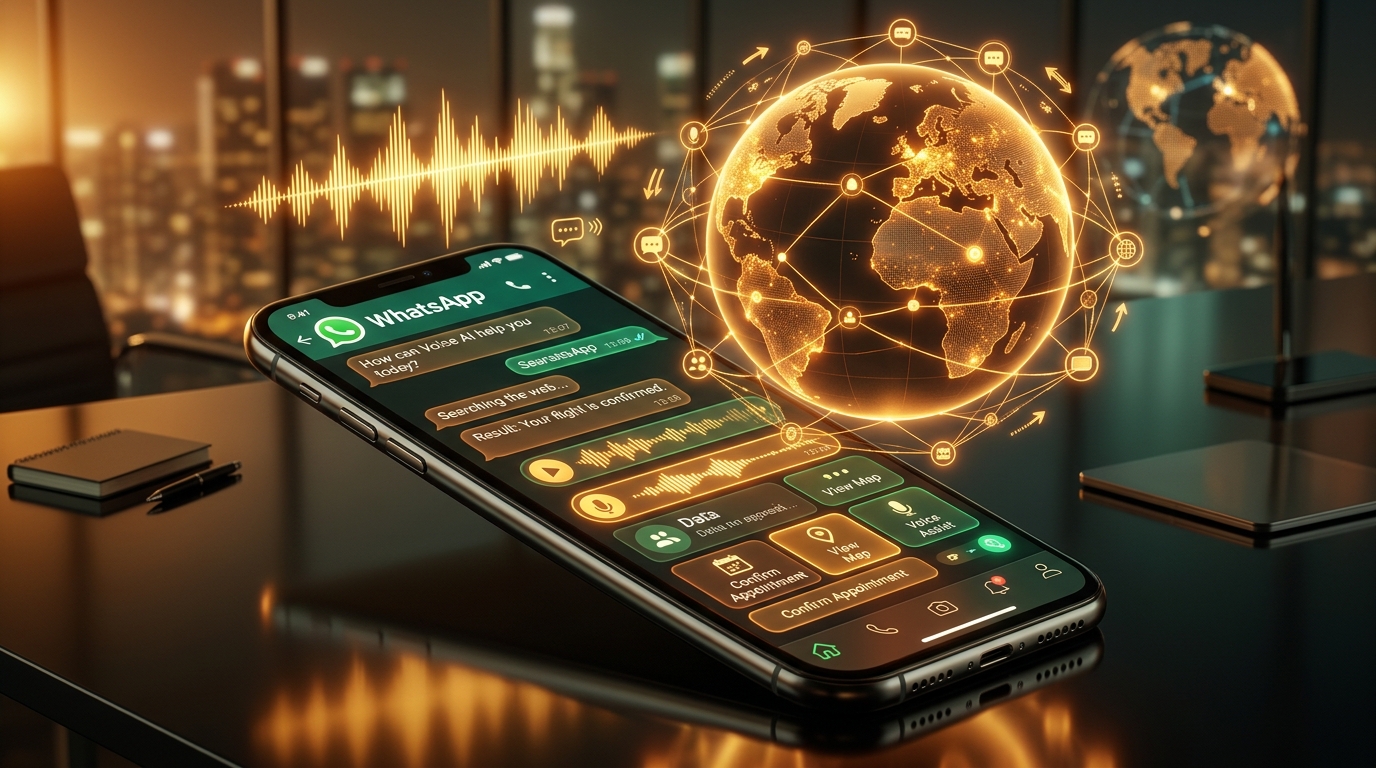
In 2026, enterprise commerce experienced a seismic transformation dubbed the WhatsApp Economic Gravity. Instead of requiring users to download an e-commerce app, register an account, navigate complex product filters, and enter credit card credentials on a web checkout form, autonomous WhatsApp agent swarms execute the entire transactional lifecycle inside the chat conversation:
Autonomous WhatsApp In-Chat Commerce Journey (SyncFlo Core)
According to conversational commerce industry benchmarks for 2026, brands migrating from traditional web funnels to autonomous WhatsApp agent flows report a 4.2x increase in checkout conversion rates and a 68% reduction in cart abandonment.
3. Vernacular Language Equity & Democratization for 3.4 Billion People
The most profound humanitarian and economic consequence of the Voice AI and WhatsApp convergence is the eradication of the digital literacy barrier.
For decades, the global digital economy excluded over one billion semiliterate, illiterate, or vernacular-speaking individuals who could not navigate complex English-dominated user interfaces, drop-down menus, and text-dense authentication forms. In countries like India, Brazil, Indonesia, Nigeria, and Mexico, everyday citizens were forced to rely on predatory middlemen to access government welfare subsidies, purchase agricultural insurance, or obtain small business loans.
In 2026, SyncFlo Voice AI and WhatsApp autonomous swarms process speech natively in over 130 regional languages and vernacular dialects, effortlessly parsing complex colloquial code-switching such as:
- Hinglish: Blending Hindi grammar with English commercial terminology across Northern and Central India.
- Spanglish: Fluid switching between Spanish and English across Hispanic commercial communities in the Americas.
- Pidgin & Swahili: Enabling frictionless agricultural market updates for smallholder farmers across East and West Africa.
A farmer in rural Karnataka can record a 10-second WhatsApp voice note in Kannada inquiring about real-time market mandi prices for ragi millet, and receive an instant voice reply, current pricing trends, and a contract transport confirmation, all backed by authenticated digital verification.
4. Sector-by-Sector Revolution: Healthcare, Banking & Emergency Dispatch
Healthcare Tele-Triage & Prescription OCR
In healthcare, the emergency triage bottleneck has long overwhelmed clinic telephone switchboards. In 2026, municipal healthcare systems and insurance providers deploy multimodal WhatsApp agents:
- Handwritten Prescription Ingestion: A patient snaps a photograph of a physician’s handwritten prescription. The agent’s edge vision model performs OCR, resolves pharmacology drug interactions against the patient's EHR, and queries local pharmacy inventories.
- Acoustic Respiratory Analysis: If a caller contacts the triage hotline coughing or displaying shortness of breath, the Direct S2S model analyzes acoustic biomarkers (cough frequency, vocal tremor, forced expiratory volume cues) to prioritize urgent emergency dispatch before the caller even completes their sentence.
Banking & Instant Voice Micro-Underwriting
Legacy banking required unbanked entrepreneurs to visit brick-and-mortar branches with stacks of paper documentation. In 2026, digital microfinance institutions leverage WhatsApp voice underwriting. An auto-rickshaw driver or street market merchant engages in a 90-second conversational voice interview over WhatsApp in their mother tongue. The agent evaluates repayment intent, verifies national digital identity tokens via zero-knowledge proofs, audits utility payment history, and disburses working capital loans directly into their digital wallet within three minutes.
5. The Omnichannel Handoff: Unifying Phone Calls and WhatsApp Threads
One of the greatest operational nightmares of the customer journey was the context gulf between telephony and digital messaging. If a customer called a company and subsequently tried to resolve the issue over chat, they were treated as a stranger, forced to repeat account numbers, order details, and historical complaints.
The 2026 SyncFlo Unified Session Fabric merges telephony and WhatsApp into a continuous, synchronized communication channel:
Imagine a customer speaking with an airline Voice AI agent while driving. The agent rebooks their canceled flight in real-time over the phone. When the customer needs to pick their seat, the voice agent states: "I've sent an interactive aircraft seat map directly to your WhatsApp. Just tap your preferred seat." As the customer taps 14B on WhatsApp, the voice agent instantly confirms: "Seat 14B confirmed. Your boarding pass is now in your WhatsApp wallet."
No app download. No SMS verification links. Zero lost context. Just fluid, uninterrupted ambient intelligence across voice and chat.
6. Conclusion: The World After the Screen
For forty years, computing required human beings to conform to machine conventions: keyboards, mice, graphical windows, URLs, and mobile application stores.
In 2026, the machine has finally learned human convention. Voice AI and WhatsApp autonomous agents represent the emergence of an ambient operating system where natural speech and intuitive chat messages are the universal command-line of human life and global business. The organizations that embrace this conversational singularity are not merely saving customer service costs—they are capturing the commercial and cultural future of the connected world.