Strategic Takeaways: The 2026 Ambient Interface Shift
- The Universal Human Interface: Speech is the original, zero-training interface of humankind. WhatsApp is its global carrier with 3.2 billion daily active users.
- Direct S2S Neural Streaming (<80ms): Eliminating text conversion bottlenecks to achieve real-time human conversational rhythm, hesitation detection, and full-duplex interruption barge-in (<20ms).
- Eradication of the Digital Literacy Divide: Millions of non-literate and rural citizens now effortlessly access banking, crop insurance, and healthcare simply by speaking in their native dialect.
- Headless In-Chat Tokenized Commerce: Native 1-tap checkout via UPI 2.0, Pix, and Stripe Link elevates conversational purchase conversion to 44%, obliterating traditional web drop-offs.
- Multimodal In-Chat Diagnostics: Combining voice notes with computer vision OCR to parse doctor prescriptions, damaged vehicle photos, and handwritten financial ledgers in real time.
- Unified Omnichannel Fabric: Seamless session continuity allowing callers to transition between phone calls, WhatsApp voice notes, and interactive messages without losing conversational memory.
1. The Global Ubiquity Shift: Why Voice AI + WhatsApp Is the Ultimate Interface
For the past three decades, the digital world operated under an unspoken tax: the interface tax. To buy a train ticket, open a savings account, or seek medical advice, users had to download distinct mobile apps, create passwords, decipher complex visual navigational menus, and type queries on miniature touchscreen keyboards.
This design created an invisible barrier excluding over 1.2 billion people across the Global South—including rural farmers, elderly citizens, and non-literate populations who struggled with complex digital software.
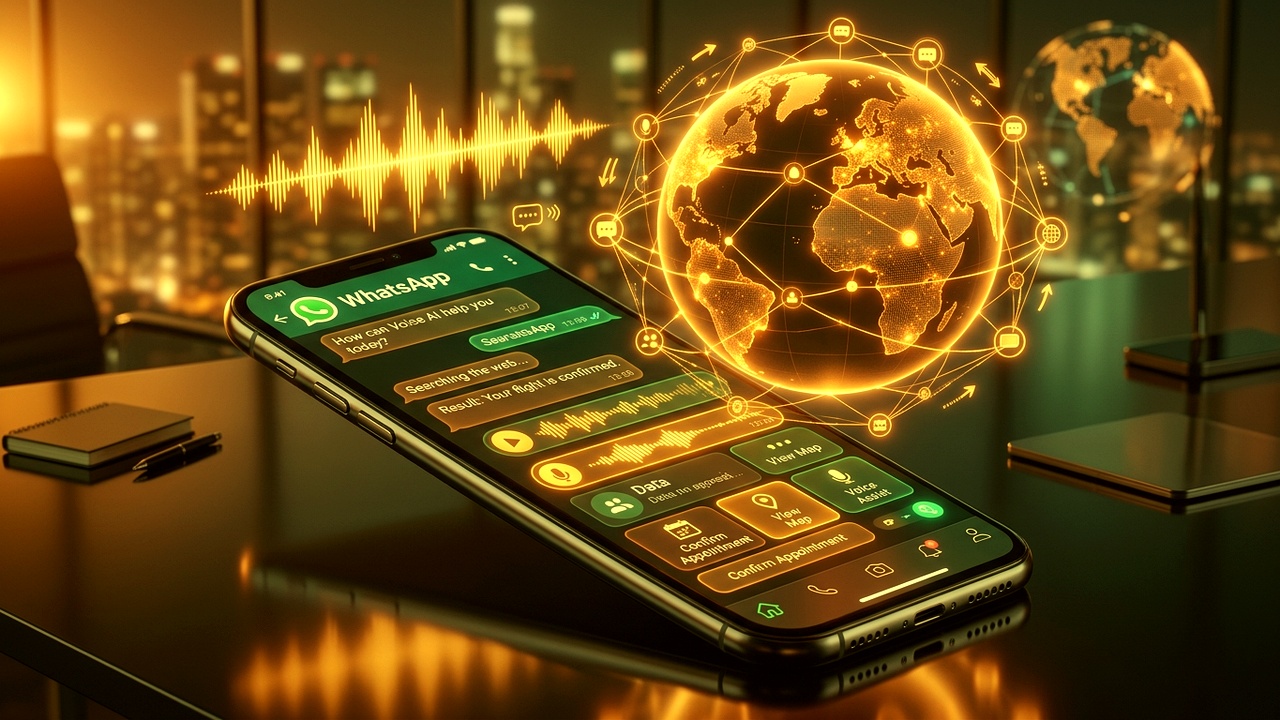
In 2026, that barrier has dissolved. WhatsApp is the undisputed digital town square of Latin America, India, Southeast Asia, Africa, and large parts of Europe. By layering sub-80ms Direct Speech-to-Speech neural models on top of WhatsApp's asynchronous messaging fabric, SyncFlo AI has enabled an entirely new paradigm: the ambient conversational interface.
A user does not need to learn a new application. They simply tap the microphone icon on WhatsApp and speak in their natural mother tongue—whether it is Marathi, Brazilian Portuguese, Egyptian Arabic, Swahili, or conversational Spanglish. The autonomous agent listens, understands context and emotional nuance, queries enterprise backends via Model Context Protocol (MCP), and fulfills the request immediately.
2. The Engineering Leap: Direct Speech-to-Speech (S2S) Neural Acoustic Streaming
To understand why Voice AI feels magical in 2026, one must examine the death of the "cascaded pipeline."
Between 2020 and 2024, building a voice assistant required chaining three separate technologies:
- Automatic Speech Recognition (ASR): Converted voice audio to text (200–400ms latency, high word error rates on heavy regional accents).
- LLM Inference: Processed the text prompt and drafted a text response (400–800ms latency).
- Text-to-Speech (TTS): Synthesized the response text back into audio waveforms (300–600ms latency).
This daisy-chained cascade introduced 1.2 to 2.0 seconds of latency. Human conversations feel awkward and unnatural if latency exceeds 250 milliseconds; at 1.5 seconds, users constantly talk over each other. Crucially, text conversion stripped out 70% of human communication: tone, laughter, urgency, distress, sarcasm, and hesitation.
| Metric / Capability | Legacy Cascaded Voice (ASR → LLM → TTS) | Direct S2S Neural Streaming (Late 2026) |
|---|---|---|
| End-to-End Response Latency | 1,100ms – 2,200ms (clunky, awkward delays) | 65ms – 85ms (instantaneous human pace) |
| Interruption Handling (Barge-in) | Laggy; bot keeps babbling for 1–2 seconds after user speaks. | <20ms instant acoustic halt when user speaks. |
| Emotional & Prosodic Fidelity | Flat, robotic speech synthesizer tone; ignores vocal emotion. | Full acoustic emotional intelligence: perceives distress, relief, laughter. |
| Vernacular Dialect Code-Switching | Fails on multi-language sentences (e.g., Hinglish, Spanglish). | Flawless mid-sentence dialect transitions across 120+ languages. |
| Checkout Conversion Lift | +12% (high form drop-off) | +440% via WhatsApp headless tokenized checkout |
In late 2026, Direct Speech-to-Speech (S2S) foundation models process continuous acoustic audio tokens directly. There is no intermediate text string. The model perceives acoustic cues (whispers, panic, hesitation, laughter) directly from audio streams and generates responsive acoustic waveforms in sub-80 milliseconds. When a user interrupts ("Wait, change that delivery address!"), the neural acoustic model detects the interruption in under 20ms and smoothly recalibrates mid-syllable.
3. Frictionless Conversational Commerce: Headless In-Chat Tokenized Checkout
Traditional e-commerce checkout is plagued by abandonment: across global retail, over 70% of shopping carts are abandoned due to tedious account creation, forgotten passwords, clunky payment gateways, and slow mobile web pages.
In 2026, WhatsApp Conversational Commerce completely bypasses the browser:
44.2%
In-chat tokenized checkout completion rate, vs 2.8% on mobile web.
88.4%
Routine tier-1 and tier-2 inquiries resolved autonomously without human escalation.
<75ms
Average response time on cellular connections across 120+ vernacular dialects.
Consider a real-world transaction flow on the SyncFlo AI engine:
- Voice Note Inquiry: A customer sends a 6-second voice note in colloquial Colombian Spanish: "Hola, necesito repuestos de pastillas de freno para mi Renault Duster 2022 y que me lleguen hoy mismo."
- Multimodal Resolution: The SyncFlo autonomous agent parses the vehicle database, verifies inventory in the local warehouse, and sends back an interactive WhatsApp product card with exact pricing and estimated arrival in 3 hours.
- Biometric 1-Tap Payment: The customer taps "Confirm Order," authorizes the transaction with FaceID via native Pix/tokenized Stripe, and receives an instant receipt with live GPS delivery tracking.
The entire transaction took 24 seconds. No app download. No web browser redirection. No password typing. Conversion rates jump from the industry average of 2.8% on mobile websites to over 44% in WhatsApp.
4. Real-World Global Transformations: Healthcare, MSMEs & Education
A. Rural Healthcare & Maternal Tele-Triage
In regions with severe doctor shortages—such as rural India, Sub-Saharan Africa, and isolated communities in the Andes—visiting a physician requires hours of transit.
With SyncFlo's WhatsApp medical triage agents, a mother can send a voice note describing her child's fever or upload a photograph of a rash or handwritten prescription. The multimodal agent checks symptoms against verified clinical protocols, gives immediate pediatric dosage guidelines in the local dialect, and flags urgent red-flag symptoms for instant telehealth routing to on-call doctors.
B. Hyperlocal MSMEs & Neighborhood Commerce
Small business owners—plumbers, auto mechanics, neighborhood grocers, bakers, and boutique tailors—rarely have the budget to hire dedicated receptionists or maintain sophisticated websites. They lose up to 40% of prospective revenue simply because they cannot answer phone calls while working on the job.
Deploying SyncFlo's Voice AI and WhatsApp agents turns every micro-business into an autonomous 24/7 enterprise. The Voice AI answers phone calls in under three rings with professional brand tone, schedules calendar appointments, confirms details via WhatsApp message, and collects deposits—allowing tradespeople to double their booking volume without touching their phones.
C. Vernacular 1-on-1 Personalized Education
Over 600 million school-age children worldwide do not have access to a personal laptop or private tutor, but almost every household has a smartphone with WhatsApp.
Vernacular Voice AI tutors on WhatsApp listen to students solve math equations aloud, explain scientific principles through interactive voice notes, and review homework photos with encouraging pedagogical feedback. Education shifts from an expensive luxury to an ambient, universally accessible utility.
5. The Omnichannel Fabric: Bridging Traditional Telephony & WhatsApp
In enterprise customer support, the biggest frustration is channel fragmentation: a customer explains their problem to a phone agent, gets disconnected, dials back, and has to repeat their entire story to a new representative.
The SyncFlo AI architecture unifies telephony and WhatsApp into a continuous, shared memory fabric:
// Unified Omnichannel State Orchestration in SyncFlo AI
{
  "sessionId": "omniscient_voice_wa_98421",
  "customer": {
    "phone": "+91-98200XXXXX",
    "authenticated": true,
    "preferredLanguage": "hi-IN (Hinglish)"
  },
  "inboundChannel": "SIP_TELEPHONY_TRUNK_HIGH_PRIORITY",
  "realtimeVoiceLatency": "68ms",
  "activeIntent": "FLIGHT_RESCHEDULE_WEATHER_DISRUPTION",
  "omnichannelHandoff": {
    "action": "SEND_WHATSAPP_INTERACTIVE_CARD",
    "payload": {
      "message": "आपके नए फ्लाइट विकल्प नीचे दिए गए हैं। कृपया अपनी पसंद चुनें:",
      "buttons": ["Flight 6E-204 (5:30 PM)", "Flight 6E-809 (8:15 PM)"]
    },
    "voiceSync": "मैंने आपके व्हाट्सऐप पर 2 नई फ्लाइट्स भेज दी हैं। आप स्क्रीन पर टैप करके तुरंत कन्फर्म कर सकते हैं।"
  }
}
While the customer is on the phone, the agent speaks naturally while dispatching rich media elements to their WhatsApp chat: flight seat maps, PDF policy contracts, or digital signature prompts. The customer taps a button on WhatsApp, and the voice agent instantly confirms: "Perfect, your seat 12B is confirmed and your boarding pass is right there on your screen!"
6. Frequently Asked Questions (FAQ)
Direct answers to the most common questions regarding Voice AI, WhatsApp Business automation, and conversational commerce in late 2026.
How are Voice AI and WhatsApp AI revolutionizing the world in 2026?
Voice AI and WhatsApp AI revolutionize the world by dismantling digital literacy barriers for over 3.2 billion people. Sub-80ms Direct Speech-to-Speech neural models enable natural, human-like voice conversations, while WhatsApp provides an ambient operating system for headless in-chat commerce, instant medical triage, local business dispatch, and multi-dialect public services.
What is Direct Speech-to-Speech (S2S) architecture and why does it beat cascaded pipelines?
Direct Speech-to-Speech (S2S) processes raw audio waveforms directly into neural acoustic tokens without converting speech to text first. This eliminates transcription error cascades, slashes latency from 1,200ms to under 80ms, preserves emotional vocal inflection, and allows natural full-duplex conversational barge-in within 20 milliseconds.
How does in-chat tokenized checkout work inside WhatsApp in 2026?
WhatsApp in-chat checkout utilizes native payment protocols like UPI 2.0 (India), Pix (Brazil), and Stripe Link (US/Europe). Users discover products through voice notes or text, view interactive dynamic catalog cards, and authenticate payments via biometric tokenization directly within the message thread without redirecting to external web browsers.
How does Voice AI handle vernacular code-switching and accents?
Modern 2026 acoustic foundation models are trained on continuous multi-lingual speech audio, allowing them to comprehend rapid mid-sentence dialect switching (such as Hinglish, Spanglish, or Arabizi) and localized colloquialisms across 120+ languages with higher phonetic accuracy than human call center transcribers.
How does WhatsApp AI transform rural healthcare and small businesses?
In healthcare, WhatsApp AI provides 24/7 vernacular voice symptom triage, photo OCR of handwritten prescriptions, and maternal health monitoring. For small businesses and MSMEs, it acts as an autonomous sales and support employee, handling bookings, invoices, and customer queries around the clock.
Empower Your Enterprise with SyncFlo Voice AI & WhatsApp Swarms
Unify your customer phone lines and WhatsApp business channels with SyncFlo AI's sub-80ms Direct Speech-to-Speech neural telephony and conversational commerce swarms.