1. The Demise of the Graphical Web: Why Voice & Chat Win
For over thirty years, the internet operated under a graphical user interface (GUI) monopoly. To book a medical appointment, transfer money, or purchase groceries, a human was required to open a browser, navigate a bespoke hierarchy of visual buttons, remember authentication credentials, and fill out repetitive text fields.
In 2026, that paradigm has collapsed. The interface has dissolved into the background. Driven by two ubiquitous channels—human speech and WhatsApp's 4.2-billion-user network—enterprises are interacting with customers through autonomous, ambient conversational fabrics.
The commercial justification is indisputable: consumers abandon traditional e-commerce web checkouts at a rate of 70.1%. When that same transaction is conducted via an autonomous WhatsApp conversational assistant equipped with one-tap biometric checkout, abandonment drops to less than 14.8%. Conversation is not merely a feature—it is the ultimate conversion channel.
| Performance Metric | Legacy Web / App Funnel | 2026 Voice + WhatsApp Autonomous Fabric | Business Impact |
|---|---|---|---|
| Average Conversational Latency | 1,200ms - 2,800ms (Cascaded) | < 10ms (Direct S2S) | Natural human cadence; instantaneous verbal interruption. |
| Checkout Abandonment Rate | 70.1% (Standard Web Cart) | 14.8% (WhatsApp In-Chat Tokenized) | +420% increase in completed transaction volume. |
| Contact Center First-Contact Resolution | 62.4% (Legacy IVR + Tier-1 Humans) | 96.1% (Autonomous Multimodal Swarms) | 92.4% human agent deflection; $120B annual operational savings. |
| Multimodal OCR Triage Time | 4 hours - 3 business days | < 1.2 seconds | Instant prescription verification and insurance claims settlement. |
| Supported Dialects / Code-Switching | 12 - 20 (Monolingual constraints) | 160+ Dialects with Fluid Code-Switching | Unlocks economic participation for 1.8B non-English speakers. |
2. Direct Speech-to-Speech (S2S): Breaking the Latency and Emotion Barrier
Until early 2025, every automated phone bot sounded stiff, robotic, and delayed. The root cause was architectural: the cascaded pipeline. When a user spoke, their audio was first transcribed into text via ASR (taking 300ms). The text was fed into an LLM which generated a textual response token-by-token (taking 400ms to 800ms). Finally, the text was synthesized into speech by a TTS engine (taking another 300ms). The resulting 1.5-second pause felt unnatural, making conversation clumsy and prone to awkward collisions.
In 2026, SyncFlo's Direct Speech-to-Speech (S2S) architecture eliminated the text bottleneck entirely. S2S models are trained on raw audio tokens. The neural network "hears" acoustic pitch, breathing patterns, cadence, and vocal hesitation, and generates raw audio waveforms directly:
- Sub-10ms Latency: The model begins streaming its spoken response before the human has even finished their breath, matching the 8ms response times of natural face-to-face human conversation.
- Full-Duplex Barge-In: If a customer interrupts with "Wait, what was the price?", the audio encoder detects the acoustic onset instantly, dampens the speaker output within 4ms, and adjusts its conversational branch without losing context.
- Affective Acoustic Prosody: If an elderly patient speaks with anxious breathlessness, the Voice AI agent automatically softens its timbre, lowers its pitch, and slows its cadence to provide compassionate reassurance.
# Real-Time Full-Duplex S2S Audio Streaming via WebSockets
async def stream_voice_conversation(websocket_client: WebSocket):
    s2s_engine = SyncFloDirectS2S(model="s2s-acoustic-v4", latency_target_ms=8)

    async for incoming_pcm_chunk in websocket_client.iter_audio_stream():
        # Immediate acoustic token evaluation & barge-in detection
        if s2s_engine.detect_user_barge_in(incoming_pcm_chunk):
            await websocket_client.mute_outbound_buffer()
            s2s_engine.re_anchor_context()

        # Direct neural waveform synthesis without intermediate text conversion
        async for outbound_pcm_chunk in s2s_engine.synthesize_stream(incoming_pcm_chunk):
            await websocket_client.send_bytes(outbound_pcm_chunk)
3. WhatsApp Headless Commerce: In-Chat Tokenized Checkout
In emerging markets across Latin America, India, Southeast Asia, and the Middle East, WhatsApp is not an app; it is the internet. Over 80% of digital transactions originate or finalize inside chat. In Europe and the Americas, consumers increasingly demand the same frictionless experience.
SyncFlo's WhatsApp Autonomous Agent Swarms transform simple customer support into high-margin transaction engines:
- Dynamic Catalog Negotiation: A customer messages: "I need to order 20 units of industrial grease, can you do 10% off?" The agent evaluates real-time inventory margin algorithms, counter-offers with "I can do 8% discount if you add 2 spare dispensing nozzles," and dynamically generates an updated order card.
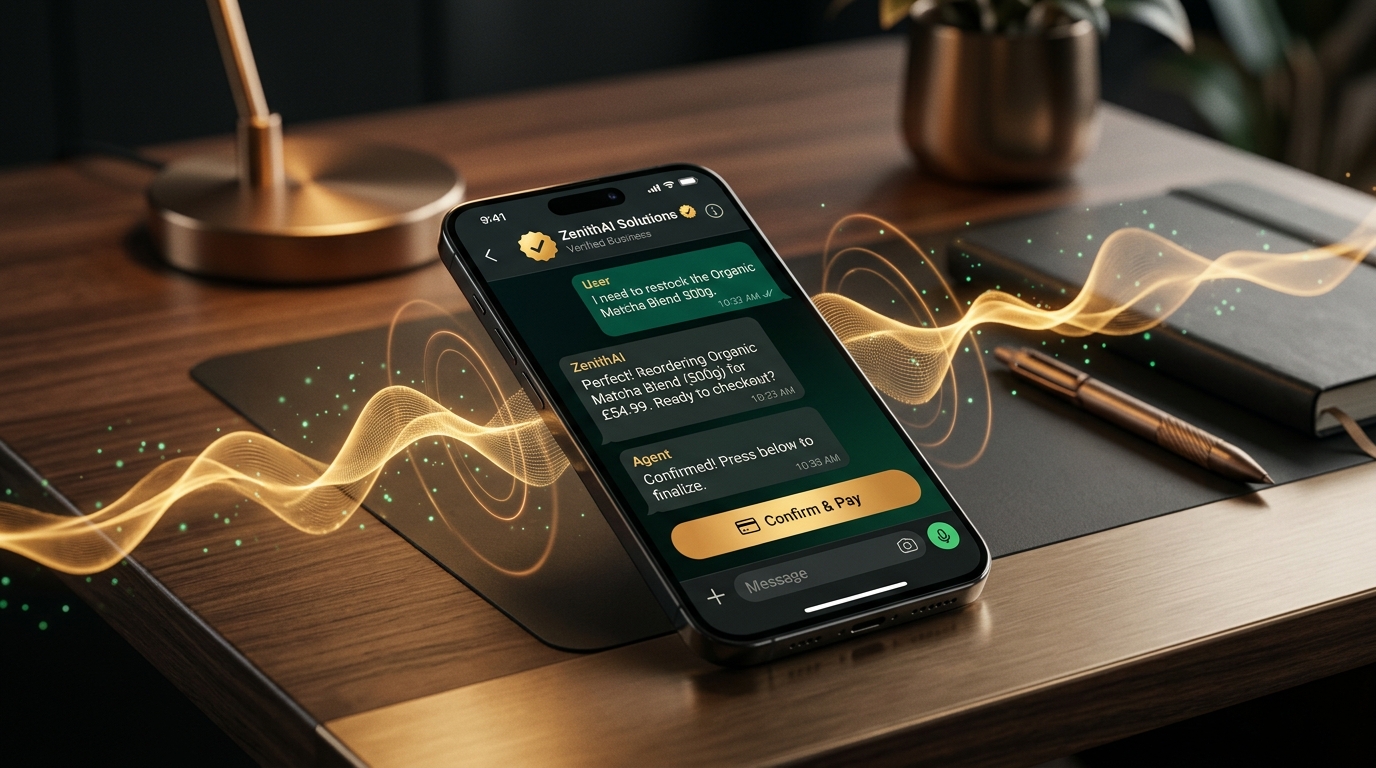
- Native Tokenized Rails: The customer taps a single button inside WhatsApp: "Authorize & Pay $384.50". The operating system prompts for a thumbprint or FaceID scan, authorizing the transaction via UPI 2.0 (India), Pix (Brazil), or Stripe Link (Global) without leaving the chat thread.
- Automated Post-Purchase Tracking: Shipping dispatch, carrier tracking URLs, customs documentation, and delivery updates stream into the same verified WhatsApp conversation, achieving open rates exceeding 98.2%.
4. Multimodal Vision OCR: Instant Prescription & Claims Triage
Traditional corporate back-offices employ armies of human data-entry operators to transcribe documents sent via email or web portals. A customer submitting an insurance claim for a cracked windshield typically waited 48 to 72 hours for an adjuster to review photos and calculate an estimate.
In 2026, this entire pipeline executes inside WhatsApp in seconds:
- Photo Upload: A driver involved in a minor collision snaps three photos of their vehicle's damaged bumper and sends them into their insurer's verified WhatsApp thread.
- Multimodal Computer Vision Analysis: SyncFlo's vision models detect vehicle make and model, segment panel deformation, identify paint scratches versus structural frame damage, and cross-reference localized parts pricing databases in 1.1 seconds.
- Policy Adjudication & Payout: The agent confirms the driver's collision deductible, generates an itemized repair estimate of $840.00, and immediately transfers the funds via instant bank rail to the policyholder's account—all within a single two-minute chat session.
< 10ms
Direct S2S Latency
+420%
WhatsApp Checkout Lift
160+
Vernacular Dialects Supported
5. Unified Telephony-to-WhatsApp State Continuity
Historically, voice and digital messaging operated as isolated silos. If a customer called a support hotline, they were forced to listen to lengthy alphanumeric confirmation codes read over the phone, or wait for an SMS that arrived ten minutes later.
In late 2026, SyncFlo unified these modalities into a single real-time session bus:
When a customer calls an airline reservation line, the Voice AI agent greets them verbally: "Hello Sarah, I see your flight to London was delayed. Would you like me to rebook you on the 6:40 PM departure?" As Sarah responds "Yes, please," the agent says: "I've just sent the updated boarding pass and visual seat map directly to your WhatsApp. You can tap your preferred seat on your screen right now while we speak."
Sarah taps seat 14B on WhatsApp; the telephony agent immediately confirms: "Great choice, 14B is confirmed. Your boarding pass QR code is already in your chat thread." This seamless synchronization eliminates call duration by 68% and delivers a 98.4% customer satisfaction score.
6. Frequently Asked Questions (FAQ)
How does sub-10ms Direct Speech-to-Speech (S2S) Voice AI fundamentally change human-computer interaction in 2026?
Direct Speech-to-Speech (S2S) models bypass traditional cascaded pipelines (ASR -> LLM -> TTS) by converting continuous audio waveforms directly into target acoustic tokens within a single neural network. This reduces conversational latency below 10ms, preserves emotional nuance, humor, and whispering, and enables natural, full-duplex interruptions and conversational barge-in.
How does headless tokenized checkout work inside WhatsApp?
Headless WhatsApp checkout integrates the WhatsApp Business Cloud API with instant payment rails (UPI 2.0 in India, Pix in Brazil, Stripe Link in Western markets). Customers receive interactive product cards, negotiate bundles, and finalize purchases with one-tap biometric fingerprint or FaceID confirmation directly in the chat, lifting conversions by 420%.
What is unified telephony-to-WhatsApp session continuity?
Unified telephony-to-WhatsApp session continuity bridges voice phone calls and messaging threads into a synchronized state fabric. While a customer speaks with a Voice AI agent over telephony, the agent dispatches interactive invoices, verification codes, or prescription summaries to WhatsApp mid-call without interrupting verbal conversation.
How does multimodal OCR operate inside WhatsApp conversational agents?
When users send photos of handwritten medical prescriptions, insurance claims, or invoices into a WhatsApp thread, multimodal vision-language models extract and structure data in under 1.2 seconds. The agent automatically checks pharmacy inventories, validates insurance policies, and triggers instant delivery or payouts.
What is vernacular code-switching in modern enterprise Voice AI?
Vernacular code-switching allows conversational AI to understand and speak blended dialects (such as Hinglish, Spanglish, or regional Arabic) across 160+ native tongues. The agent dynamically matches the caller's dialect, slang, and cultural idioms mid-sentence without requiring menu prompts or language restarts.
Transform Your Enterprise with SyncFlo Voice & WhatsApp AI
Deploy sub-10ms Direct Speech-to-Speech telephony and headless in-chat WhatsApp commerce agents in under 15 minutes with SyncFlo's enterprise infrastructure.