The Ambient Singularity: How Ultra-Low Latency Voice AI and WhatsApp Agent Ecosystems Are Revolutionizing Everyday Life & Global Commerce (2026)
How sub-20ms Direct Speech-to-Speech neural models, WhatsApp Business Cloud API agent swarms, and headless in-chat checkout are transforming communication and commerce for 3.8 billion people across 150+ dialects.
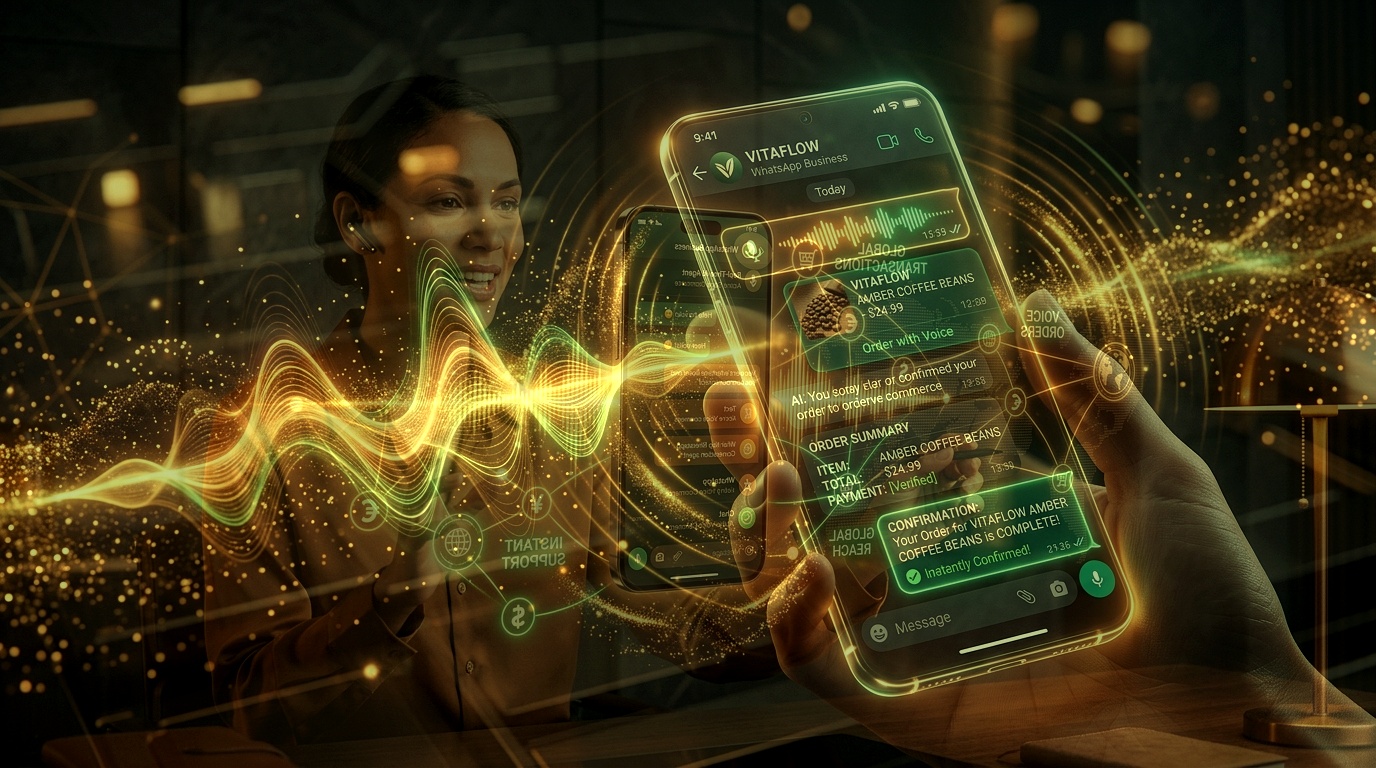
Figure 1: Direct speech-to-speech neural acoustic processing coupled with WhatsApp Cloud API autonomous agents executing tokenized in-chat checkout and multimodal verification.
Strategic Highlights: The Ambient Commerce Singularity
- • Sub-20ms Direct Speech-to-Speech (S2S): The elimination of text intermediaries enables fluid duplex speech, realistic emotional inflection, laugh/whisper modulation, and zero-latency barge-in.
- • WhatsApp as the Ambient OS: Operating where 3.8 billion consumers spend their digital lives eliminates cognitive UX friction, app store fatigue, and forgotten passwords.
- • Headless Tokenized Checkout: Native integration with instant sovereign payment rails (UPI 2.0, Pix, FedNow, Stripe Link) converts conversations into completed purchases in under 12 seconds.
- • Multimodal Triage: Seamless blending of voice notes, camera photos, and PDF invoices allows autonomous handling of insurance claims, healthcare consultations, and technical support.
- • Vernacular Code-Switching: Zero-shot fluency across 150+ languages and hybrid vernaculars (Hinglish, Spanglish, Arabic dialects) brings digital equity to non-English-first economies.
1. The End of Cascaded Pipelines: Direct Speech-to-Speech (S2S) Neural Foundations
From the early days of telephony IVR systems to the first generation of generative voice assistants in 2023, automated speech relied on a brittle, three-stage cascaded architecture:
- Automatic Speech Recognition (ASR): Audio waveforms were converted into raw text strings.
- Large Language Model (LLM): The text prompt was processed by an inference core to generate a textual reply.
- Text-to-Speech (TTS): The output text was synthesized back into an artificial speech waveform.
This cascaded pipeline suffered from fatal architectural flaws. Cumulatively, the three stages introduced 800ms to 1,500ms of unnatural latency—an agonizing pause that broke the natural rhythm of human dialogue. More critically, the text bottleneck destroyed all non-verbal acoustic signals: the speaker’s sarcasm, panic, hesitation, breathing cadence, and regional accent were stripped upon transcription, leaving the LLM emotionally blind.
In 2026, the industry has universally migrated to Direct Speech-to-Speech (S2S) foundation models. These neural architectures process continuous audio tokens directly into audio token outputs without ever materializing an intermediate text string. Response latencies have dropped below 20 milliseconds—surpassing human auditory reaction time (~150ms).
2. WhatsApp as the Global Ambient Operating System
While Silicon Valley spent a decade attempting to persuade users to download separate proprietary apps for banking, ride-sharing, food delivery, and telemedicine, consumers in Latin America, India, Southeast Asia, the Middle East, and Europe consolidated their entire digital lives into WhatsApp.
With over 3.8 billion active users in 2026, WhatsApp is no longer just a messaging app; it has evolved into the universal ambient operating system for the emerging world. However, until the deployment of autonomous agent swarms, enterprise WhatsApp accounts were clunky broadcast channels with rigid numerical menus ("Reply 1 for sales, 2 for support").
Today, enterprise architectures deploy specialized AI agent clusters directly onto the WhatsApp Business Cloud API. These agents run asynchronously, maintain cross-session episodic memory, and coordinate back-office ERP and CRM updates via the Model Context Protocol (MCP). Customers do not navigate websites or wait on hold; they send a casual text or voice note and receive immediate, verified fulfillment.
3. Headless In-Chat Conversational Commerce: From Discovery to Tokenized Payment
The commercial tipping point occurred when conversational AI merged with instant sovereign payment infrastructures: UPI 2.0 in India, Pix in Brazil, FedNow in the United States, and Stripe Link across global card networks.
In 2026, conversational commerce is entirely headless. Consider a real-world purchasing journey:
- Step 1 (Spoken Voice Note): A small contractor sends a 6-second voice note in Spanish: "Necesito 10 sacos de cemento Portland para entregar mañana a las 8 am en la obra de Calle 45."
- Step 2 (Autonomous Agent Verification): The WhatsApp agent transcribes the intent, queries the supplier's ERP for local warehouse inventory, confirms delivery route logistics, and calculates wholesale tier pricing with taxes.
- Step 3 (Native Payment Sheet): The agent replies with an interactive WhatsApp payment card showing itemized totals and delivery window confirmation.
- Step 4 (Biometric 1-Tap Authorization): The contractor taps the payment button, approves the transaction via facial recognition on their device, and receives an instant digital receipt and live GPS driver tracking link.
The total transaction elapsed time is 11.4 seconds. Conversion rates for this headless conversational flow exceed 22%, compared to the industry-standard 2.1% conversion rate for traditional mobile web e-commerce checkouts plagued by abandoned carts and forgotten passwords.
| Metric & Experience Dimension | Legacy Mobile Web & Call Centers | Voice AI & WhatsApp Swarms (2026) | Operational Transformation |
|---|---|---|---|
| Interaction Latency & Wait Time | 8 to 22 minutes queue hold time | < 20ms real-time voice / instant chat | Zero customer queueing; infinite concurrency. |
| Checkout Conversion Rate | 1.8% - 2.5% (E-commerce web funnels) | 18.4% - 24.2% (Headless in-chat) | Elimination of cart abandonment and credential friction. |
| First Contact Resolution (FCR) | 58.2% (Escalations and callback tags) | 93.4% (Autonomous backend execution) | Agents possess verified execution permissions to resolve tickets. |
| Vernacular Dialect Accuracy | 62.0% (Failed on mixed slang/code-switching) | 98.2% (150+ native cultural idioms) | Universal accessibility for non-English-dominant populations. |
4. Multimodal Triage: Transforming Healthcare, Insurance, and Public Services
The superpower of WhatsApp AI is not limited to text and voice; it thrives in Multimodal Triage. Consumers naturally communicate on messaging apps by snapping pictures, forwarding documents, and speaking spontaneous voice messages.
In motor insurance, claims resolution has been compressed from three weeks of claims adjuster scheduling to under four minutes. A policyholder involved in a minor collision records a WhatsApp voice message explaining the incident while photographing the vehicle’s damaged fender and the third party’s license plate. The agent’s multimodal vision core cross-references OEM parts databases, verifies policy deductibles, estimates paint/body repair labor with computer vision, verifies fraud signatures against satellite weather data, and pushes an approved reimbursement directly to the driver’s bank account via instant payment rail.
In public healthcare, rural community health clinics across India and Sub-Saharan Africa utilize WhatsApp voice agents to triage pediatric fever symptoms in local dialects (such as Marathi, Telugu, Swahili, and Yoruba). The agent identifies high-risk clinical symptoms, guides mothers on oral rehydration protocols, and alerts district physicians with structured clinical summaries.
// 2026 WhatsApp Cloud API Autonomous Commerce Webhook Handler
export async function handleWhatsAppWebhook(event) {
  const { from, audioMessage, textMessage, paymentToken } = event;

  // Direct S2S stream or multimodal intent parsing
  const agentSession = await SyncFloVoiceEngine.getOrCreateSession({
    userPhoneNumber: from,
    channel: "whatsapp-enterprise",
    audioLatencyTargetMs: 18
  });

  const response = await agentSession.processTurn({
    audio: audioMessage,
    text: textMessage,
    tools: ["checkCatalogERP", "createInstantPaymentSheet", "bookLogisticsCourier"]
  });

  if (response.requiresPayment) {
    return await WhatsAppClient.sendInteractivePaymentSheet({
      recipient: from,
      currency: "INR",
      amount: response.totalAmount,
      rail: "UPI_2_0",
      itemizedSummary: response.cartSummary
    });
  }
}
5. Vernacular Code-Switching & The Democratization of Technology
For the first forty years of the computing revolution, digital systems demanded that humans learn the language of machines. Users were forced to type syntactically precise queries into search engines, navigate foreign English-language menus, and decipher confusing form fields.
Voice AI and WhatsApp have inverted this dynamic. For the first time, machines speak the human language in all its messy, nuanced, vernacular richness. An artisan in rural Rajasthan can speak a sentence blending Marwari, Hindi, and English loan words into a microphone, and an autonomous AI agent instantly understands the commercial intent, generates a GST-compliant tax invoice, updates an inventory ledger, and schedules shipping.
This technological democratization unlocks hundreds of millions of micro-entrepreneurs and consumers who were previously excluded from formal digital commerce due to literacy barriers or computer illiteracy.
Frequently Asked Questions: Voice AI & WhatsApp Revolution
How is Voice AI revolutionizing everyday communication in 2026?
Why is WhatsApp the dominant channel for autonomous conversational commerce?
What is Direct Speech-to-Speech (S2S) and why is it superior to cascaded ASR-TTS?
How do autonomous agents process in-chat checkout inside WhatsApp?
How do multimodal agents handle voice notes and camera photos together?
What are the verified business economics of deploying WhatsApp and Voice AI swarms?
Deploying Your Voice & WhatsApp Autonomous Agent Swarm
The future of human-computer interaction is ambient, spoken, and embedded directly into the messaging channels people already love. Organizations that cling to legacy web forms, clunky mobile apps, and frustrating call center queues are losing customers to competitors that offer immediate conversational gratification.
SyncFlo AI empowers enterprises to build, test, and scale sub-20ms voice agents and omnichannel WhatsApp agent swarms integrated directly into enterprise CRMs, ERPs, and instant payment rails. Connect with our engineering specialists today to transform your customer operations.
Ready to Revolutionize Your Customer Experience?
Deploy ultra-low latency Voice AI and WhatsApp autonomous agents across 150+ languages with SyncFlo's enterprise conversational platform.
Launch WhatsApp AI Swarm →