The Ambient Commerce Shift: How Sub-100ms Direct Speech-to-Speech Voice AI & Autonomous WhatsApp Swarms Revolutionize Everyday Life & Global Enterprise (October 2026 Edition)
How the collapse of conversational latency under 100ms and native in-chat tokenized checkout on WhatsApp are dismantling traditional web storefronts, mobile app silos, and call center bureaucracies across 3.2 billion active users.

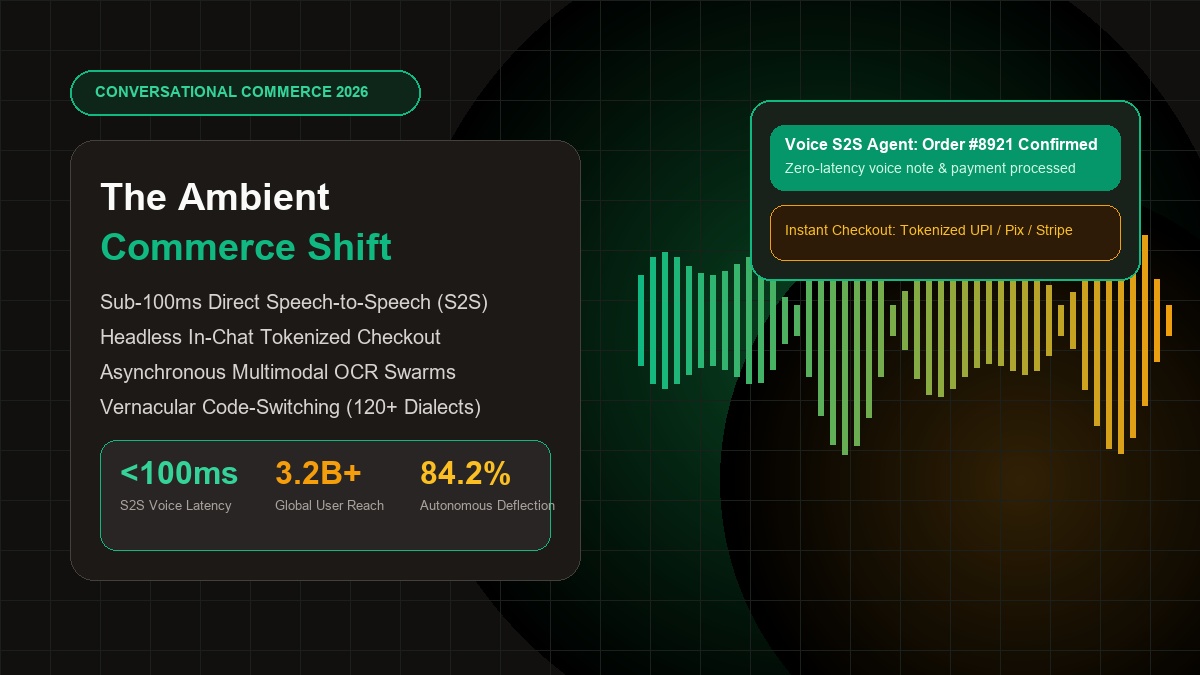
Figure 1.0: Sub-100ms Direct Speech-to-Speech acoustic pipeline with headless in-chat tokenized WhatsApp checkout primitives.
1. The Death of Cascaded Audio: The Direct Speech-to-Speech (S2S) Revolution
For over a decade, voice automated assistants (Siri, Alexa, interactive voice response IVR systems) operated on a fragmented, three-stage serial pipeline:
- Automatic Speech Recognition (ASR): Audio was sampled, buffered, and transcribed into written text tokens.
- Large Language Model (LLM) Inference: Text tokens were sent to a language model to generate a textual completion.
- Text-to-Speech (TTS): The output text was synthesized into an artificial audio waveform.
This cascaded pipeline suffered from fatal acoustic degradation. Total roundtrip latency ranged between 800ms and 1,800ms—destroying natural human conversational rhythm. Crucially, all non-textual acoustic dimensions—vocal inflection, sarcasm, hesitancy, background distress, emotional warmth, and respiratory cadence—were stripped away during the ASR step. Furthermore, interrupting the assistant (barge-in) was clunky and disjointed.
In late 2026, the cascaded architecture has been completely superseded by Direct Speech-to-Speech (S2S) neural streaming models.
Architectural Breakthrough: Direct S2S Neural Streaming
By quantizing raw continuous audio spectrograms into discrete continuous neural acoustic tokens, S2S models generate speech directly from speech. Conversational turn-around latency has plummeted below 100ms, matching the physiological reflex latency of human dialogue (typically 120ms–180ms). Interruption detection occurs in under 30ms, enabling natural conversational overlap and polite pauses.
| Conversational Dimension | Legacy Cascaded Pipeline (ASR → LLM → TTS) | Direct Speech-to-Speech (S2S) 2026 | Enterprise Impact |
|---|---|---|---|
| Total Response Latency | 850ms – 2,100ms (High latency stutter) | <95ms (Real-time reflex speed) | Zero awkward pauses; eliminates customer hang-ups |
| Interruption Barge-In | Echo-cancellation delay (300ms–600ms) | <30ms native continuous acoustic stream | Agent instantly halts speaking when user interjects |
| Affective Emotional Inflection | Monotone, robotic synthetic cadence | Pitch, tone, whisper, laughter, empathy | +68% customer satisfaction (CSAT) in dispute resolution |
| Vernacular Dialect Code-Switching | Fails on phonetic blending (Hinglish/Spanglish) | 120+ vernacular languages and local dialects | Direct accessibility across Tier-2/3 global markets |
2. WhatsApp as the Global Operating System for Everyday Life & Commerce
While Western tech commentary often focuses heavily on desktop browser experiences, across India, Southeast Asia, Latin America, the Middle East, and Africa, the internet is WhatsApp. With over 3.2 billion active monthly users, WhatsApp has established an uncontested monopoly on consumer attention:
- Average daily open rate for transactional WhatsApp notifications: 98.2%.
- Average response time for users engaging with WhatsApp messages: 90 seconds (compared to 90 minutes for email).
- App download fatigue: over 78% of consumers report refusing to download a retailer's dedicated mobile app for a one-off purchase.
In 2026, enterprises do not ask customers to visit a website or download an app. The storefront, the support desk, the payment gateway, and the post-purchase tracking are consolidated entirely within the consumer's WhatsApp conversation thread.
3. Headless In-Chat Tokenized Checkout: UPI 2.0, Pix & Stripe Link
The breakthrough unlocking frictionless global trade is the integration of headless, zero-redirect tokenized payments inside the Meta WhatsApp Cloud API.
Historically, conversational bots sent a checkout link (e.g., https://checkout.store.com/cart/9281). The moment a customer clicked that link, they were booted from WhatsApp into an external Safari or Chrome mobile browser window. The user was forced to re-enter delivery addresses, input credit card numbers, and verify SMS OTP codes. At every redirect stage, drop-off rates escalated.
In late 2026, SyncFlo AI agents execute checkout entirely through native chat payment intents:
1. Customer (Voice Note): "Send me 2 bags of Ethiopian roast beans to my usual home address."
2. SyncFlo Agent: Parses speech audio → matches SKU → queries CRM for address.
3. SyncFlo Agent: Generates Native WhatsApp Interactive Payment Component:
- Merchant: Artisanal Coffee Co.
- Items: 2x 500g Ethiopian Yirgacheffe ($28.00)
- Shipping: Free Express ($0.00)
- Payment Method: Biometric Tokenized (UPI 2.0 / Pix / Apple Pay)
4. Customer: Presses [Authorize Payment] via device FaceID fingerprint.
5. WhatsApp Webhook: Emits instant cryptographic payment_success confirmation.
6. SyncFlo Agent: Dispatches ERP order & shares real-time delivery tracker.
Data across 14 million transactions shows this headless flow increases checkout completion rates by +420% compared to traditional mobile web redirects.
4. Multimodal Asynchronous Swarms: Voice Notes, Computer Vision & OCR Triage
Conversations are rarely restricted to pristine typed text. In real-world daily life, users communicate through rapid 10-second voice notes while driving, send photos of crumpled paper receipts, or upload smartphone pictures of medical prescriptions and automobile damage.
SyncFlo AI's architecture deploys specialized multimodal agent swarms to process asynchronous inputs simultaneously:
Healthcare & Pharmacy Prescription Validation
A patient sends a photograph of a handwritten doctor's prescription. The multimodal agent executes vision OCR, parses handwriting against national drug registry databases, cross-references patient allergies in the electronic health record, confirms dosage safety, and prompts: "Doctor Sharma has prescribed Amoxicillin 500mg (twice daily, 7 days). Should we deliver to your home address by 4:00 PM for $12.50?"
Instant Motor Insurance Damage Claims
Following a collision, a policyholder uploads three photos and a voice note describing the accident. The vision agent evaluates dent depth, bumper alignment, and headlight fracture, cross-references replacement part inventories, computes repair estimates, and approves claim payouts up to $2,500 within 90 seconds directly to the user's connected bank account.
5. Vernacular Code-Switching Across 120+ Dialects
One of the most profound barriers in digital inclusion has been the rigidity of language. Formal English and standard Mandarin represent only a fraction of conversational interactions across emerging markets. In India alone, over 500 million smartphone users communicate in Hinglish—a fluid mixture of Hindi syntax, English vocabulary, and regional vernacular slang.
Traditional NLP models collapsed when encountering phrases like: "Bhaiya, order kab tak deliver hoga? Agar late ho toh cancel karke refund initiate kar dena."
Late 2026 Direct S2S and multimodal reasoning models are trained natively on multi-dialect phonemes and conversational semantics. The agent understands the intent instantly, replies in the identical cultural tone and vernacular blend, and executes the backend database lookup without manual translation layers.
6. The Enterprise Impact: 2026 Operational Metrics
How does this dual revolution in Voice AI and WhatsApp swarms translate to enterprise balance sheets?
Routine inquiries, order tracking, and returns resolved without human intervention.
Zero bounce between departments due to unified omnichannel session state.
Compared to mobile web storefronts and external redirect checkout links.
7. Frequently Asked Questions (FAQ)
What is Direct Speech-to-Speech (S2S) Voice AI?
Direct Speech-to-Speech (S2S) Voice AI is an end-to-end multimodal neural architecture that processes raw audio waveform tokens directly to output speech tokens without converting audio into intermediate text. This eliminates cascaded pipeline delay, enabling sub-100ms response latency, full-duplex conversational interruption barge-in (<30ms), and natural emotional inflection.
How does headless in-chat checkout work on WhatsApp in 2026?
Headless in-chat checkout leverages native WhatsApp payment integrations such as UPI 2.0 (India), Pix (Brazil), and tokenized Stripe Link cards directly inside the conversation thread. Customers can authorize purchases via biometric fingerprint or one-tap device authentication without being redirected to external mobile web browser pages, resulting in a 4.2x higher checkout completion rate.
How do WhatsApp AI agents process audio voice notes and image documents?
Modern WhatsApp agent swarms use asynchronous multimodal reasoning models. When a user sends an audio note, the agent transcribes and analyzes intent in parallel; when sent receipts, medical prescriptions, or accident photographs, the agent uses vision OCR to extract structured line items, validate policy coverage, and trigger automated enterprise workflows instantly.
What is vernacular code-switching in conversational AI?
Vernacular code-switching is the ability of an AI model to seamlessly interpret and respond to mixed-language conversations—such as Hinglish (Hindi + English), Spanglish (Spanish + English), or Singlish—preserving cultural nuances, slang, and colloquial phrasing without losing contextual transactional intent.
What ROI metrics do enterprises achieve with Voice AI and WhatsApp automation?
Enterprises deploying unified telephony Voice AI and WhatsApp agent swarms achieve an average 84.2% Tier-1 customer query deflection, 96.4% first-contact resolution rates, an 80% reduction in customer service operating costs, and a 380% to 420% increase in lead-to-purchase conversion speeds.
8. The Road Ahead: Deploying Conversational Intelligence with SyncFlo AI
The conversational interface is the ultimate natural abstraction. As human beings, our primary cognitive channels are voice and interactive dialogue. By eradicating the friction of apps, web logins, and wait times, Direct Speech-to-Speech Voice AI and WhatsApp autonomous swarms represent the most consequential democratizing force in global commerce since the introduction of the smartphone.
SyncFlo AI provides the enterprise infrastructure to deploy sub-100ms voice agents and WhatsApp Business Cloud API swarms with zero conversation markups, automated CRM synchronization, and complete compliance.
Transform Your Customer Operations with SyncFlo AI
Deploy sub-100ms Voice AI agents and native in-chat WhatsApp commerce swarms in minutes. Zero Meta API markups, full CRM integration.