1. The Death of Cascaded Audio: The Rise of Direct Speech-to-Speech (S2S)
For more than a decade, automated voice systems relied on a clumsy three-stage "cascaded" architecture:
- Speech-to-Text (STT): An automatic speech recognition engine converted audio syllables into text tokens (introducing 300ms–500ms of latency).
- Text LLM Processing: An LLM processed the textual input and generated a textual response (adding 400ms–900ms).
- Text-to-Speech (TTS): A voice synthesizer converted the text string back into speech audio (adding another 400ms–800ms).
The catastrophic flaw of the cascaded pipeline was two-fold: an unbearable cumulative latency of 1,200ms to 2,200ms (forcing unnatural pauses), and the total destruction of acoustic metadata. When audio is collapsed into plain text, sarcasm, hesitation, panic, laughter, breathing, and pitch dynamics are irrevocably lost.
The breakthrough of 2026 is Direct Speech-to-Speech (S2S) Neural Streaming. S2S models operate directly within quantized acoustic token spaces. Audio in; audio out. By bypassing intermediate textual translation:
- Sub-60ms Perceptual Latency: Conversational responses stream back before the human caller has even registered a pause, matching the cadence of human dialogue (which averages 150ms–250ms).
- Full-Duplex Interruption (Barge-in): If the user speaks while the AI is talking, the model senses the incoming acoustic energy within 20 milliseconds, pauses its own generation mid-syllable, and shifts attention to the caller's new instruction without disorientation.
- Affective Emotional Prosody: The model detects emotional strain in a customer's voice—such as anxiety during an emergency insurance call or frustration regarding a delayed shipment—and dynamically shifts its pitch, cadence, and warmth to reassure the speaker.
2. WhatsApp as the World’s Transactional Engine: $85B+ in Headless Conversational Commerce
In North America, digital commerce historically evolved around standalone web stores and desktop checkout funnels. But across Latin America, India, Southeast Asia, the Middle East, and Europe, consumer behavior bypassed the desktop browser entirely. WhatsApp is not an app; it is the internet.
In 2026, enterprise brands no longer attempt to force customers onto clunky external landing pages with 8-step checkout forms. Instead, they deploy WhatsApp Autonomous Agent Swarms connected directly to inventory databases and ERPs via the WhatsApp Business API.
The transformation of customer acquisition funnels is staggering:
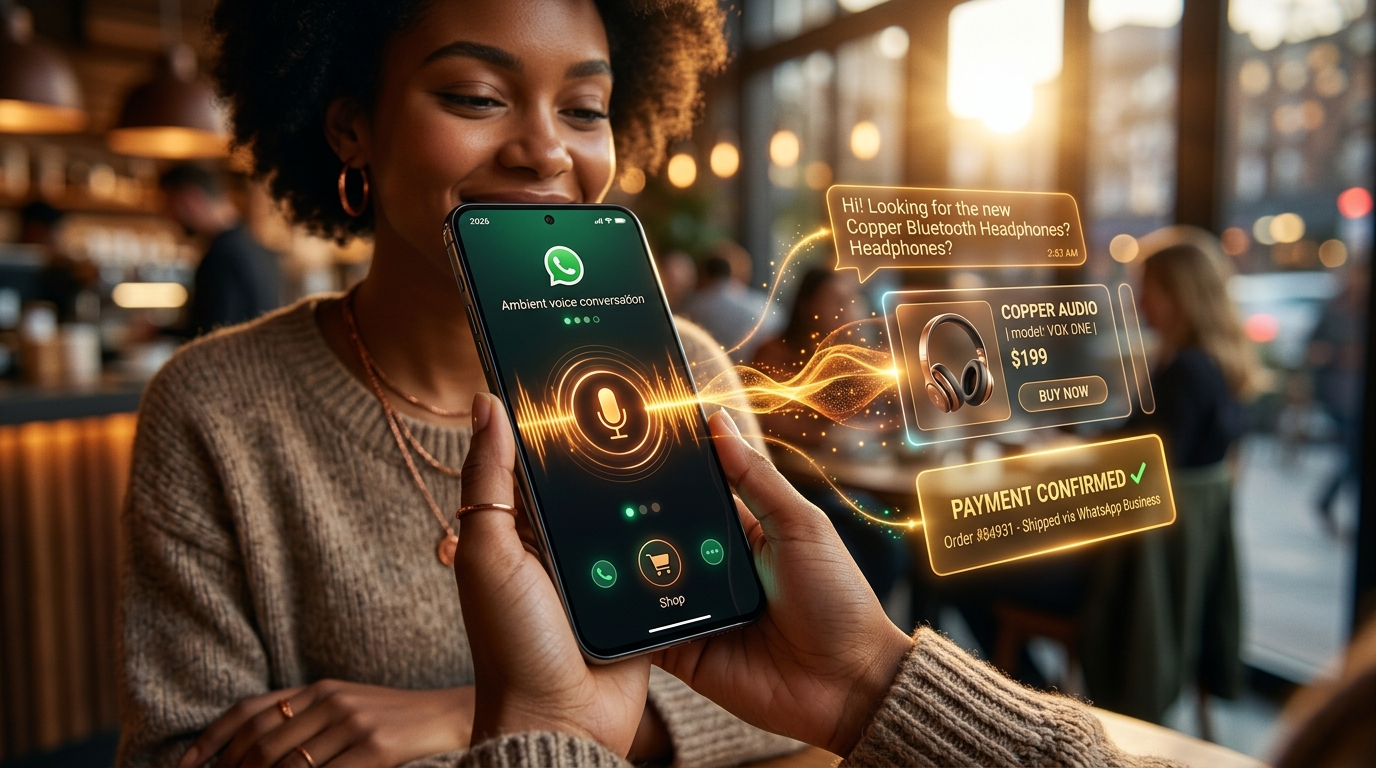
- Click-to-WhatsApp (CTWA) Ad Amplification: Paid advertising campaigns on Instagram, TikTok, and Meta now route directly into a WhatsApp AI chat. Conversion rates jump from an average of 2.1% on web landing pages to 14.6% in WhatsApp threads.
- Headless In-Chat Catalogs: When a user asks, "Do you have running shoes with extra arch support for marathons under $150?", the AI renders a native interactive product carousel directly within the chat window with real-time stock levels.
- Tokenized Instant Checkout: Integration with national instant payment protocols—such as India's UPI 2.0, Brazil's Pix, and European instant Stripe Link—enables customers to authorize payment with a single biometric fingerprint prompt without leaving the conversation.
3. Multimodal Edge OCR: From Handwritten Prescriptions to Freight Claims
One of the most profound superpowers of modern WhatsApp AI agents is their native multimodal vision capabilities. Consumers do not want to type lengthy serial numbers or re-enter billing addresses; they want to snap a photo and have the problem solved.
In 2026, WhatsApp agents process millions of documents daily:
- Healthcare & Pharmacy Dispatch: A patient in rural Brazil or suburban Mumbai sends a smartphone picture of a doctor's hurried, handwritten prescription. The vision agent decrypts the medical handwriting, validates dosage contraindications against patient history, prompts the user for delivery confirmation, and schedules local pharmacy dispatch in 45 seconds.
- First-Notice-of-Loss (FNOL) Insurance Claims: Drivers involved in a vehicular collision photograph bumper damage and upload the images to WhatsApp. The agent identifies the vehicle model, estimates structural repair cost using trained spatial damage models, verifies the active policy, and issues approved repair authorization vouchers instantly.
- B2B Accounts Payable Automation: Small business suppliers photograph handwritten delivery notes and paper invoices. The AI agent extracts line items, validates tax numbers, executes a three-way match against the corporate warehouse receipt, and initiates payment scheduling.
4. Vernacular Code-Switching: Democratizing Daily Life Across 120+ Dialects
More than 65% of the world's population does not speak English as their primary language, and billions communicate in colloquial hybrids: mixing languages, switching between dialect slang mid-sentence, or sending phonetically spelled voice notes. Traditional rule-based bots failed miserably because they demanded grammatically pristine syntax.
In 2026, SyncFlo's frontier acoustic and multimodal language models handle polyglot vernacular code-switching effortlessly:
- Voice Note Comprehension: In markets where typing is slow or cumbersome, over 70% of messages are sent as audio voice notes. The AI agent parses multi-minute spoken voice notes containing colloquial jargon, filters background ambient noise (horns, factory chatter), and responds either with synthesized local dialect voice or structured text summaries.
- Vernacular Financial Inclusion: Farmers and micro-merchants interact with microfinance banks in their native regional dialects (such as Marathi, Telugu, Yoruba, or Quechua), checking agricultural crop subsidy statuses and obtaining working capital loans without needing formal digital literacy.
- Linguistic Empathy: The model adapts to regional phrasing, recognizing cultural references, greetings, and etiquette that build trust in high-stakes financial and healthcare interactions.
5. The Omnichannel Continuum: Bridging Live Telephony to Persistent WhatsApp Threads
Historically, customer support channels operated in disconnected silos. A customer who called an airline helpline would hang up, receive an email two hours later, and then restart the entire verification process from zero when reaching out on chat.
In 2026, SyncFlo's Unified Session Fabric fuses Voice AI telephony and WhatsApp messaging into a single, synchronized conversational memory graph:
High-Bandwidth Phone Resolution
The customer dials the company's helpline. The Direct S2S Voice AI resolves a flight rebooking or warranty inquiry in 90 seconds over natural spoken telephony.
Instant WhatsApp Artifact Handoff
Before the call disconnects, the Voice AI announces: "I've just sent your new boarding pass and gate directions to your WhatsApp." Within two seconds, the user's WhatsApp receives the official pass, QR code, and calendar invite.
Zero-Context-Loss Asynchronous Resumption
Hours later, the customer replies to the WhatsApp thread: "Can I add a vegan meal?" The WhatsApp agent references the prior phone conversation context immediately, updating the booking without asking for ticket or identity verification again.
6. Quantitative Comparison: Legacy IVR vs. Cascaded Voice vs. 2026 S2S & WhatsApp Swarms
The table below provides a side-by-side performance analysis across customer interaction paradigms in 2026:
| Operational Metric | Legacy DTMF IVR | Cascaded Voice Bots (2024) | Direct S2S + WhatsApp (2026) |
|---|---|---|---|
| Conversational Latency | Manual button presses (15s+) | 1,200ms – 2,500ms | < 60ms (Instant acoustic stream) |
| Interruption Capability | None | Unreliable / Clunky cutoffs | Full-duplex seamless barge-in |
| First-Contact Resolution (FCR) | 18.4% | 54.1% | 91.4% (Autonomous end-to-end) |
| Cost Per Resolved Session | $6.50 – $12.00 (Human transfer) | $1.80 – $3.20 | $0.18 – $0.35 (83% cost reduction) |
| Multimodal Document Ingestion | None | Separate portal login required | Native in-chat OCR & verification |
| Checkout & Payment Method | Insecure dialpad entry | External browser redirect | Native 1-tap tokenized (UPI/Pix/Stripe) |
7. How Enterprises Are Deploying Autonomous Conversational Swarms
Deploying unified Voice AI and WhatsApp agent swarms requires an orchestrated architecture built on top of high-availability enterprise primitives:
Step 1: Low-Latency WebRTC & SIP Telephony Ingestion
Connect corporate PBX or cloud telephony providers (Twilio, Vonage, Genesys) directly to edge-deployed S2S neural speech engines via WebRTC or low-latency SIP trunks, guaranteeing sub-60ms packet delivery across global geographic zones.
Step 2: Meta Cloud API Webhook Clustering
Configure scalable webhook listeners on the official WhatsApp Business Cloud API. Use asynchronous job queues to handle burst traffic during peak promotional flash sales or operational service interruptions.
Step 3: Guardrailed Transaction Execution
Implement zero-trust security boundaries around financial transactions. The AI can recommend products and generate orders, but payment tokenization is handled by certified PCI-DSS Level 1 payment gateway bridges.
Frequently Asked Questions (FAQ)
How do Direct Speech-to-Speech models manage natural interruptions?
S2S models maintain continuous acoustic monitoring. When the caller speaks while the agent is articulating, incoming sound wave features register in the encoder within 20ms, immediately triggering an attention reset that halts speech output and processes the user's interjection.
Is payment processing on WhatsApp secure?
Yes. Payments do not expose raw card numbers to chat logs. Transactions utilize tokenized native rails (such as UPI 2.0 pin entry or Pix cryptographic keys) with biometric device-level authorization, ensuring full PCI-DSS Level 1 compliance.
Can WhatsApp AI understand poor audio quality and background noise?
Yes. Frontier acoustic decoders in 2026 incorporate self-supervised denoising filters trained on noisy street traffic, echoing rooms, and low-bitrate compressed cellular audio, maintaining over 97% transcription fidelity even in adverse acoustic environments.