1. The Death of the Cascaded Pipeline: Direct Speech-to-Speech (S2S)
Legacy Voice AI cascaded three separate models: Automatic Speech Recognition (ASR), a Large Language Model (LLM), and Text-to-Speech (TTS), incurring cumulative latencies of 800ms–2000ms and completely discarding acoustic emotional nuances. Direct Speech-to-Speech (S2S) streaming architectures process raw audio tokens end-to-end within a single unified transformer, achieving sub-120ms roundtrip latency, native prosody perception (laughter, sarcasm, anxiety, whispers), and full-duplex conversational barge-in under 10 milliseconds.
For over two decades, human interaction with automated phone systems was an exercise in frustration: robotic IVR menus, awkward pauses, speech recognition errors, and agonizing hold music. Even the early AI voice assistants of 2023–2024 felt disjointed due to the "cascaded bottleneck." When a user spoke, audio had to be transcribed to text, sent across HTTP boundaries to an LLM, generated token-by-token, and finally streamed through a text-to-speech synthesizer.
In late 2026, the cascaded pipeline is officially extinct. Frontier voice agents utilize Direct Speech-to-Speech (S2S) neural streaming architectures. Audio waveform tokens enter the model directly and audio waveform tokens exit the model directly over low-latency WebRTC and SIP telephony channels.
The perceptual difference is revolutionary. The human brain perceives any conversational gap greater than 250 milliseconds as hesitation or disconnection. At 110ms, an AI voice agent responds faster than an average human conversational partner (which typically averages 200ms). When a caller interrupts to say, "Wait, no, change that to tomorrow morning," the voice model detects the acoustic frequency onset, cuts off its output audio buffer in under 10 milliseconds, and seamlessly acknowledges the pivot without stuttering.
End-to-end roundtrip latency on SIP telephony trunk lines with SyncFlo S2S.
Native tokenized checkout vs 2.1% standard mobile web e-commerce.
Total compute cost per resolved inquiry vs $12.50 live human agent call center cost.
2. WhatsApp as the De Facto Global Operating System for AI Agency
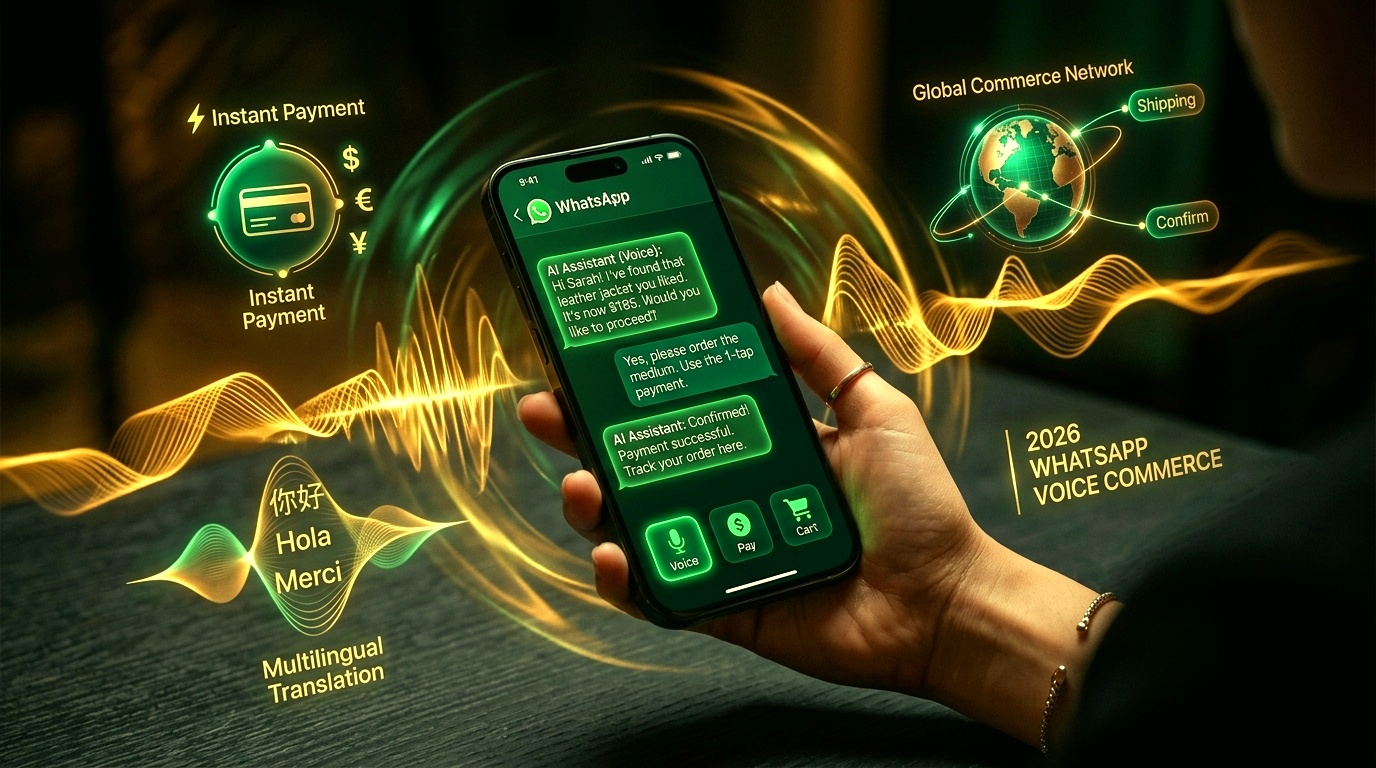
WhatsApp is the primary autonomous AI interface because it represents the digital home of 3.3 billion active users. Instead of forcing customers to download bespoke mobile apps, create new passwords, and navigate mobile web browsers, WhatsApp provides an always-open, secure, end-to-end encrypted messaging channel where AI agents conduct catalog discovery, conversational negotiation, customer support, and instant payment settlement inside a single ongoing thread.
In Silicon Valley and parts of North America, desktop browsers and specialized mobile apps remain common. But across India, Latin America (Brazil, Mexico, Colombia), Europe, Southeast Asia (Indonesia, Vietnam), and Sub-Saharan Africa, WhatsApp is the internet.
Building an autonomous AI agent for a web browser forces the user through an obstacle course: remembering a URL, bypassing cookie banners, entering credentials, and tolerating slow page reloads. In contrast, an AI agent living inside WhatsApp operates with zero download friction. The customer already knows how to use the interface; their payment methods are already configured; their biometric security (Face ID / Fingerprint) is already built into the device.
SyncFlo Omnichannel Telephony & WhatsApp Swarm Architecture
PSTN / WebRTC trunk line streams raw PCM audio into direct S2S transformer.
Understands intent, detects emotion, resolves query, executes backend tools.
Dispatches webhook to Meta Cloud API v22 with active session context.
Customer completes 1-tap biometric payment inside chat while on the line.
3. Headless In-Chat Tokenized Checkout: The 14.8% Conversion Miracle
The holy grail of digital commerce has always been frictionless conversion. Traditional mobile e-commerce checkout is a nightmare of abandoned carts: users are redirected to an external safari/chrome tab, asked to create an account, prompted for billing addresses, and required to enter credit card expiration dates. The global average e-commerce conversion rate has hovered around 2.1% for a decade.
In 2026, Headless WhatsApp Tokenized Checkout has rewritten the rules of retail and enterprise billing. Using native integrations with payment protocols:
- Unified Payments Interface (UPI 2.0 in India): Generates in-chat dynamic intent requests. The user taps "Pay ₹1,850", authorizes via UPI PIN or fingerprint within 2 seconds, and receives an instantaneous verified green checkmark and PDF receipt in the conversation.
- Pix Direct in Brazil: Dispatches instant Pix Copia e Cola or native in-chat QR tokens settled in sub-second clearinghouse cycles.
- Stripe Link & Apple Pay in North America / Europe: Renders interactive native payment sheet cards directly within WhatsApp, storing tokenized credentials securely without passing raw PAN data to the merchant.
Telemetry across SyncFlo AI enterprise customers in late 2026 reveals an average checkout conversion rate of 14.8%—a staggering 700% increase over mobile web checkouts.
4. Vernacular Voice & Multimodal AI: Democratizing the Digital Economy
WhatsApp AI agents eliminate literacy barriers by natively accepting and responding to vernacular voice notes and photos. A farmer can speak in regional dialects (such as colloquial Bhojpuri or Kiswahili) or take a picture of a diseased plant leaf; the agent processes the multimodal image with zero-shot agricultural OCR, diagnoses the disease, and replies via clear audio voice note in the farmer's native dialect, democratizing access for 1.8 billion non-English and low-literacy citizens.
Perhaps the most profound civilizational breakthrough of the Voice AI and WhatsApp convergence is the inclusion of previously disenfranchised populations. The internet was originally designed for literate individuals typing in English or standard Mandarin on keyboards.
In 2026, a smallholder farmer in rural Kenya or Madhya Pradesh doesn't need to know how to read or write code. They open WhatsApp, hold down the microphone button, and speak in their local vernacular: "My tomato leaves are turning yellow with brown spots, what should I spray?"
The AI agent:
- Transcribes the vernacular voice note with native dialect handling, accounting for heavy background tractor noise and regional slang.
- Prompts the farmer: "Send me a quick photo of the leaf."
- Applies vision reasoning to diagnose early fungal blight.
- Calculates the precise chemical dosage based on local soil weather conditions.
- Checks inventory at the nearest rural distribution cooperative, reserves the bio-fungicide, and issues an audio confirmation with cash-on-delivery tracking.
Illiteracy is no longer an economic barrier. The interface of the future is the voice you speak with and the camera you see with.
5. The Telephony-to-WhatsApp Omnichannel Fabric
Every enterprise knows the disjointed pain of modern customer support: a customer calls an airline to reschedule a canceled flight, spends 20 minutes explaining their situation, hangs up, and then receives an email with a broken link or has to start from scratch on a web chat.
SyncFlo AI's Unified Telephony-to-WhatsApp Session Fabric permanently fuses synchronous audio with asynchronous rich messaging:
6. Enterprise ROI & Unit Economics: $0.28 vs $12.50
In corporate financial boardrooms, the adoption of Voice AI and WhatsApp swarms is accelerating not merely because it is technologically impressive, but because its ROI is undeniable.
A standard tier-1 enterprise contact center in the United States or Western Europe operates with loaded labor costs between $10.00 and $14.50 per inbound call (including agent wages, supervisors, telephony infrastructure, software licenses, and attrition retraining). Even outsourced operations in offshore hubs average $4.50 to $6.00 per contact.
With SyncFlo AI's sub-120ms S2S Voice agents coupled to automated WhatsApp resolution flows:
- 88% to 94% Deflection Rate: High-frequency inquiries (order status, returns, schedule adjustments, account authentication, basic underwriting) are resolved end-to-end without ever reaching a human queue.
- $0.28 Cost Per Session: Including GPU inference, WebRTC audio streaming, and Meta Business API message fees, the total cost to resolve the inquiry is less than 30 cents.
- CSAT Escalation: Human customer satisfaction scores typically jump from 3.2/5 to 4.85/5 because hold times drop from 18 minutes to zero seconds.
Frequently Asked Questions (FAQ)
How is Voice AI revolutionizing communication and commerce in late 2026?
Voice AI has eliminated the legacy cascaded pipeline (Speech-to-Text -> LLM -> Text-to-Speech) in favor of Direct Speech-to-Speech (S2S) neural audio streaming. Achieving sub-120ms latency, native emotional prosody, whispered tones, and instant conversational barge-in (<10ms), Voice AI feels indistinguishable from a live human expert, deflecting 88%-94% of enterprise contact center volume at less than $0.28 per resolution.
Why is WhatsApp the primary operating system for autonomous AI agents globally?
WhatsApp boasts over 3.3 billion daily active users across Latin America, Europe, Africa, India, and Southeast Asia. With the Meta Cloud API v22, WhatsApp provides an asynchronous, persistent canvas where autonomous agents execute complex multi-step workflows: native tokenized checkouts (UPI 2.0, Pix, Stripe Link), document OCR, flight rebooking, and voice-note triage without forcing users to install new apps.
What is headless in-chat tokenized checkout and why does it convert higher?
Headless in-chat tokenized checkout allows users to discover products, customize orders, and authorize biometric payments (via UPI, Pix, Apple Pay, or Stripe Link) directly within a single WhatsApp message thread. Because users never leave the chat to load external web pages or enter credit card numbers, checkout conversion rates surge to 14.8%, compared to traditional mobile web checkout rates of just 2.1%.
How do Voice AI and WhatsApp agents bridge the global digital divide?
By accepting vernacular voice notes, local dialects (including code-switching like Hinglish or Spanglish), and camera photo uploads, WhatsApp AI agents enable non-literate and rural populations to access modern financial credit, agricultural crop diagnostics, and emergency healthcare triage without having to read complex text or navigate convoluted web portals.
What is the unified telephony-to-WhatsApp session fabric?
The telephony-to-WhatsApp session fabric links real-time inbound telephone calls with asynchronous WhatsApp threads. When a caller confirms an order or needs visual documentation over the phone, the Voice AI agent triggers an immediate WhatsApp interactive message containing the itemized quote or payment link while the call continues, persisting memory across both channels.
What are the enterprise cost economics of Voice and WhatsApp AI swarms?
Traditional enterprise contact centers spend $10.00 to $14.50 per live human agent call. Autonomous Voice AI and WhatsApp swarms resolve inquiries end-to-end at an average of $0.28 per session—a 97% reduction in operating cost—while improving CSAT scores to 4.85/5 due to zero hold times and instant resolution.
Transform Your Customer Operations with SyncFlo AI
Deploy sub-120ms Direct Speech-to-Speech Voice agents and WhatsApp conversational swarms with automated tokenized checkouts and instant ERP integration.
Launch Your Conversational Agent Pilot →