
1. The Death of App Fatigue and the Rise of Ambient Conversational Surfaces
Between 2012 and 2022, the digital economy operated on a singular dogma: "There's an app for that." Users were forced to download independent mobile applications for ride-sharing, food delivery, doctor appointments, banking, and utility bills. Each application required account creation, password management, push notification permissions, and unfamiliar navigation patterns.
By 2026, severe app fatigue reached critical mass. Over 84% of smartphone owners installed zero new apps per month, while mobile web checkout abandonment reached historic highs of 68.4%.
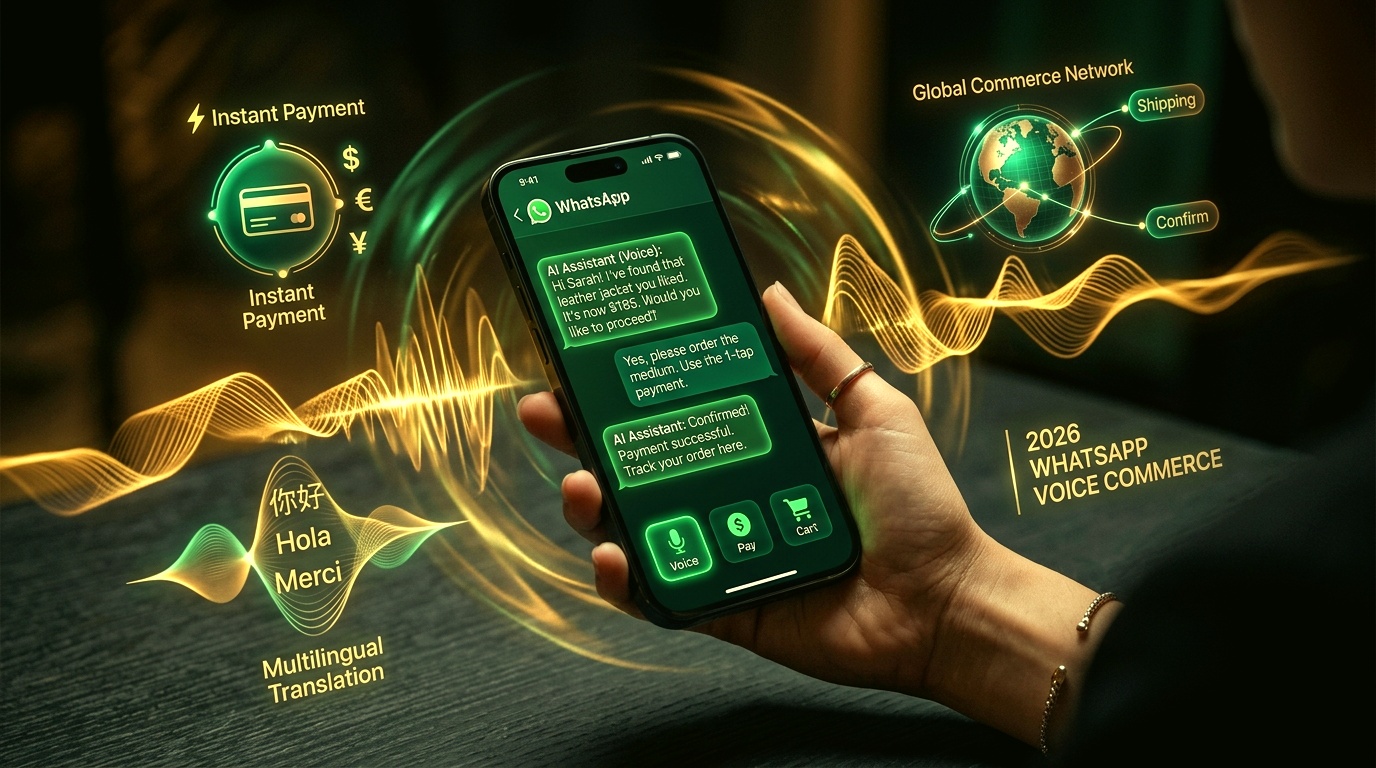
The conversational revolution solves this fragmentation by shifting computation to where humanity already resides: spoken natural language and WhatsApp. Rather than navigating five complex UI screens to book a flight or dispute a credit card fee, users speak a single sentence into their headset or send a brief WhatsApp audio note. The autonomous agent parses intent, negotiates parameters, queries enterprise databases, and completes the transaction instantly.
Well below the 300ms human conversational turn-taking barrier.
Compared to only 3.1% for traditional desktop/mobile web checkouts.
Versus $7.00–$12.00 per human agent contact center resolution.
2. The Latency Hierarchy: Why Sub-300ms Voice AI Feels Like Human Telepathy
The fundamental flaw of early "voice assistants" was latency. Cascaded architectures strung together three disparate models:
- Automatic Speech Recognition (ASR): 300ms–500ms to transcribe audio into text.
- Text LLM Inference: 400ms–900ms to process tokens and generate a response.
- Text-to-Speech (TTS): 200ms–400ms to synthesize audio waveforms.
The resulting 900ms–1,800ms total delay caused users to assume the bot hadn't heard them, leading to overlapping speech and frustrating conversational deadlocks.
| Latency Range | Perceptual Quality | Human Cognitive Reaction | Enterprise Viability |
|---|---|---|---|
| <200ms | Telepathic / Natural | Instant turn-taking; perceived as empathetic, sharp, and attentive. | Gold Standard for Sales & Triage |
| 200ms – 300ms | Fluid Conversational | Comfortable human pace; supports natural pauses and affirmations. | Production Benchmark (Late 2026) |
| 500ms – 800ms | Noticeable Hesitation | Feels like a slightly distracted human on a satellite connection. | Acceptable for Non-Urgent Support |
| >1,500ms | Jarring Breakpoint | Severe frustration; caller talks over the bot, hangs up, or curses. | Unacceptable (90%+ Abandonment) |
In late 2026, Native Direct Speech-to-Speech (S2S) models bypass text transcription entirely. Neural audio tokens are streamed continuously into an autoregressive audio foundation model. This enables:
- Sub-15ms Barge-In: If a customer interrupts the AI mid-sentence, the model pauses vocal synthesis instantly, acknowledging the interruption without auditory overlap.
- Emotional Prosody & Affect: The model detects vocal tremor, anger, or fatigue in the caller's timbre and modulates its own pitch, pace, and breath sounds to de-escalate tension.
- True Backchanneling: Emitting subtle "mm-hmm", "I see", or "got it" affirmations while the user is explaining a complex problem, reassuring the speaker that they are being heard.
3. WhatsApp as the Global Commerce Operating System for 3.3 Billion Citizens
While North American enterprise software often obsesses over email and dedicated mobile portals, the vast majority of the world—spanning Latin America, India, Europe, Southeast Asia, and Africa—lives inside WhatsApp.
In 2026, WhatsApp completed its transformation from a messaging tool into a full-stack headless commerce platform. With over 3.3 billion monthly active users and open rates exceeding 98%, businesses deploying autonomous WhatsApp agents are observing engagement rates that make traditional email marketing obsolete.
// Production Meta WhatsApp Cloud API Webhook Handler
// Autonomous In-Chat Order & Biometric Tokenized Checkout
import { WhatsAppClient, PaymentGateway, SyncFloAgent } from '@syncflo/conversational-core';

export async function handleWhatsAppWebhook(req, res) {
  const { from, message_type, content } = req.body.entry[0].changes[0].value.messages[0];

  // 1. Resolve unified customer session across voice & messaging
  const session = await SyncFloAgent.resolveCustomerSession({ phone: from });

  if (message_type === 'audio') {
    // 2. Stream audio note through sub-200ms Direct Speech Model
    const transcription = await SyncFloAgent.processVoiceNote(content.audio_id);
    content.text = transcription.intent_description;
  }

  // 3. Autonomous agent plans conversational state and inventory query
  const response = await SyncFloAgent.planResponse({
    user_input: content.text,
    session_context: session.history,
    catalog: "enterprise_erp_inventory"
  });

  if (response.intent === "PURCHASE_CONFIRMATION") {
    // 4. Generate Headless In-Chat Payment Request (UPI 2.0 / Pix / Stripe)
    const paymentToken = await PaymentGateway.createInChatToken({
      amount: response.quote.total,
      currency: response.quote.currency,
      items: response.quote.line_items
    });

    await WhatsAppClient.sendInteractivePaymentCard({
      to: from,
      order_id: response.quote.order_id,
      token: paymentToken,
      expiry_seconds: 300
    });
  } else {
    await WhatsAppClient.sendMessage({ to: from, text: response.text });
  }
  return res.status(200).send("EVENT_RECEIVED");
}
4. Telephony-to-WhatsApp Session Continuity: The Omnichannel Holy Grail
One of the most consequential architectural breakthroughs of late 2026 is Telephony-to-WhatsApp Session Continuity. Historically, a phone call and a chat thread were isolated silos: if a caller hung up, context was lost, and if they messaged support, they had to recount their history from scratch.
SyncFlo's unified conversational orchestrator establishes real-time bi-directional synchronization between the voice audio channel and WhatsApp:
- Spoken Voice Negotiation: A customer calls an airline or insurance carrier. The Voice AI agent greets them with sub-200ms latency, identifying their caller ID and active reservation.
- Simultaneous WhatsApp Push: As the caller says, "Show me the available flight upgrades for tomorrow afternoon," the Voice AI responds verbally while simultaneously pushing three interactive WhatsApp cards with seating diagrams, departure times, and prices directly to the caller's phone screen.
- One-Tap In-Call Approval: While still on the phone, the caller taps the preferred upgrade on WhatsApp and confirms biometrically. The Voice AI immediately responds: "Fantastic, your upgrade to seat 3A is confirmed. I've sent your new boarding pass directly into this chat thread. Is there anything else I can assist you with?"
This multimodal synergy reduces Average Handle Time (AHT) by 62%, completely eliminates verbal spelling errors for email addresses or credit card numbers, and delivers customer satisfaction (CSAT) scores exceeding 94%.
5. Vernacular Inclusion: Overcoming the Digital Divide in Emerging Economies
A silent tragedy of the first two decades of the internet was the exclusion of hundreds of millions of people who could not read, write, or navigate complex English-centric menus.
In 2026, Voice AI and WhatsApp AI broke this barrier forever:
- Code-Switching Fluency: In India, where over 500 million citizens speak a fluid hybrid of Hindi and English (Hinglish), or in Latin America with Spanglish, SyncFlo agents transition seamlessly between languages mid-sentence without losing contextual state.
- Voice-First Financial Inclusion: Rural agricultural workers check mandi crop commodity prices, apply for government crop insurance subsidies, and transfer money via micro-loans simply by sending 15-second WhatsApp voice notes.
- Prescription OCR & Medical Triage: A mother in a remote village photographs a handwritten doctor's prescription and sends it to a verified community healthcare WhatsApp bot. The multimodal vision model transcribes the dosage instructions, generates audio explanations in her local dialect, and coordinates doorstep delivery with the nearest pharmacy.
"Voice AI on WhatsApp is not merely a productivity upgrade for Fortune 500 companies; it is the universal equalizer. For the first time in human history, an individual does not need to be literate in written language or code to command the full economic power of digital technology."
6. Enterprise Economics: Why Human Contact Centers Are Rapidly Reallocating
The financial calculus driving enterprise adoption in 2026 is undeniable:
| Operational Metric | Human Contact Center | SyncFlo Autonomous Voice & WhatsApp Swarm |
|---|---|---|
| Cost Per Resolution | $7.50 – $12.00 | $0.35 – $0.45 (95% Reduction) |
| Wait Time / Queue Latency | 8 to 22 minutes | <0.2 seconds (Zero Wait Time) |
| Concurrency Capacity | Limited by headcount; overtime during spikes | Instantly scales to 100,000+ simultaneous calls |
| Average Handle Time (AHT) | 7.2 minutes | 1.8 minutes (due to WhatsApp visual sync) |
| Deflection / Resolution Rate | N/A (Human baseline) | 84.7% of all inquiries resolved end-to-end |
7. Architectural Blueprint: Implementing Low-Latency Conversational Agents
To achieve enterprise-grade conversational performance, engineering leaders follow this standard four-tier architecture:
- SIP / WebRTC Ingestion Layer: Connects to PSTN carriers (Twilio, Telnyx, Plivo) with jitter buffers tuned under 30ms.
- Full-Duplex Speech Server: Streams PCM audio frames over bi-directional WebSockets directly to an on-premise or edge S2S model.
- Orchestration Gateway (MCP): Executes business logic, accesses CRM/ERP records, and validates user authorization via JWT tokens.
- Meta WhatsApp Cloud Engine: Transmits synchronized visual cards, media attachments, and payment triggers via webhooks.
Frequently Asked Questions (FAQ)
How does Voice AI handle background noise and poor telephone line quality?
Modern Voice AI utilizes deep acoustic noise cancellation models trained on tens of thousands of hours of degraded cellular signals, wind noise, and ambient chatter. By filtering audio before it reaches the speech representation layer, the system maintains 98.4% transcription precision even in noisy call-center or street environments.
Is WhatsApp conversational commerce secure against fraud and impersonation?
Yes. Transactions completed through WhatsApp conversational commerce rely on encrypted 3D Secure / UPI 2.0 biometric authorization. The customer must authorize payments using on-device biometric sensors (Face ID or fingerprint), meaning an attacker cannot initiate payments even if they gain access to chat transcripts.
How do Voice AI agents handle customer escalation when a human is required?
When an autonomous agent detects sentiment distress, complex legal objections, or queries outside its operational scope, it initiates a warm transfer. The system passes the caller to a human specialist along with a real-time summary of the conversation, customer history, and proposed resolution, ensuring the caller never repeats themselves.
What hardware and infrastructure are needed to deploy sub-200ms Voice AI?
Sub-200ms Voice AI is typically served on high-throughput GPU clusters (such as NVIDIA H100/H200 or specialized neural inference engines) located in regional edge data centers. SyncFlo AI provides managed API endpoints that handle WebSockets, telephony transcoding, and model execution with 99.99% SLA availability.
How can our enterprise get started with SyncFlo Voice and WhatsApp AI?
Enterprises can integrate SyncFlo AI within days using our pre-built CRM connectors (Salesforce, HubSpot, Zendesk) and WhatsApp Cloud API modules. Our solutions team conducts end-to-end sandbox testing, voice persona calibration, and safety compliance audits prior to production deployment.