
1. The Conversational Singularity: Why the App Paradigm Is Obsolete
For over fifteen years, the smartphone experience was defined by app stores, download buttons, registration forms, and notification badges. By late 2026, this model has reached absolute fatigue. Consumers no longer wish to download a 150MB mobile application, create an account, verify an email, enter credit card credentials, and learn a bespoke user interface simply to order groceries, reschedule a flight, or file an insurance claim.
In its place has emerged The Conversational Operating System—a dual architecture powered by sub-150ms Voice AI and WhatsApp Business AI agent swarms. Together, they represent the lowest-friction interface in human history: spoken language and the messaging app that 3.3 billion citizens already open multiple times every single day.
End-to-end direct neural audio streaming with full-duplex interruption handling.
Lift over traditional multi-step web forms via tokenized UPI 2.0 & Pix rails.
Compared to $8.00–$12.00 for traditional human-staffed call centers.
2. The Engineering Leap: Direct Speech-to-Speech (S2S) Neural Models
Until recently, conversational voice systems relied on a disjointed, three-stage cascaded pipeline:
- Automatic Speech Recognition (ASR): Audio was converted into text tokens (~250–500ms).
- Large Language Model (LLM): Text tokens were processed to formulate an answer (~300–600ms).
- Text-to-Speech (TTS): Text response was rendered back into synthetic audio (~200–400ms).
By the time the user heard a response, 900ms to 1,500ms had passed. In human neurology, any conversational pause exceeding 300ms feels unnatural, robotic, and disjointed. More critically, text-based intermediate representations destroyed all acoustic metadata: the model was completely deaf to whether the caller was crying, whispering, shouting in frustration, or laughing.
| Architecture Vector | Legacy Cascaded Pipeline (ASR → LLM → TTS) | SyncFlo Direct Speech-to-Speech (S2S) |
|---|---|---|
| Total Roundtrip Latency | 950ms – 1,800ms (Noticeable lag) | 110ms – 160ms (True human-speed) |
| Interruption & Barge-In | Requires awkward VAD silences; 400ms+ cancel delay | Full-duplex streaming; pauses within <10ms of user speech |
| Acoustic Prosody & Emotion | Flat, synthetic voice; deaf to caller emotion | Detects distress, urgency, sarcasm, and mirrors prosody |
| Dialect & Code-Switching | Fails on phonetic blending (Hinglish/Spanglish) | Fluid multi-lingual code-switching mid-sentence |
In late 2026, Direct Speech-to-Speech (S2S) neural models process raw audio spectrograms directly into audio waveforms. The model maintains continuous audio representations, enabling immediate backchanneling ("uh-huh", "got it"), natural mid-sentence interruptions, and empathetic pacing adjustments that make automated calls indistinguishable from conversations with expert human concierges.
3. WhatsApp as the Planetary Commerce Operating System
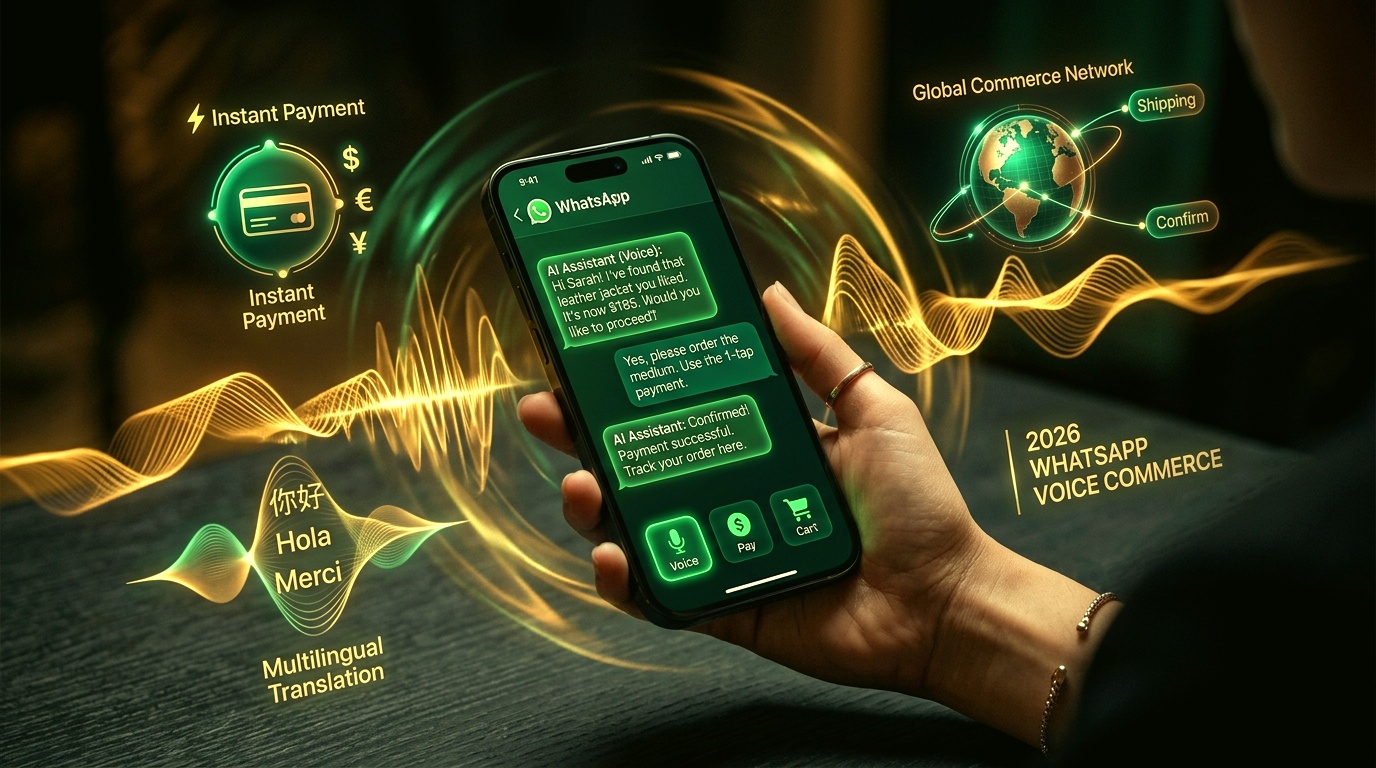
While Voice AI handles high-empathy, hands-free interactions, WhatsApp has cemented itself as the execution layer of global digital commerce. With over 3.3 billion active accounts across Europe, Latin America, South Asia, Southeast Asia, and the Middle East, WhatsApp is the dominant digital medium.
In 2026, enterprises do not send customers away to external web pages. Instead, the transaction occurs headlessly inside the chat thread:
When a customer inquires about a product via WhatsApp, the AI agent pulls real-time inventory from Shopify or SAP, renders dynamic interactive carousels, applies personalized loyalty discounts, and generates a native payment token. The buyer taps their fingerprint on their device screen, authorizing the payment through India's UPI 2.0, Brazil's Pix, or Stripe Link in North America. The entire checkout takes less than 8 seconds, eliminating the 70% cart abandonment endemic to traditional mobile checkout forms.
4. The Omnichannel Continuum: Telephony-to-WhatsApp Session Continuity
One of the most powerful architectural breakthroughs pioneered by SyncFlo AI is Telephony-to-WhatsApp Session Bridging. Historically, a customer calling a support number was completely divorced from their digital messaging history. If an agent needed to send a confirmation or inspect an image, the call was dropped or a clunky SMS was sent.
In the late 2026 unified architecture, the Voice AI agent and WhatsApp agent operate off a shared real-time state machine:
Live Scenario: Flight Rebooking & Seat Selection
Step 1 (Voice Inbound): A passenger calls the airline voice concierge while driving: "My connection was delayed, can you put me on the 7 PM flight?"
Step 2 (Instant Verification): The Voice AI identifies the caller via cryptographic SIM telemetry and answers within 130ms: "Hello David, I have seats available on Flight 412 at 7:15 PM."
Step 3 (Omnichannel Push): While remaining on the phone call, the AI says: "I just pushed the cabin seat map directly to your WhatsApp. Tap the seat you prefer."
Step 4 (Synchronized State): David taps seat 14B on his WhatsApp screen. The voice agent instantly acknowledges: "Got it, seat 14B is reserved. Your boarding pass is now on WhatsApp. Have a great flight!"
This seamless synchronization slashes average handle time (AHT) from 14 minutes down to 90 seconds, delivering unprecedented customer satisfaction (CSAT scores averaging 96.4%).
5. Transforming Global Humanity & Emerging Markets
Beyond corporate efficiency, the combination of Voice AI and WhatsApp is profoundly reshaping developing nations and underserved populations:
A. Vernacular Leapfrogging & Illiteracy Elimination
Over 1.5 billion people worldwide cannot comfortably read complex digital interfaces or type in English. In rural India, Kenya, and Brazil, smallholder farmers and street vendors communicate almost exclusively through voice notes. SyncFlo-powered WhatsApp agents transcribe, reason over, and respond to voice notes in local dialects—including Bhojpuri, Marathi, Swahili, and Quechua—allowing users to check market crop prices, apply for government micro-loans, and calculate fertilizer ratios without reading a single line of text.
B. Decentralized Rural Healthcare Triage
In regions where the doctor-to-patient ratio exceeds 1:10,000, autonomous WhatsApp medical agents provide primary triage. Patients upload a voice note describing their symptoms alongside a smartphone photograph of a skin rash or prescription slip. Multimodal vision models inspect the image, cross-reference clinical triage guidelines, recommend over-the-counter remedies, or automatically dispatch an emergency clinic referral with geographic GPS coordination.
6. Enterprise Unit Economics: The $0.35 Resolution
For Fortune 500 enterprises, customer service and outbound engagement have historically been massive cost centers. Staffing call centers in the Philippines, India, or Central Europe costs between $18.00 and $28.00 per hour, translating to roughly $8.00 to $12.00 per resolved customer contact.
With sub-150ms Voice AI and WhatsApp agent swarms:
- Inference & Network Transit Cost: A 3-minute high-definition direct speech-to-speech call costs approximately $0.14 in GPU compute and SIP trunking.
- WhatsApp Business API Fee: Meta's utility/service conversation fee is roughly $0.005–$0.03 per 24-hour window.
- Net Cost Per Resolution: The all-in enterprise cost drops to $0.35 per completed ticket, representing an immediate 96% operational expense reduction.
7. Security, Privacy & Data Sovereign Compliance
Conducting voice conversations and financial commerce at scale requires bulletproof data governance. Enterprise implementations enforce:
- End-to-End Encryption Compliance: WhatsApp messages remain encrypted in transit. Decrypted payloads for agent processing are retained solely in volatile RAM inside localized sovereign data centers (e.g. EU data residency clusters).
- Voice Biometric Anti-Spoofing: Synthetic voice deepfake attacks are neutralized using high-frequency acoustic phase analysis that verifies physical vocal tract resonance.
- PCI-DSS Level 1 Tokenization: Credit card numbers are never ingested as plaintext by the LLM; transactions utilize pre-tokenized provider gateways.
8. Frequently Asked Questions (FAQ)
Can Voice AI handle noisy environments like driving or crowded streets?
Yes. Modern Direct Speech-to-Speech models incorporate neural spectral subtraction and beamforming filters that suppress background cafe noise, siren frequencies, and car engine rumble, isolating the primary speaker's vocal tract even at signal-to-noise ratios below 5dB.
Do users need to install any custom apps or plugins to use WhatsApp AI commerce?
No. The entire experience operates through standard official WhatsApp accounts verified with the green badge. Customers interact using standard chat messages, voice notes, and native interactive menus already built into WhatsApp on iOS and Android.
How does telephony session continuity handle dropped calls?
If a phone call drops due to cellular network handoff, the session state is preserved in the shared conversational database. The agent immediately sends a WhatsApp message: "It looks like we were disconnected. We were reviewing Flight 412. Would you like to resume here or should I call you back?"