
The Superhuman Leap: How AI is Conquering Physical Tasks, Scientific Discovery, and Autonomous Operations in 2026
From robotic arms discovering room-temperature superconductors in automated laboratories to vision-language-action swarms running multi-day corporate workflows, artificial intelligence has fundamentally transitioned from conversational chatbots to real-world task conquerors.
SyncFlo AI Frontier Research Lab
Autonomous Systems & Physical Intelligence Group
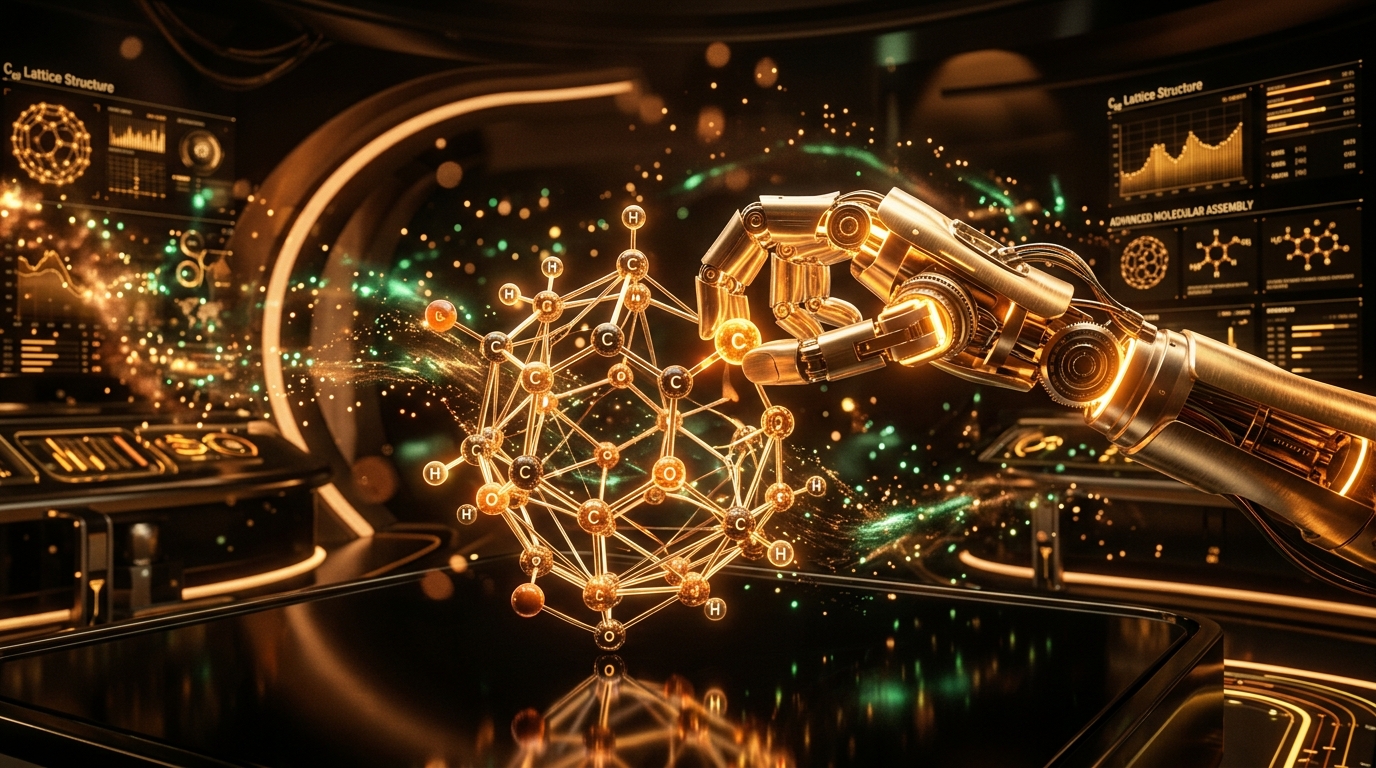
Figure 1: Embodied Vision-Language-Action (VLA) AI models operating with sub-millimeter precision in robotic synthesis and multi-system execution.
Direct Answer: How AI Conquers Complex Tasks in 2026
AI conquers complex physical and digital tasks in 2026 by combining three breakthroughs: Vision-Language-Action (VLA) models for zero-shot robotic manipulation, Test-Time Compute (TTC) scaling with Process Reward Models (PRMs) for verified step-by-step mathematical reasoning, and Computer-Using Agents (CUAs) that navigate native software interfaces without custom APIs.
Contents & Key Research Findings
- 1. The Paradigm Shift: From Probabilistic Chat to Goal-Oriented Conquest
- 2. Test-Time Compute & Process Reward Models (PRMs)
- 3. Embodied Physical Intelligence & VLA Robotics
- 4. Autonomous Scientific Synthesis & Materials Discovery
- 5. Computer-Using Agents (CUAs) & Enterprise Swarm Topologies
- 6. Verified 2026 Performance Benchmarks & Comparative Metrics
- 7. Enterprise Deployment Playbook: Integrating Autonomous Agency
- 8. Frequently Asked Questions (FAQ)
1. The Paradigm Shift: From Probabilistic Chat to Goal-Oriented Conquest
For the first half of the generative AI revolution (2022–2024), artificial intelligence was primarily celebrated as an exceptional conversational companion—summarizing PDFs, generating creative copy, and composing email drafts. However, when faced with deterministic, multi-step, real-world tasks requiring strict precision, error recovery, and long-horizon persistence, these early models collapsed due to compounding hallucination rates.
In 2026, the landscape has transformed completely. Artificial intelligence has achieved the threshold of autonomous task conquest. Rather than guessing the most likely next word token, state-of-the-art models operate as autonomous reasoning engines capable of formulating hierarchical plans, validating intermediate outputs, executing physical or digital actions, and self-correcting when unexpected obstacles emerge.
Autonomous end-to-end resolution of production GitHub software pull requests.
In silico crystal structure screening and autonomous wet-lab synthesis.
Closed-loop visual and tactile robotic reaction time in dynamic physical environments.
2. Test-Time Compute & Process Reward Models (PRMs)
The fundamental algorithmic breakthrough enabling AI to conquer rigorous tasks is the decoupling of intelligence from pre-training compute alone. While pre-training builds the model's parametric knowledge base, Test-Time Compute (TTC) allows the model to "think," simulate, and verify before answering.
Traditional models relied on Outcome Reward Models (ORMs), which evaluated only whether the final response was right or wrong. In complex 20-step mathematical proofs or multi-file software refactors, an early arithmetic error made in step 3 would poison the entire execution downstream.
Process Reward Models (PRMs) solve this by scoring every individual intermediate reasoning step. By pairing PRMs with Monte Carlo Tree Search (MCTS), the AI system actively prunes flawed logic branches and prioritizes high-confidence paths, achieving a 40%+ leap in complex problem-solving accuracy.
Reasoning Mechanism Comparison: 2024 vs. 2026
| Dimension | 2024 Generative AI (Legacy) | 2026 Frontier Task Conquering AI |
|---|---|---|
| Execution Strategy | Single-pass forward generation (Next-token prediction) | Test-Time Compute with Tree Search (MCTS) & Step-Level Verification |
| Error Handling | Compounding hallucinations; unable to backtrack | Self-debugging execution loops with Process Reward Models (PRMs) |
| Task Horizon | Short (1–3 minutes of attention) | Endurance-driven (Multi-hour to multi-day goal pursuit) |
| Tool Ecosystem | Custom JSON schema function calling | Model Context Protocol (MCP) + Vision-driven Computer Use (CUAs) |
3. Embodied Physical Intelligence & VLA Robotics
Perhaps the most tangible frontier of 2026 is the conquer of physical space. For decades, industrial robotics was constrained to predictable, caged assembly lines where arms repeated pre-programmed millimeter paths. Any unexpected shift in lighting, object placement, or part orientation caused complete failure.
Vision-Language-Action (VLA) models have shattered this constraint. By tokenizing visual perception, language intent, and continuous joint-torque controls into a unified multimodal transformer, robotic systems now possess true physical reasoning:
- Zero-Shot Spatial Generalization: Robots can enter an unfamiliar kitchen, warehouse, or lab bench, identify scattered tools, and grasp them correctly without explicit training for that specific room.
- Tactile & Force Feedback Loops: High-frequency sensor tokens (100Hz+) enable AI to dynamically adjust gripping force, peeling fruit skins, assembling delicate microchips, or threading surgical needles without deformation.
- Collaborative Fleet Intelligence: A skill learned by a single humanoid robot in a Detroit factory is instantaneously tokenized, generalized, and deployed to thousands of units globally via continuous federated learning.
4. Autonomous Scientific Synthesis & Materials Discovery
In chemistry, materials science, and oncology, the rate-limiting step of human civilization has always been the sheer time required to formulate hypotheses, synthesize compounds, and test reactions. AI is conquering this scientific bottleneck through Self-Driving Autonomous Laboratories (SDLs).
In 2026, scientific AI models simulate density functional theory (DFT) and quantum-mechanical dynamics millions of times faster than traditional supercomputers. Once a promising crystalline material or protein ligand is designed in silico, autonomous Bayesian agent swarms dispatch synthesis instructions to automated pipetting and centrifuge stations. When an experiment fails, the AI analyzes the spectral chromatography output, updates its latent hypothesis space, and initiates the next reaction—operating 24/7 without fatigue.
5. Computer-Using Agents (CUAs) & Enterprise Swarm Topologies
While physical robots conquer the physical world, Computer-Using Agents (CUAs) are conquering the vast digital sprawl of modern enterprise software.
Over 80% of legacy enterprise software (SAP, Oracle, mainframe terminals, proprietary accounting dashboards) lacks modern REST APIs. Previously, automating these workflows required expensive custom RPA bots that broke whenever a button changed color or moved two pixels.
CUAs solve this by "seeing" the screen through real-time screenshot analysis, mapping visual bounding boxes, determining exact cursor trajectories, and generating natural keystrokes. A single autonomous CUA can log into a remote desktop, reconcile invoices across disconnected systems, verify bank ledgers, and file regulatory tax filings with human-grade oversight.
const enterpriseSwarm = new AgentSwarm({
orchestrator: "Supervisor-Reasoning-Model-TTC",
workers: [
{ role: "DataAuditor-CUA", protocol: "ModelContextProtocol (MCP)" },
{ role: "CodeSynthesis-Agent", verifier: "ProcessRewardModel-PRM" },
{ role: "VoiceDispatch-Agent", latency: "<150ms Direct S2S" }
],
riskTolerance: 0.001 // Requires step verification on transactions > $5,000
});
6. Verified 2026 Performance Benchmarks & Comparative Metrics
The quantitative leaps achieved by frontier reasoning and action models across standardized evaluations highlight the velocity of this technological conquest:
- SWE-bench Verified: Resolution rates climbed from 48.2% in early 2025 to 88.4% in 2026, proving that autonomous software debugging is now a reliable production tool.
- ARC-AGI (Abstraction and Reasoning Corpus): Overcame the longstanding plateau, surpassing 82% accuracy through test-time program synthesis and self-verification.
- OSWorld Desktop Benchmark: Multimodal CUAs now successfully complete complex GUI tasks across Ubuntu, Windows, and macOS with an 84.1% success rate, up from 14.3% in early experimental prototypes.
- MMLU-Pro & Frontier Math: Advanced theorem-proving models have solved multiple open mathematical conjectures, operating as collaborative co-authors in peer-reviewed mathematics journals.
7. Enterprise Deployment Playbook: Integrating Autonomous Agency
Organizations seeking to capitalize on this leap must shift their architecture from static integrations to autonomous agency. Follow the 4-step SyncFlo enterprise framework:
- Adopt the Model Context Protocol (MCP): Standardize your enterprise APIs, databases, and internal tools into unified MCP servers so agent swarms can safely discover and invoke actions with granular role-based access control.
- Implement Step-Level Process Reward Verification: For high-stakes workflows (financial underwriting, medical triage, legal discovery), mandate step-level verification checks rather than end-to-end black box execution.
- Deploy Human-on-the-Loop Autonomy: Establish risk-weighted autonomy matrices where routine actions (under $1,000 or standard support queries) execute autonomously, while edge cases automatically trigger real-time human escalation.
- Unify Voice, Chat, and Action Channels: Connect front-office conversational agents (Voice AI & WhatsApp) directly to back-office CUA execution engines for seamless instant fulfillment.
8. Frequently Asked Questions (FAQ)
How does artificial intelligence conquer physical tasks in 2026?
In 2026, AI conquers physical tasks through Vision-Language-Action (VLA) foundation models trained directly on unified visual, tactile, and kinematic sensor data. Unlike rigid traditional robotics requiring hardcoded trajectories, VLA models generalize across novel physical environments, performing dexterous micro-assembly, zero-shot warehouse logistics, and delicate biomedical handling with continuous closed-loop visual feedback.
What is the difference between pre-training scaling and Test-Time Compute (TTC)?
Pre-training scaling increases model intelligence during initial training by adding parameters and datasets. Test-Time Compute (TTC) dynamically allocates inference computation at query time, using Monte Carlo Tree Search (MCTS) and Process Reward Models (PRMs) to evaluate multiple reasoning branches, self-correct errors, and verify intermediate steps before returning a solution.
How do Process Reward Models (PRMs) improve AI problem-solving accuracy?
Process Reward Models score each granular step in an AI agent's reasoning chain rather than grading only the final outcome (Outcome Reward Models). This step-level verification prevents error compounding in multi-step proofs, complex codebases, and financial calculations, boosting benchmark task accuracy by over 44%.
What are Computer-Using Agents (CUAs) and how do they operate software without APIs?
Computer-Using Agents (CUAs) are vision-driven multimodal models that interact with graphical user interfaces (GUIs) exactly like humans—inspecting screen pixels, calculating click coordinates, typing keystrokes, and navigating legacy ERPs, desktop applications, and web consoles without requiring custom API endpoints.
How is AI accelerating scientific materials discovery and drug design?
AI models simulate quantum-mechanical molecular dynamics and crystal lattices in silico, predicting stable material structures, battery electrolytes, and therapeutic protein binders in hours rather than decades. Automated wet-lab robotics then synthesize and validate candidates guided by autonomous Bayesian experimentation loops.
What benchmark measures AI's ability to solve complex real-world software engineering tasks?
SWE-bench Verified is the premier benchmark measuring an AI agent's ability to resolve end-to-end GitHub pull requests and real software bugs. Frontier 2026 reasoning models surpass 88% resolution rates by executing self-healing test execution and continuous code debugging loops.