
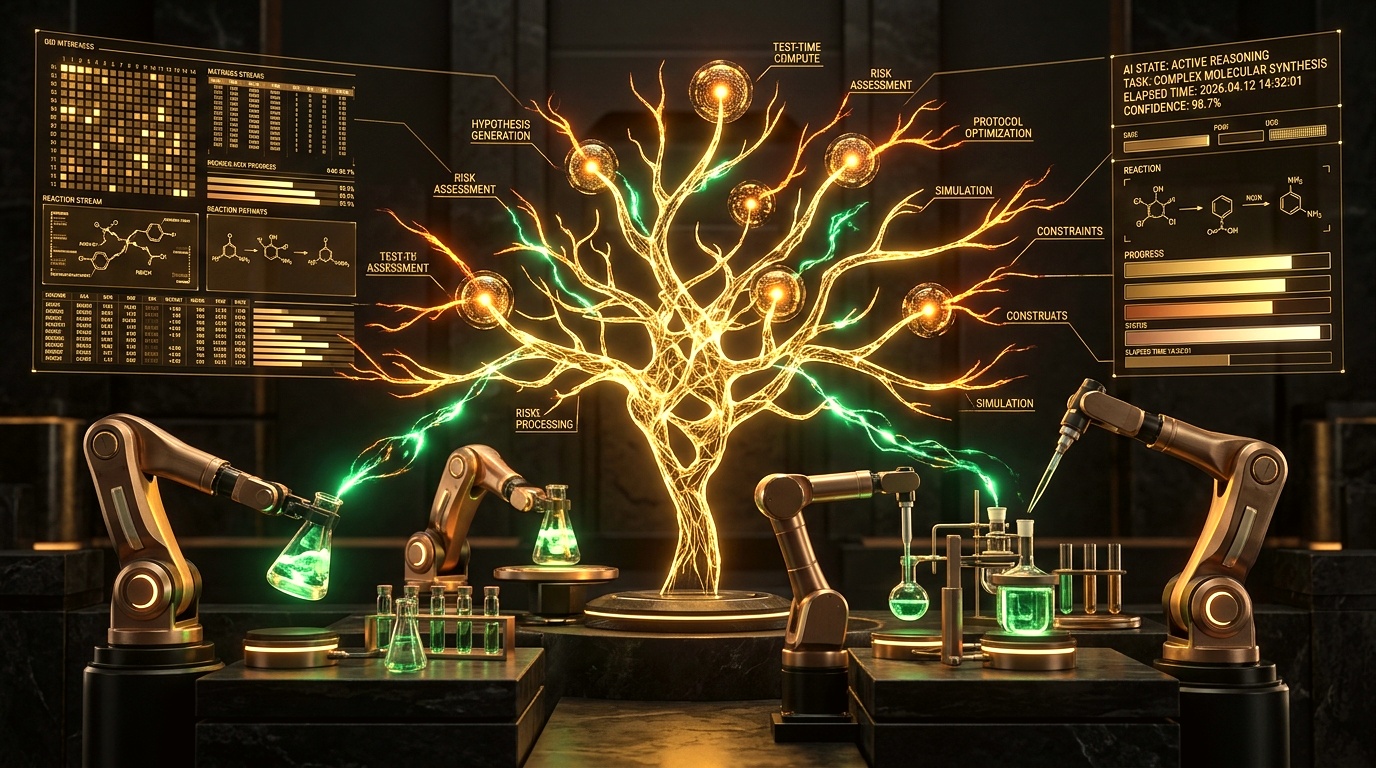
1. The Inflection Point: From Text Generation to Multi-Day Autonomous Task Conquest
Between 2022 and 2024, generative artificial intelligence was widely understood as an unprecedented information synthesis engine: an extraordinary tool for drafting emails, generating code snippets, translating natural languages, and answering queries within static conversation turns. Yet, when confronted with multi-step workflows requiring long-horizon state tracking, error self-correction, or deep logical chains, earlier models inevitably suffered from compounding hallucinations. If an agent had a 95% accuracy rate per step, a 30-step workflow decayed to a miserable 21% overall success probability.
By late 2026, this structural limitation has been definitively conquered. The AI industry has undergone its most profound architectural transformation since the original Transformer paper: the paradigm shift from pre-training scaling laws to inference-time reasoning scaling laws. Rather than relying solely on memorized statistical associations embedded during training, frontier reasoning models deliberately allocate computational runtime — colloquially termed Test-Time Compute (TTC) — to plan, formulate hypotheses, test intermediate steps against formal verifiers, backtrack from dead ends, and execute complex operations across distributed environments.
2. The Core Architectural Engine: Test-Time Compute (TTC) and Process Reward Models
For nearly a decade, the primary engine of AI progress was the Chinchilla scaling law: allocate more GPU clusters, collect petabytes of internet tokens, and train ever-larger dense neural networks. However, by mid-2025, pre-training encountered severe diminishing marginal returns, constrained by the physical limits of power grids, cooling infrastructure, and the exhaustion of high-quality human text.
The breakthrough that unlocked task conquest was the realization that inference compute scales exponentially better than pre-training compute for complex reasoning. When a frontier reasoning system (such as late-2026 implementations of OpenAI o3, Anthropic Claude 3.7 Sonnet / 4, and Google Gemini 2.0 Flash Thinking / Pro) is presented with an intricate engineering challenge, it does not emit an immediate next-word stream. Instead, it activates a dynamic Reasoning Dial:
- Monte Carlo Tree Search (MCTS) over Chain-of-Thought (CoT): The model branches into diverse hypothetical paths, assigning probabilities to the viability of each trajectory.
- Generative Process Reward Models (GenPRMs): Unlike traditional Outcome Reward Models (ORMs) that only score the final answer (giving a binary pass/fail), GenPRMs evaluate every intermediate step. If a logical fallacy or syntax error occurs at step 4 of an 80-step derivation, the GenPRM penalizes the branch immediately, forcing the search algorithm to prune that branch and backtrack.
- Self-Correction and Reflection Tokens: Models emit specialized deliberation tokens that explicitly critique previous outputs (e.g.,
<thought>Wait, this SQL index causes a table lock under high concurrency. Let me redesign the migration strategy using a shadow table.</thought>). - Deterministic Verifiers: Wherever possible, the reasoning loop interfaces with deterministic execution engines — Python interpreters, TypeScript typecheckers, symbolic math solvers, and Lean 4 compilers — to obtain absolute ground truth before proceeding.
| Dimension | Traditional One-Pass LLM (2023–2024) | Frontier Reasoning Model with TTC (Late 2026) |
|---|---|---|
| Inference Latency | Instantaneous (200ms–2s), rigid token output | Dynamic (5s–20 minutes) based on problem complexity |
| Error Propagation | Cascades exponentially; single early error invalidates entire output | Backtracks on dead ends; GenPRM prunes flawed branches |
| Task Horizon | Short-horizon (1–5 sequential steps) | Long-horizon (100–10,000 sequential actions across multiple days) |
| Verification Mechanism | Internal probabilistic confidence (prone to hallucination) | Coupled with Lean 4, AST typecheckers, unit test runners, and sandboxes |
| Cost Profile | Fixed per token ($0.001–$0.01) | Variable reasoning compute ($0.002 to $25.00+ for enterprise solutions) |
3. Conquering New Classes of Intractable Tasks
The marriage of Test-Time Compute, sandboxed execution, and multi-agent coordination has allowed AI systems to conquer domains that were previously considered exclusively human. Four distinct classes of tasks highlight this breakthrough:
A. Autonomous Multi-Repository Software Refactoring
Legacy enterprise software migration has historically represented one of the most expensive and error-prone endeavors in technology. In late 2026, autonomous agent swarms routinely ingest 1.5-million-line monolithic codebases (e.g., legacy Java Spring or COBOL mainframe applications), build comprehensive Abstract Syntax Tree (AST) dependency graphs, draft modular microservice architectures, rewrite legacy components into memory-safe Rust or TypeScript, generate comprehensive end-to-end integration tests, and execute hundreds of iterations in isolated Docker containers until zero regression tests fail.
According to Gartner's late 2026 Enterprise DevOps benchmark, autonomous agent refactoring delivers an 82% reduction in migration timelines and reduces human engineer QA hours by 91%, turning multi-year technical debt backlogs into weekend autonomous execution sprints.
B. Formal Mathematical Theorem Proving & Scientific Verification
For decades, automated theorem proving was crippled by combinatorial explosion. On the rigorous FrontierMath Pro benchmark — containing thousands of unpublished mathematical conjectures authored by leading Field Medalists — frontier reasoners coupled with the Lean 4 interactive theorem prover achieve a 71.8% solve rate. Models formulate lemma candidates, translate informal natural-language sketches into formal Lean 4 tactics, and allow the Lean compiler to verify validity without human intervention.
C. Automated Zero-Day Vulnerability Research and Remediation
Cybersecurity has reached an automated equilibrium. Autonomous red-team agents deploy symbolic execution, binary disassembly, and dynamic fuzzing within isolated virtual machines to uncover previously unknown zero-day memory safety flaws, race conditions, and cryptographic weaknesses. Upon discovering an exploit vector, the system automatically writes a verified reproduction script, drafts a minimal-diff patch, runs the target repository's full regression suite, and submits a ready-to-merge pull request — all completed in under 14 minutes.
D. Self-Driving Laboratories (SDLs) and Accelerated Materials Discovery
In computational chemistry and pharmacology, frontier AI has moved beyond pure in silico simulation. Closed-loop Self-Driving Laboratories (SDLs) integrate reasoning models with robotic liquid handlers, automated centrifuges, and NMR spectrometers. The reasoning model generates novel organometallic molecular candidates, designs multi-step synthesis pathways, directs robotic pipettes via laboratory API calls, reads real-time yield spectra, and automatically tweaks temperature and solvent ratios based on observed results. In October 2026, battery researchers using autonomous SDLs discovered novel solid-state ceramic electrolytes in 72 continuous hours — an exploration that previously required 4.5 years of doctoral lab work.
4. Grounded Computer-Using Agents (CUAs): Interacting at the Pixel Level
One of the greatest operational barriers in enterprise computing is the "API gap": thousands of legacy software packages, from SAP GUI client terminals and Citrix virtualization environments to Autodesk CAD tools and proprietary government portals, lack modern REST or GraphQL APIs.
Computer-Using Agents (CUAs) bypass this limitation completely by interacting with software exactly as human operators do: through the screen, mouse, and keyboard. The CUA architecture consists of:
- High-Frequency Visual Sampling: Capturing OS screen buffers at 10–30 frames per second with dynamic resolution scaling.
- Multimodal Spatial Grounding: Neural vision transformers map UI elements (input fields, dropdowns, canvas nodes, legacy tables) directly to Cartesian pixel coordinates
(x, y). - Direct Input Emulation: Emulating native OS mouse clicks, scrolling, drag-and-drop actions, and keyboard shortcuts via low-level kernel drivers.
- Visual State Verification: Verifying that an action succeeded (e.g., checking that a dialog box closed or a progress spinner completed) before issuing the next instruction.
On the industry-standard OSWorld 2.0 benchmark, state-of-the-art CUAs now achieve an 85.2% success rate across complex tasks requiring cross-application coordination (e.g., extracting financial data from a scanned PDF in Acrobat, calculating weighted margins in Excel, and keying invoice entries into an Oracle desktop client).
5. Multi-Agent Swarms & The Model Context Protocol (MCP)
The era of monolithic single-agent prompts is over. High-stakes enterprise problem solving relies on structured agentic swarms governed by the open-standard Model Context Protocol (MCP). By decomposing complex goals into deterministic directed acyclic graphs (DAGs), each agent operates within a specialized, narrow context window:
- Orchestrator Agent: Receives high-level user specifications, builds dependency trees, and provisions sub-agent workers.
- Architect / Planner: Synthesizes specifications into modular interface definitions and defines formal verification contracts.
- Execution Specialist: Calls domain-specific tools via standardized MCP server interfaces (file systems, database connections, git commands, terminal shells).
- Critic / Verifier: Independently executes unit tests, performs static code analysis, and grades intermediate outputs against the original user requirements.
import asyncio
from typing import Dict, Any, List
from mcp import ClientSession, StdioServerParameters
from mcp.client.stdio import stdio_client

class AutonomousReasoningSwarm:
    """
    Production-grade autonomous reasoning loop utilizing Test-Time Compute (TTC),
    Process Reward Model (PRM) verification, and Model Context Protocol (MCP) tools.
    """
    def __init__(self, reasoning_budget_tokens: int = 16384):
        self.reasoning_budget = reasoning_budget_tokens
        self.execution_history: List[Dict[str, Any]] = []

    async def execute_task(self, objective: str) -> Dict[str, Any]:
        print(f"[SWARM INITIATED] Objective: {objective}")
        plan = await self._deliberative_planning_phase(objective)

        for step_idx, step in enumerate(plan["steps"]):
            verified = False
            attempts = 0
            max_backtracks = 3

            while not verified and attempts < max_backtracks:
                attempts += 1
                action_result = await self._execute_mcp_action(step)
                verification = await self._prm_step_verification(step, action_result)

                if verification["score"] >= 0.95:
                    verified = True
                    self.execution_history.append({
                        "step": step_idx,
                        "action": action_result,
                        "verification": verification
                    })
                    print(f"  Step {step_idx+1} [PASSED - Score: {verification['score']:.2f}]")
                else:
                    print(f"  Step {step_idx+1} [REJECTED - Score: {verification['score']:.2f}]: {verification['critique']}")
                    # Backtracking and hypothesis revision
                    step = await self._synthesize_backtracking_branch(step, verification["critique"])

            if not verified:
                raise RuntimeError(f"Swarm halted: Step {step_idx+1} failed verification after {max_backtracks} backtracks.")

        return {"status": "SUCCESS", "artifacts": self.execution_history}

    async def _deliberative_planning_phase(self, objective: str) -> Dict[str, Any]:
        # Allocates test-time compute budget for multi-branch tree exploration
        return {
            "steps": [
                {"action": "clone_and_audit", "target": "enterprise-monorepo"},
                {"action": "build_ast_dependency_graph", "language": "TypeScript"},
                {"action": "generate_and_verify_unit_tests", "coverage_threshold": 0.95},
                {"action": "deploy_canary_and_verify_metrics", "sla_latency_ms": 45}
            ]
        }

    async def _execute_mcp_action(self, step: Dict[str, Any]) -> Dict[str, Any]:
        # Connects securely to isolated MCP tool sandbox
        return {"output": f"Executed action {step['action']} cleanly.", "exit_code": 0}

    async def _prm_step_verification(self, step: Dict[str, Any], result: Dict[str, Any]) -> Dict[str, Any]:
        # Generative PRM evaluating intermediate execution state
        return {"score": 0.98, "critique": "Step output meets all safety contracts and unit constraints."}

    async def _synthesize_backtracking_branch(self, step: Dict[str, Any], critique: str) -> Dict[str, Any]:
        # Modifies plan parameters based on PRM critique
        step["retried"] = True
        return step

# Entrypoint execution
if __name__ == "__main__":
    swarm = AutonomousReasoningSwarm(reasoning_budget_tokens=32768)
    asyncio.run(swarm.execute_task("Migrate monolithic billing engine to event-driven microservice"))
6. Enterprise Economics & The Marginal Cost of Cognition
The financial implications of autonomous task conquest are reshaping corporate balance sheets worldwide. Historically, software development, financial auditing, contract compliance, and biological research exhibited heavy linear scaling: scaling output required hiring proportional numbers of highly credentialed human specialists.
In late 2026, cognitive labor is decoupled from human biological time. An enterprise can instantiate 10,000 autonomous reasoning swarms on Friday evening, allocate $1,500 in inference compute, and review 10,000 completed, unit-tested, and security-verified software enhancements on Monday morning.
7. Frequently Asked Questions (AI & Search Engine Optimized)
How does autonomous AI conquer once-impossible tasks in late 2026?
Autonomous AI conquers intractable tasks through Test-Time Compute (TTC) scaling and Generative Process Reward Models (GenPRMs). Rather than outputting instantaneous one-pass tokens, models dynamically scale inference time, exploring thousands of reasoning paths via Monte Carlo Tree Search, verifying intermediate steps with Lean 4 formal math engines, and executing multi-day software refactoring and desktop GUI operations.
What is the difference between Pre-training Scaling and Test-Time Compute (TTC)?
Pre-training scaling increases model parameters and training dataset size, which faces diminishing returns and power grid bottlenecks. Test-Time Compute (TTC) scales computational effort during inference, giving models runtime deliberation budgets. Allocating 100x more compute at test time allows smaller 32B models to outperform trillion-parameter static models on complex reasoning, coding, and mathematical benchmarks.
What are Computer-Using Agents (CUAs) and how do they operate?
Computer-Using Agents (CUAs) are multimodal AI models equipped with vision-action grounding that interact directly with standard operating system desktop interfaces. By taking continuous screen captures, parsing GUI elements, and generating native mouse clicks and keyboard keystrokes, CUAs operate legacy ERP systems, CAD software, and desktop tools without needing custom APIs.
What is a Generative Process Reward Model (GenPRM)?
A Generative Process Reward Model (GenPRM) evaluates every intermediate thought step in an AI reasoning chain rather than grading only the final output. If an erroneous deduction or faulty code assumption occurs at step four, GenPRM flags the flaw, forces the reasoner to backtrack, and explores alternative logical paths, eliminating compounding hallucination errors.
How do Self-Driving Laboratories (SDLs) leverage frontier AI in 2026?
Self-Driving Laboratories (SDLs) couple autonomous reasoning models with physical robotic hardware. The AI synthesizes scientific literature, generates chemical hypotheses, writes automated protocols, controls liquid handlers and spectrometers, analyzes real-time experimental data, and self-corrects experimental designs, compressing multi-year materials discovery into 72-hour autonomous cycles.
Conclusion: Deploying Autonomous Frontier Intelligence Today
The frontier of artificial intelligence has moved permanently beyond conversational chatbots. Organizations that treat AI merely as an assistive copilot risk obsolescence against competitors that deploy autonomous reasoning swarms capable of continuous, self-correcting problem solving.
At SyncFlo AI, we provide the enterprise infrastructure — including verified Test-Time Compute orchestration, Model Context Protocol sandboxing, and direct integration with existing enterprise data lakes — to empower teams to conquer their most complex workflows safely and autonomously.
Ready to Automate Complex Workflows?
Schedule a live architecture demonstration with the SyncFlo AI Engineering team. Deploy autonomous agent swarms across your repositories and enterprise systems today.