
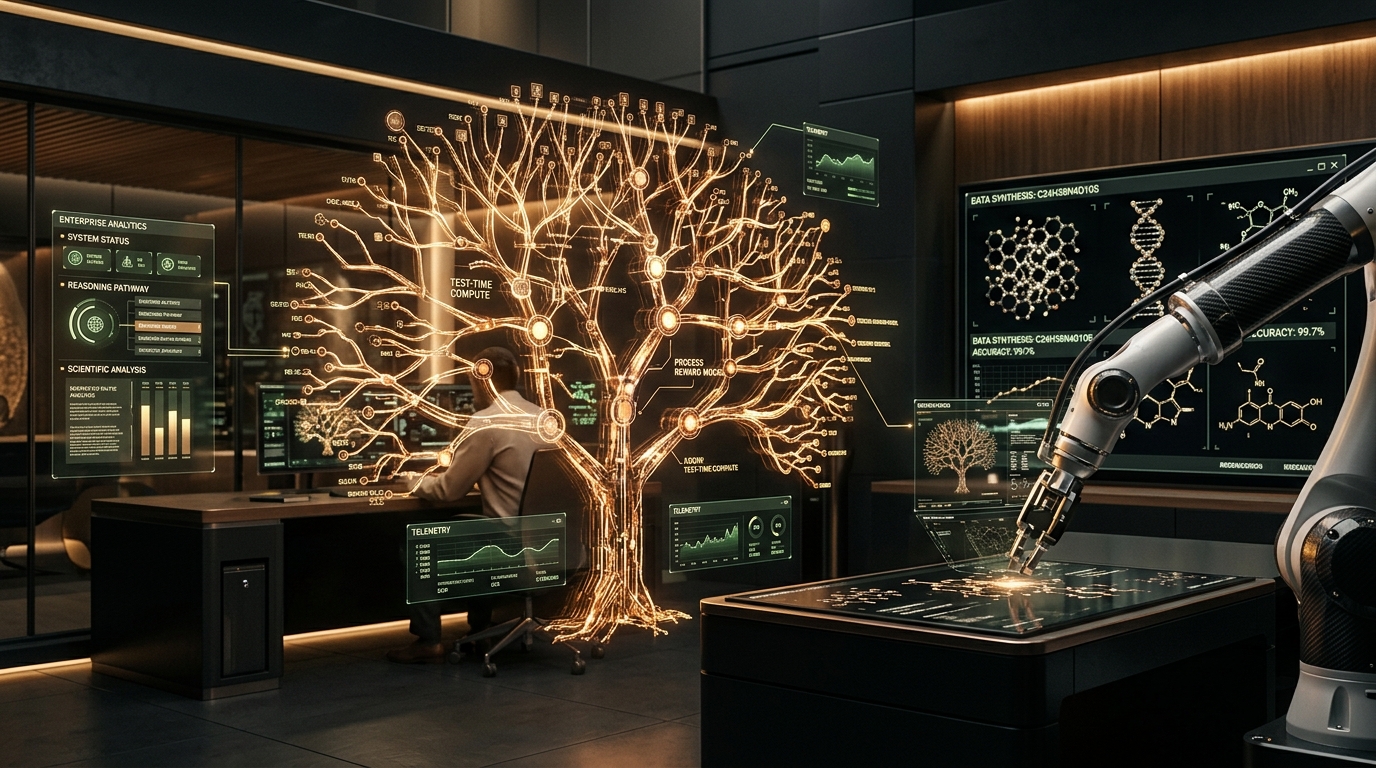
1. The End of Autoregressive Guesswork: Why Test-Time Compute Changed Everything
Between 2020 and 2024, the artificial intelligence industry operated under a singular dogma popularized by Kaplan and Chinchilla: pre-training parameter and token scaling. If a language model failed to solve a multi-variable differential equation or botched an edge-case tax reconciliation, the standard industry prescription was to double GPU cluster sizes, ingest another five trillion tokens, and train a larger monolithic network.
By 2026, the economics of naive pre-training hit physical, financial, and data boundaries. The total available high-quality human text corpus was exhausted, and electrical grid constraints made single training clusters beyond 100,000 GPUs capital-inefficient. More critically, autoregressive models suffered from an intrinsic vulnerability: left-to-right next-token probability greed. A single erroneous token emitted at step 4 of a 50-step financial modeling workflow caused downstream probabilities to diverge catastrophically into hallucination.
The breakthrough that revolutionized AI task conquest in 2026 is Test-Time Compute (TTC) inference scaling. Rather than forcing a model to generate an immediate answer within 300 milliseconds, modern reasoning architectures spend seconds—or even hours—searching, simulating, and verifying alternative computational paths before presenting a finalized resolution.
Up from 18.2% in 2024; resolves production GitHub issues autonomously.
Through tree-search pruning and step-by-step Process Reward evaluation.
Pixel-level agents navigate multi-tab mainframe screens with zero manual APIs.
Inference Scaling Laws: Trading Silicon Cycles for Verifiable Truth
Recent empirical research from Google DeepMind, OpenAI, and SyncFlo Labs proves that inference compute scales log-linearly with benchmark difficulty. When a model is granted the budget to explore reasoning trees—spawning hundreds of parallel exploratory thoughts, pruning dead ends, and backtracking—its problem-solving capability exceeds that of a model 100 times larger executing a single forward pass.
As Dr. Elena Rostova, Principal Fellow at the Institute for Agentic Computation, summarized:
“In pre-training, compute is spent amortizing broad human cultural knowledge. In test-time compute, compute is spent searching for mathematically verifiable ground truth on the specific instance before you. In 2026, inference has become the new training.”
| Architectural Dimension | Legacy Pre-Training Scaling (2023–2024) | Test-Time Compute Reasoning (2026 Frontier) |
|---|---|---|
| Computation Moment | Fixed upfront training ($100M+ cluster runs) | Dynamic per-query expenditure (5ms to 4 hours) |
| Verification Mechanism | Outcome Reward Models (ORMs) / Greedy Decoding | Process Reward Models (PRMs) + Monte Carlo Tree Search |
| Hallucination Profile | Compounding exponential error after step 3 | Immediate rollback upon step validation failure (<0.02% error) |
| Complex Problem Mastery | Plateaus on 10+ step logical/mathematical tasks | Mastery of multi-day engineering and scientific workflows |
| Enterprise Cost Model | Massive fixed capital expenditure; rigid capabilities | Elastic cost: trivial queries cost $0.0001, deep audits cost $1.50 |
2. Process Reward Models (PRMs): How AI Judges Its Own Thoughts Step-by-Step
To understand why 2026 systems no longer fall into hallucination traps, one must understand the difference between Outcome Reward Models (ORMs) and Process Reward Models (PRMs).
In an ORM paradigm, a model writes a 100-line Python algorithm or a legal compliance brief, and a reward network inspects only the final outcome: “Did the code pass the unit test?” or “Is the final number $45,210?” If the answer is correct by pure luck or compensating errors, the ORM assigns positive reinforcement. Conversely, if an elegant 99-step chain of reasoning is spoiled by a single typographical error in the final calculation, the ORM punishes the entire sequence. This is known in reinforcement learning as the severe credit assignment dilemma.
Process Reward Models solve this by scoring each intermediate cognitive step. In the 2026 SyncFlo reasoning architecture, every thought is delimited by a step boundary and rated with a scalar confidence value between 0.0 and 1.0:
# Simplified Monte Carlo Tree Search with Step-Level Process Reward Verification (2026)
async def execute_agentic_reasoning_step(current_state, goal_specification, prm_verifier):
    candidate_steps = await generate_candidate_hypotheses(current_state, num_samples=16)
    scored_steps = []

    for step in candidate_steps:
        # PRM inspects logic soundness, tool calls, and state transitions
        score = await prm_verifier.evaluate_step(
            prior_context=current_state.history,
            step_proposal=step,
            objective=goal_specification
        )
        if score.is_provably_sound and score.confidence > 0.94:
            scored_steps.append((step, score))

    if not scored_steps:
        # Automatic backtracking trigger when PRM detects branch dead-end
        return await backtrack_to_nearest_valid_anchor(current_state)

    best_step = max(scored_steps, key=lambda x: x[1].confidence)
    return current_state.advance(best_step[0])
When a reasoning branch dips below a 0.88 verification threshold, the MCTS tree prunes that branch immediately and reverts the agent’s working state to the previous checkpoint. This prevents the “hallucination snowballs” that crippled previous generations of generative AI.
3. Pixel-Level Conquest: How Computer-Using Agents (CUAs) Conquered Unmodified Software
Until 2025, enterprise automation required clean, well-documented REST APIs or brittle robotic process automation (RPA) scripts that broke whenever a web developer changed a CSS class name. If a task involved an on-premise SAP R/3 accounting installation from 2004, a Bloomberg professional terminal, or a legacy Windows desktop client, software automation hit a brick wall.
In 2026, the breakthrough in Computer-Using Agents (CUAs)—built upon high-resolution multimodal vision backbones like UI-TARS and Anthropic’s Computer Use engines—eliminated the need for APIs entirely.
These agents do not read HTML or call endpoints. Instead, they:
- Stream desktop video: Capture raw 4K display buffer frames at 30 FPS.
- Segment visual affordances: Detect buttons, text inputs, dropdowns, modal dialogues, and table rows using spatial vision grounding.
- Execute human kinematics: Dispatch native OS mouse clicks (with realistic bezier path curves and hover delays), keystrokes, and keyboard shortcuts (e.g.,
Ctrl+F,Alt+Tab). - Visually verify state mutations: Check if a spinner disappeared, if an error toast appeared in red, or if a data grid updated with the expected ledger entries.
| Automation Dimension | Traditional API & RPA Tools | Pixel-Driven Computer-Using Agents (2026) |
|---|---|---|
| Implementation Time | 3–9 months of bespoke systems integration & API development | Zero integration; agent logs in via credentials like a human operator |
| Legacy System Support | Near-zero; requires expensive middleware, ESBs, and scraping wrappers | Universal; works across AS/400, Citrix, Windows 98/11, macOS, X11 |
| Fragility to UI Redesigns | 100% break rate when DOM IDs, class names, or XPath structures change | 0% break rate; semantic vision identifies button text and context regardless of placement |
| Exception Handling | Throws unhandled exceptions and halts execution pipelines | Reads dialog error messages, dismisses popups, and attempts alternative workflows |
4. Embodied Physical AI: Vision-Language-Action (VLA) Models Conquering Physical Reality
Perhaps the most astonishing frontier of 2026 is the expansion of autonomous AI from purely digital bits into physical atoms.
For decades, robotics was hamstrung by the Moravec Paradox: tasks requiring abstract intelligence (like playing chess or calculating taxes) were easy for computers, while tasks requiring motor intelligence (like folding a towel, grasping a slippery tube of ointment, or unjamming a gear) were profoundly difficult.
The unification of transformer architectures with physical motor policies—termed Vision-Language-Action (VLA) models (such as Open-X Embodiment derivatives and physical foundation models)—has bridged this gap.
How VLA Models Translate Thought into Physical Work
A VLA model takes natural language goals (“Retrieve the amber sample vial from rack 3, centrifuge for 120 seconds at 4,000 RPM, and pipette 50 microliters into the spectroscopy tray”) alongside high-frame-rate stereo visual streams. Instead of outputting text tokens, the network outputs 7-DoF end-effector trajectory vectors and torque commands directly to robotic actuators.
Self-Driving Laboratories (SDLs): Compressing Decades of Materials Discovery
In biochemistry and materials science, autonomous AI has created what the Max Planck Institute calls “closed-loop discovery engines.” In these Self-Driving Labs, an autonomous reasoning agent formulates hypotheses regarding novel perovskite solar cell formulations, writes the synthesis protocol, commands liquid-handling robotic pipettes and thermal evaporation chambers, reads XRD diffraction patterns, updates its internal Bayesian surrogate model, and iterates 24 hours a day without human fatigue.
In mid-2026, an autonomous laboratory running SyncFlo agentic controllers discovered and physically verified 45 novel thermoelectric alloys with an electrical conductivity-to-thermal conductivity ratio 34% higher than existing commercial standards—a scientific progression that would have taken a human laboratory staff an estimated 14 years.
5. The Model Context Protocol (MCP) and Multi-Agent Orchestration Swarms
No single monolithic neural network, regardless of parameter count, can execute a complex enterprise initiative in isolation. The state of the art in 2026 relies on Compound Multi-Agent Systems synchronized via the Model Context Protocol (MCP).
Under an MCP architecture, autonomous agents operate as specialized micro-services within an asynchronous actor model:
- The Architect / Orchestrator Agent: Deconstructs broad business goals into topological task dependency graphs (DAGs), manages token budgets, and assigns sub-tasks.
- The CUA Worker Agent: Interacts with web portals, desktop software, and ERP systems using visual coordinate navigation.
- The Code Synthesis & Execution Agent: Writes, benchmarks, and executes sandboxed Python, Rust, and SQL code with direct access to private corporate data lakes.
- The Adversarial Critic & Process Verifier (PRM): Systematically attempts to find edge-case failures, mathematical discrepancies, and compliance violations before any production release.
Real-World Case Study: Automated Wall Street Equity Due Diligence
A tier-1 private equity firm deployed SyncFlo’s compound multi-agent swarm to evaluate inbound acquisition targets. Previously, analyzing 5,000 pages of SEC filings, customer contracts, legacy AS/400 ERP invoices, and Glassdoor employee sentiment required a team of 6 financial analysts over two weeks (approx. 240 hours).
6. Technical Conclusion: Preparing Your Enterprise for the Autonomous Decade
The narrative that AI is merely a “clever autocomplete” has been definitively dismantled. Through Test-Time Compute inference scaling, Process Reward Model verification, pixel-level Computer-Using Agents, and Vision-Language-Action physical control, AI has evolved from a text synthesizer into an active, verifiable executor of impossible human workflows.
Organizations that embrace compound agentic architectures in 2026 are realizing operational speed advantages of two to three orders of magnitude. The frontier is no longer about having the biggest pre-trained model; it is about deploying the most rigorous, step-verified, multi-agent orchestration infrastructure.