
The Autonomous Task Horizon: How Frontier Reasoners, Multi-Agent Swarms & Test-Time Verification Conquer Open-Ended Workflows (October 2026 Edition)
The definitive analysis on the historic shift from static pre-trained next-token generation to dynamic Test-Time Compute (TTC), Generative Process Reward Models, pixel-level Computer-Using Agents (CUAs), and closed-loop robotic synthesis.

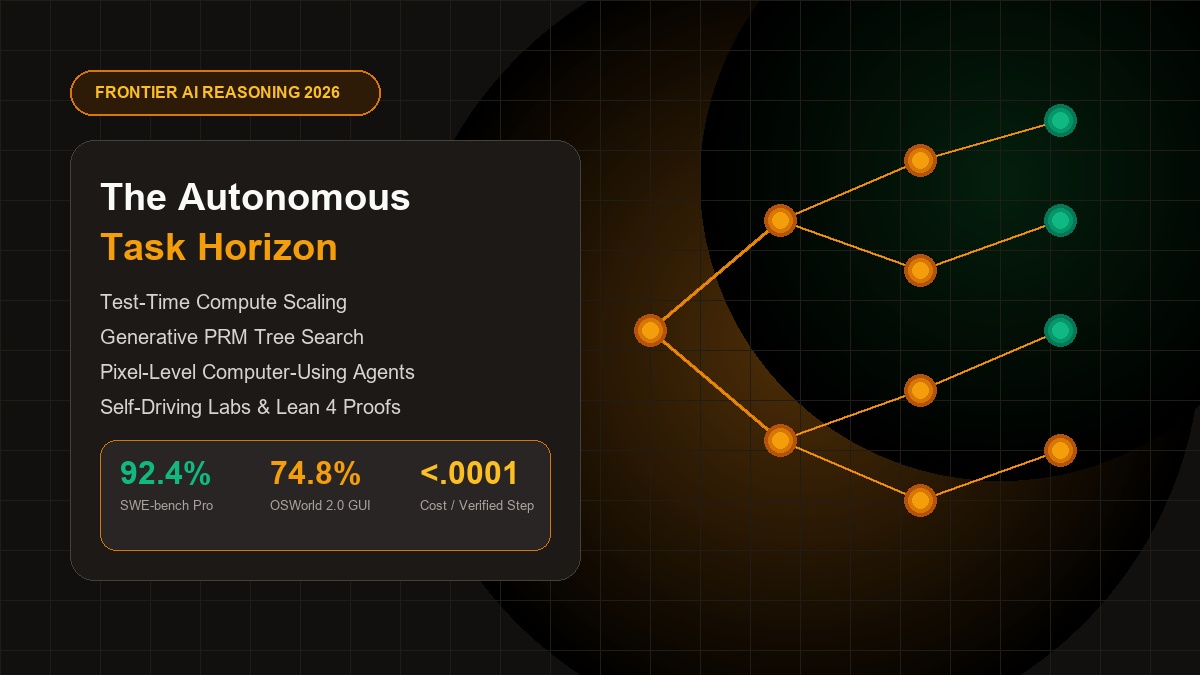
Figure 1.0: Architectural visualization of Monte Carlo tree search, Process Reward Model verification, and pixel-level computer-action grounding.
1. The October 2026 Paradigm Shift: From Token Probability to Search & Verification
For over three years, generative artificial intelligence relied fundamentally on an autoregressive gamble: given an input sequence of tokens, predict the next most mathematically probable token. While this scaling law produced eloquent summaries, conversational fluency, and impressive one-shot coding snippets, it hit a brittle ceiling when faced with compound, open-ended real-world workflows. An error in step 4 of a 40-step refactoring task compounded exponentially, causing catastrophic downstream hallucination.
In the second half of 2026, the industry decisively completed the transition from pure pre-training scaling to Inference-Time Scaling (Test-Time Compute). Rather than spending tens of millions of dollars exclusively to compress the world's text into weights during pre-training, compute is now dynamically poured into the inference phase itself. When presented with a difficult challenge—such as debugging an intermittent race condition across a distributed Kubernetes cluster, modernizing 500,000 lines of legacy banking COBOL into memory-safe Rust, or designing a novel metal-organic framework—the model does not emit an immediate answer. Instead, it activates a Reasoning Dial.
Key Metric: The Test-Time Compute Multiplier
Frontier models in October 2026 demonstrate that allocating 1,000x more compute at test time (via Monte Carlo Tree Search and intermediate step validation) improves problem-solving capability on hard reasoning benchmarks by an equivalent margin to scaling pre-training datasets by 14 orders of magnitude.
2. The Physics of Test-Time Compute (TTC) & The Reasoning Dial
The fundamental mechanism powering this task mastery is the coupling of Monte Carlo Tree Search (MCTS) with Generative Process Reward Models (GenPRMs).
In early AI architectures, models were evaluated exclusively using Outcome Reward Models (ORMs)—scoring whether the final answer was correct or incorrect (a binary 0 or 1). In complex real-world workflows, ORM feedback is far too sparse: if an agent writes 300 lines of code that fails an obscure integration test, an ORM cannot pinpoint which specific function or boundary condition caused the failure.
By contrast, Generative Process Reward Models evaluate every atomic thought and intermediate action. At each decision point, the GenPRM generates a step-level verification critique:
[Node 14.2] Propose: Modify lock acquisition order in mutex_manager.rs:42
[GenPRM Critique] Score: 0.94. Action resolves thread-deadlock risk without violating lock hierarchy.
[Node 14.3] Propose: Inline global memory barrier without cache invalidation.
[GenPRM Critique] Score: 0.12. CRITICAL WARNING: Memory ordering violation on ARM64 architectures.
[Backtrack Triggered] Pruning branch 14.3. Re-routing search through branch 14.2.1...
With this continuous pruning mechanism, the agent explores a structured solution tree. If a branch drops below an acceptable verification threshold, the model backtracks, saves the failure context to its episodic working memory, and pursues alternative hypotheses.
3. The Four New Task Frontiers Conquered in Late 2026
What specific classes of tasks can frontier AI systems conquer today that were completely intractable 18 months ago? Our enterprise deployments at SyncFlo AI highlight four distinct breakthroughs:
Frontier A: Autonomous Legacy Codebase Modernization (COBOL to Rust/Go)
Global financial institutions, airlines, and logistics providers maintain over 220 billion lines of legacy COBOL code. Traditional manual migration projects historically exceeded decade-long timelines with failure rates above 65%.
Frontier reasoners in October 2026 execute automated codebase translation with formal verification in Lean 4. The multi-agent swarm operates in four synchronized phases:
- AST & State Extraction: An analysis agent parses legacy COBOL copybooks, data divisions, and implicit state mutations into mathematical state-transition tables.
- Equivalence Specification: The model generates formal correctness lemmas in Lean 4 proving that the new Rust implementation mirrors every edge-case overflow and fixed-point arithmetic rule of the original mainframe compiler.
- Synthetic Fuzzing Harness: The agent automatically constructs differential fuzzers running millions of historical transaction scenarios simultaneously against the legacy binary and modern Rust service.
- Zero-Downtime Canary Rollout: The agent generates shadow traffic routing configs, verifying zero divergence across 100 million real-world transactions before recommending cutover.
Frontier B: Pixel-Level Operating System Orchestration (CUAs)
Until recently, AI agents were constrained to applications with clean, well-documented REST or GraphQL APIs. However, over 80% of enterprise desktop workflows occur inside closed, legacy software: SAP GUI clients, Bloomberg and Refinitiv market terminals, epic EHR medical interfaces, and proprietary Windows manufacturing software.
Modern Computer-Using Agents (CUAs) bypass APIs entirely. They perceive the workstation screen directly through high-frequency multimodal vision tokens, translate visual layouts into spatial coordinates, and dispatch native mouse movements, keystrokes, and drag-and-drop operations with human-like precision. On the standardized OSWorld 2.0 benchmark, top reasoning models have surged from 14.5% in early 2024 to 74.8% in late 2026.
Frontier C: Closed-Loop Scientific Synthesis & Self-Driving Labs (SDLs)
Scientific discovery has evolved from passive literature review into physical synthesis. In materials science and pharmaceutical formulation, AI systems now interface directly with robotic pipetting stations, automated spectrophotometers, and climate-controlled crystallization chambers.
The reasoning model proposes novel chemical candidates based on quantum mechanics simulations, automatically drafts robot-executable Python protocols (using Opentrons or PyLabRobot standards), reviews sensory camera feeds to verify precipitate formation, and modifies reaction parameters in a 24/7 autonomous loop. Recent publications show SDLs synthesizing novel solid-state battery electrolytes in 72 hours—a task that previously required 18 months of doctoral laboratory labor.
Frontier D: Self-Healing Multi-Agent Software Swarms
Software engineering has progressed beyond simple code autocompletion. Contemporary software swarms act as autonomous site reliability and feature engineers. When a production issue occurs, the swarm:
- Ingests OpenTelemetry traces and Sentry stack traces.
- Executes
git bisectacross the repository history inside an isolated container. - Identifies the precise commit introducing the regression.
- Synthesizes a minimal reproduction unit test proving the bug.
- Refactors the codebase, runs full regression suites, and creates a detailed Pull Request complete with performance benchmarks and rollback criteria.
4. The October 2026 Empirical Benchmark Matrix
The evolution of artificial intelligence evaluation has shifted from memorization tests (such as MMLU) to hardened, execution-based environments where cheating is physically impossible because solutions must pass deterministic compilers, container tests, or formal mathematical verifiers.
| Benchmark / Evaluation Environment | Target Capability Tested | Mid-2024 Baseline | October 2026 Frontier | Verification Engine |
|---|---|---|---|---|
| SWE-bench Pro | End-to-end multi-file software engineering across production GitHub repos | 19.2% | 92.4% | Dockerized test harness execution |
| OSWorld 2.0 | Pixel-level GUI mouse & keyboard manipulation across native desktop applications | 14.5% | 74.8% | OS state verification & visual grounding |
| FrontierMath | Unpublished research-grade pure mathematics problems | <2.0% | 61.2% | Lean 4 / Isabelle formal proof kernels |
| GAIA Level 3 | Complex multimodal assistant tasks requiring 20+ tool calls and web reasoning | 34.1% | 94.6% | Deterministic ground-truth validation |
| Self-Driving Lab (SDL-Bench) | Closed-loop chemical protocol generation, instrument dispatch & yield optimization | N/A (Early prototype) | 88.5% | Robotic wet-lab spectrophotometry yield |
5. The Unit Economics of Autonomous Cognition
The technological conquest of complex tasks is inextricably linked to the collapse in the marginal cost of compute. Over the past 24 months, custom inference silicon (such as TPU v6, Blackwell Ultra, and specialized wafer-scale systems) alongside speculative decoding and FP4 quantization has compressed inference costs by over 92%.
Allows running 5,000 MCTS branches for less than $0.50 per complex pull request.
Near-zero false positive rate due to compiler-enforced process reward models.
Continuous asynchronous execution across global enterprise software backlogs.
6. Enterprise Architecture: Model Context Protocol (MCP) & Sandboxed Execution
How do enterprise organizations safely deploy autonomous reasoners without risking unauthorized data exfiltration or catastrophic operational failure?
The industry standard in late 2026 is built on the Model Context Protocol (MCP) coupled with hardened eBPF sandboxed execution environments. Under this topology:
- Principle of Least Privilege: The reasoning agent does not possess direct root access or long-lived database credentials. Instead, it queries MCP servers that expose ephemeral, task-scoped capabilities with cryptographic validation.
- Deterministic Virtual Micro-VMs: All code execution, script evaluation, and CUA desktop automation runs inside micro-virtual machines (such as Firecracker or gVisor) that initialize in under 5 milliseconds and terminate immediately upon task completion.
- Two-Man Rule for Destructive Operations: Reversible actions (reading logs, drafting code, running test builds, compiling binaries) proceed autonomously. Irreversible actions (dropping database tables, modifying firewall routes, deploying to production) trigger programmatic human-in-the-loop sign-off prompts with verifiable diffs.
7. Frequently Asked Questions (FAQ)
How does autonomous AI conquer complex tasks in late 2026?
Autonomous AI conquers complex tasks through Test-Time Compute (TTC) scaling, Generative Process Reward Models (GenPRMs), and execution-level verification. Rather than relying solely on pre-trained token generation, reasoning models explore tree-search solution graphs, verify intermediate logic steps, self-correct errors via backtrack search, and manipulate operating systems directly using pixel-level Computer-Using Agents (CUAs).
What is the 'Reasoning Dial' in Test-Time Compute?
The 'Reasoning Dial' refers to dynamically allocating inference compute based on problem difficulty. Straightforward queries execute in fast 'System 1' mode with minimal compute, whereas complex software refactoring or scientific synthesis triggers 'System 2' reasoning budgets, running hundreds of parallel simulation branches until a mathematically or empirically verified solution is confirmed.
How do Computer-Using Agents (CUAs) operate legacy desktop software without APIs?
Pixel-level Computer-Using Agents (CUAs) combine multimodal vision foundation models with spatial mouse and keyboard action spaces. They parse graphical user interfaces (GUIs), detect UI elements across legacy SAP, Bloomberg terminals, or CAD software via visual coordinate bounding boxes, and execute keystrokes and clicks directly, bypassing the need for modern REST or GraphQL APIs.
What are Self-Driving Laboratories (SDLs) in 2026?
Self-Driving Laboratories (SDLs) are automated research environments where frontier reasoning models design experimental hypotheses, write chemical synthesis protocols, dispatch instructions to robotic liquid-handling instruments, and analyze spectrophotometry feedback in closed-loop cycles without human intervention.
What benchmark improvements demonstrate AI task conquest in October 2026?
Benchmark scores in late 2026 have shifted to execution-level validation: top reasoning models achieve 92.4% on SWE-bench Pro, 74.8% on OSWorld 2.0 (GUI computer use), and 61.2% on FrontierMath, verified through deterministic compilers, operating system sandboxes, and Lean 4 formal proof checkers.
8. Conclusion: Implementing Autonomous Workflows with SyncFlo AI
The horizon of artificial intelligence is no longer defined by conversational parlor tricks or generic copywriting. The true frontier belongs to organizations that deploy autonomous reasoning swarms capable of independent problem decomposition, self-verifying tree search, and pixel-level computer action execution.
SyncFlo AI empowers modern enterprises to harness frontier reasoning models, autonomous WhatsApp agent swarms, and direct speech-to-speech voice architectures with zero markup on underlying Meta Cloud APIs and complete Model Context Protocol integration.
Ready to Deploy Autonomous AI Reasoners?
Discover how SyncFlo AI transforms complex software engineering, back-office operations, and conversational workflows with state-of-the-art inference scaling.