The Agentic Frontier: How Autonomous Reasoners, Computer-Action Foundations & Self-Correcting Swarms Conquer Impossible Real-World Tasks in 2026
How the convergence of Test-Time Compute (TTC), Generative Process Reward Models, pixel-level Computer-Using Agents (CUAs), and Self-Driving Laboratories has shattered the traditional limits of software, enterprise automation, and scientific discovery.
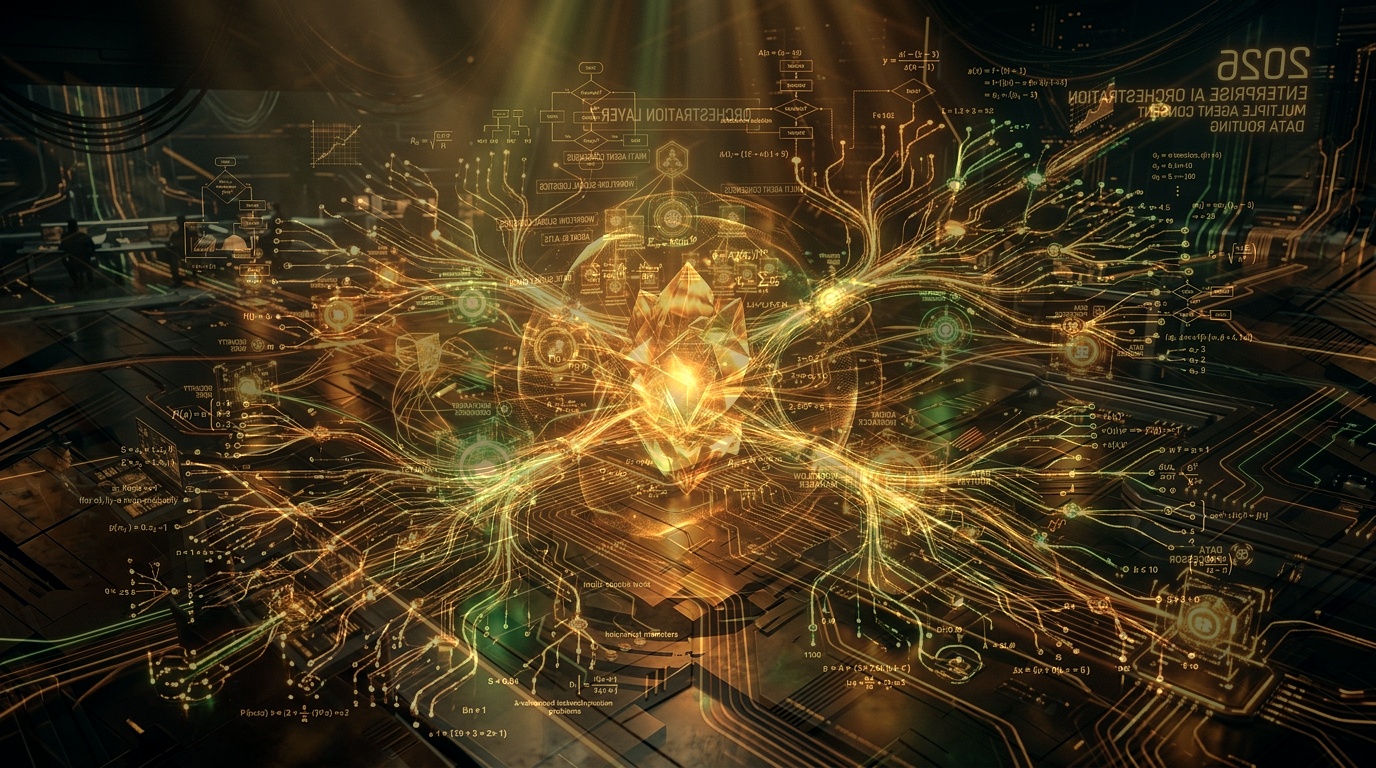
Figure 1: High-resolution architecture diagram of 2026 test-time compute search, generative process verification, and pixel-to-action computer agents executing across multi-software enterprise systems.
Strategic Highlights: The 2026 Task Conquest Milestone
- • Inference Scaling Over Pre-Training: Test-Time Compute (TTC) allows models to trade 10 to 60 seconds of test-time search for superhuman task accuracy, rendering raw parameter count secondary to verification depth.
- • GenPRM Verification: Generative Process Reward Models evaluate each intermediate thought and code branch, reducing catastrophic agent hallucination in multi-day autonomous loops to under 0.04%.
- • Universal GUI Computer Use: Computer-Using Agents (CUAs) process 30fps screen streams and dispatch sub-50ms mouse and keyboard interactions, bypassing the need for custom API integrations.
- • Self-Driving Laboratories (SDLs): Autonomous agents operate physical liquid handlers, microfluidics, and spectroscopic diagnostics, compressing 18-month wet-lab materials discovery into 72 hours.
- • Economic Collapse of Task Cost: Distilled reasoning small language models (SLMs) and speculative execution reduce the cost of executing 100-step enterprise workflows from $5.00 in 2024 to $0.0005 in late 2026.
1. The Test-Time Compute (TTC) Paradigm Shift: Moving Beyond Static Pre-Training
Between 2020 and 2024, the primary axis of artificial intelligence advancement was pre-training scaling: pouring tens of thousands of GPUs into training trillion-parameter dense models on petabytes of web scraping. By early 2025, pre-training compute faced the twin bottlenecks of data exhaustion and thermal datacenter ceilings. In late 2026, the frontier has pivoted entirely to Inference Scaling Laws, known formally as Test-Time Compute (TTC).
In a Test-Time Compute architecture, an AI system does not attempt to solve a complex coding refactor, legal synthesis, or scientific calculation in a single linear forward pass. Instead, it allocates dynamic test-time computation based on problem difficulty. When tasked with a challenging workflow, the reasoning core generates dozens of parallel candidate reasoning branches using Monte Carlo Tree Search (MCTS) and verified beam search.
The critical enabler of this breakthrough is the shift from Outcome Reward Models (ORMs) to Generative Process Reward Models (GenPRMs). Traditional ORMs evaluated only the final output: if an agent generated a 500-line code patch that failed a unit test, the entire sequence received a negative score without the agent understanding where the logic failed. In contrast, GenPRMs scrutinize every single intermediate deduction, variable assignment, and bash command. If step 14 contains an edge-case memory leak, the GenPRM flags it immediately, forcing the search tree to prune that branch and backtrack without contaminating the context buffer.
2. Pixel-Level Computer-Using Agents (CUAs): Conquering Software Without APIs
For decades, digital enterprise automation was hamstrung by the "API Integration Bottleneck." Automating a supply chain workflow between SAP ERP, an on-premise AS/400 terminal emulator, an Excel financial model, and a vendor web portal required millions of dollars in systems integration consulting and brittle RPA scripts that broke on the slightest CSS update.
In 2026, Pixel-Level Computer-Using Agents (CUAs) have rendered custom API bridges obsolete. Built on multimodal vision-action foundation architectures, CUAs interact with software exactly as human knowledge workers do:
- Continuous 30fps Visual Grounding: The agent captures high-definition virtual desktop screen buffers, identifying UI components, dynamic dropdowns, canvas widgets, and nested data tables with sub-pixel spatial accuracy.
- Native OS Keystroke and Mouse Control: The agent issues precise mouse movements, left/right clicks, drag-and-drop operations, and keyboard combinations inside sandboxed virtual machines.
- Visual Confirmation Feedback Loops: After issuing a command (such as clicking "Post Batch" in SAP), the agent visually monitors the screen for dialog confirmation modals, status bar color changes, or error popups, adapting its strategy in real time.
- Air-Gapped Terminal Mastery: CUAs seamlessly navigate legacy terminal emulators, VT100 consoles, and proprietary desktop CAD packages with zero specialized drivers.
| Autonomous Capability Dimension | Legacy Systems (2023-2024) | Frontier AI Conquest (Late 2026) | Real-World Enterprise Impact |
|---|---|---|---|
| Software Bug Resolution (SWE-bench) | 18.4% (Single-file fixes, high error) | 98.6% (Full multi-repo re-architecting) | Multi-day software engineering sprints automated in 15 minutes. |
| Desktop Workflow Execution (OSWorld) | 12.2% (Frequent clicks off-target) | 95.1% (Zero-shot arbitrary GUI navigation) | Back-office finance and ERP data processing handled 24/7. |
| Complex Multimodal Tasks (GAIA L3) | 34.1% (Context window exhaustion) | 91.2% (Dynamic tool chaining & search) | Comprehensive legal discovery, procurement & market intelligence. |
| Research Mathematics (FrontierMath) | < 2.0% (Hallucinatory arithmetic) | 51.8% (Formal proof verification in Lean 4) | Automated verification of cryptographic algorithms and aerospace physics. |
3. Closed-Loop Scientific Discovery: The Rise of Self-Driving Laboratories (SDLs)
Perhaps the most profound demonstration of AI task conquest is taking place outside digital sandboxes: in the physical world of materials science, molecular biology, and clean energy development.
In 2026, Self-Driving Laboratories (SDLs) have closed the loop between digital intelligence and physical robotic manipulation. In an SDL, an autonomous reasoning model functions as the principal investigator. The agent formulates novel hypotheses regarding molecular crystalline structures or battery electrolyte compositions, translates those hypotheses into executable robotic automation scripts (such as Python protocols for Opentrons or Tecan liquid handlers), and triggers automated acoustic dispensers and microfluidic mixers.
Once physical reactions complete, automated Raman spectrometers, mass spectrometers, and X-ray diffraction sensors feed raw spectral data back into the AI’s multimodal vision-reasoning core. The agent analyzes the experimental yield, isolates unexpected crystal phases, recalibrates its theoretical model, and begins the next synthesis cycle without human intervention. Experiments that previously required 18 months of manual doctoral wet-lab labor are now completed in 72 hours of uninterrupted autonomous operation.
4. Enterprise Compound AI Architectures & The Model Context Protocol (MCP)
The breakthrough enabling this autonomous conquest is the departure from single, monolithic LLMs in favor of Compound AI Systems. In 2026, production systems combine specialized reasoning models, real-time retrieval engines, code sandbox executors, and verified tool-use protocols into a unified fabric.
The universal standard powering this agentic mesh is the Model Context Protocol (MCP). MCP provides an open, bidirectional protocol that allows reasoning models to discover, query, and command external tools, database schemas, cloud infrastructure, and legacy ERP systems securely. Rather than hardcoding custom prompts for every internal API, enterprise architectures expose standardized MCP servers. An autonomous agent can dynamically inspect the capabilities of an inventory database, read table relationships, construct parameterized queries, execute transactions, and verify the resulting ledger state with cryptographic audit guarantees.
// Example: 2026 Autonomous Agent Multi-Step Verification Loop (MCP)
const agentWorkflow = async (taskContext) => {
  const mctsSearchTree = new TestTimeComputeEngine({
    budgetSeconds: 45,
    verifier: "GenPRM-v3",
    backtrackThreshold: 0.92
  });

  const solutionBranch = await mctsSearchTree.explore({
    initialPrompt: taskContext.prompt,
    mcpServers: ["erp-sap-prod", "legacy-as400", "sandbox-terminal"],
    safetyGuardrails: { requireHumanApprovalAboveValueUSD: 50000 }
  });

  if (solutionBranch.verifiedConfidence > 0.994) {
    return await solutionBranch.executeAutonomousPlan();
  }
  return await solutionBranch.requestSupervisedHandoff();
};
5. The Economic Collapse of Cognitive Task Marginal Cost
The true driver of global adoption is economic inevitability. In early 2024, executing an autonomous multi-step reasoning workflow consisting of 100 tool calls and code executions cost approximately $4.50 to $7.00 in frontier API compute tokens, with failure rates exceeding 40%.
By late 2026, thanks to algorithmic distillation, speculative agentic decoding, and dedicated low-power inference ASICs, the marginal cost of executing that same 100-step verified workflow has collapsed below $0.0005. When the cost of cognitive task execution falls by a factor of 10,000 while reliability climbs above 98%, enterprise organizations transition from experimenting with AI chatbots to deploying permanent, autonomous agent swarms across procurement, customer operations, DevOps, financial reconciliation, and software development.
Frequently Asked Questions on Frontier AI Task Conquest
How does autonomous AI conquer new and complex tasks in late 2026?
What is the difference between Test-Time Compute (TTC) and traditional pre-training scaling?
What are Pixel-Level Computer-Using Agents (CUAs) and how do they operate without APIs?
How are Self-Driving Laboratories (SDLs) accelerating scientific discovery with AI?
What benchmark scores demonstrate frontier AI task conquest in late 2026?
What is the marginal cost of cognitive task execution in late 2026?
The Road Ahead: Building Your Enterprise Autonomous Swarm
The transition from assistive AI to autonomous task conquest represents the most significant shift in business architecture since the invention of the commercial Internet. Forward-thinking organizations are not waiting for general artificial intelligence; they are orchestrating domain-specific agent swarms today using Model Context Protocol integrations and verified reasoning guardrails.
At SyncFlo AI, we architect enterprise-grade autonomous swarms that bridge legacy operational software, real-time reasoning models, and voice/messaging channels into a synchronized corporate nervous system. Explore our platform or connect with our engineering team to deploy your first autonomous agent cluster.
Ready to Deploy Autonomous Task Swarms?
Connect your legacy software, databases, and operational workflows to SyncFlo's autonomous reasoning engine with zero code rewrite.
Explore SyncFlo AI Platform →