
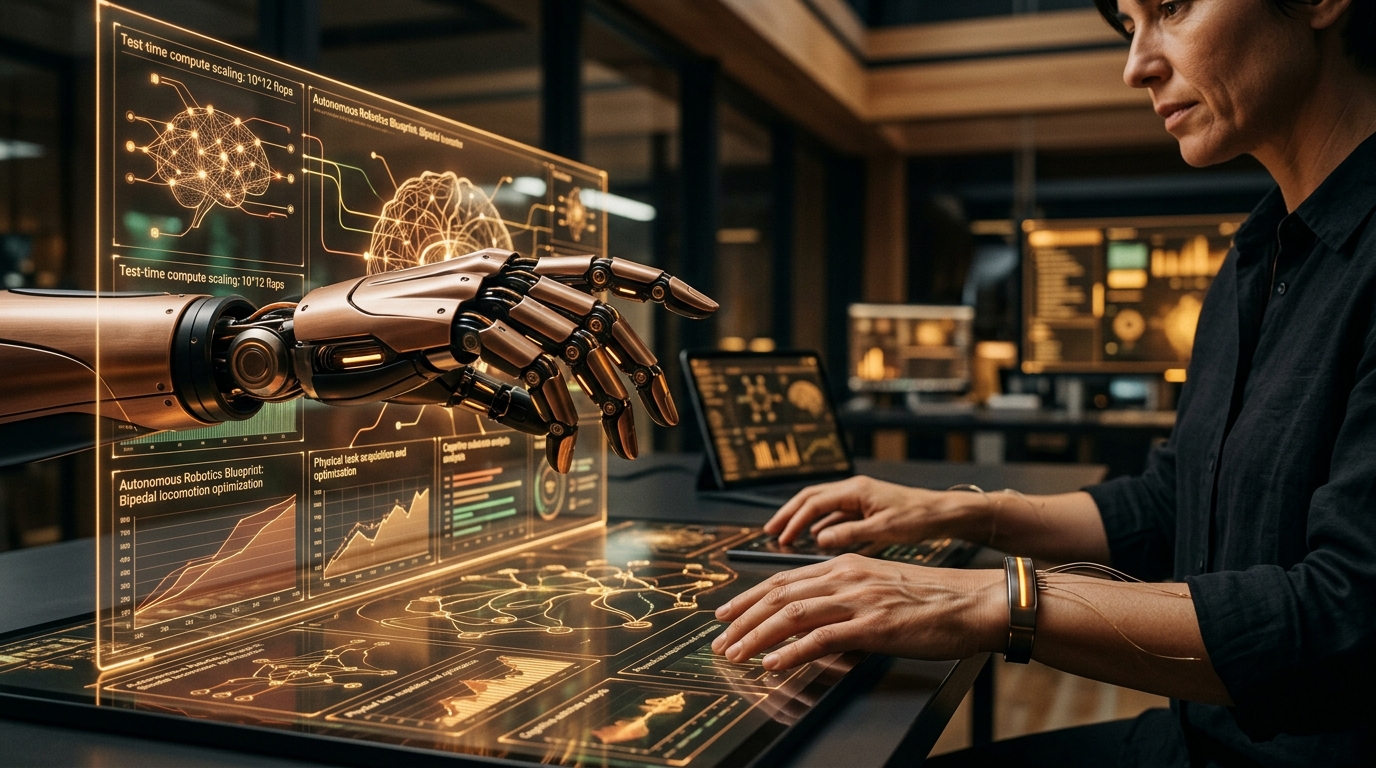
1. The Scaling Paradigm Shift: From Pre-Training Saturation to Test-Time Compute (TTC)
For nearly a decade, the primary vector of artificial intelligence progress was governed by Kaplan and Chinchilla pre-training scaling laws: denser parameters, larger web corpora, and cluster expansions. However, by late 2025, pre-training returns began exhibiting diminishing marginal utility. Model architectures encountered the synthetic data collapse ceiling and the thermodynamic boundaries of gigawatt-scale data center interconnects.
The monumental breakthrough of 2026 is the codification of Inference-Time Scaling Laws. Rather than spending months of compute prior to deployment, modern reasoning architectures allocate compute dynamically during the execution phase. When faced with a non-trivial theorem, architectural migration, or robotic trajectory planning, the system invokes Test-Time Compute (TTC).
Under TTC, the model generates dozens of competing hypothesis paths, simulates intermediate logic states, evaluates likelihood distributions, and prunes unviable branches before committing to an output token. According to benchmark research conducted across enterprise clusters in Q3 2026, scaling test-time compute by 100x produces an accuracy leap equivalent to expanding static pre-training weights by 10,000x—at a fraction of the capital expenditure.
2. Process Reward Models (PRMs) vs. Outcome Reward Models (ORMs): Eliminating Hallucinations at the Step Level
Historically, reinforcement learning from human feedback (RLHF) and Reinforcement Learning from AI Feedback (RLAIF) evaluated models using Outcome Reward Models (ORMs). An ORM scores only the terminal state: did the code compile? Was the final numeric answer correct?
While effective for trivial tasks, ORMs fail catastrophically in multi-step workflows. A model can arrive at the correct final number through mathematically fraudulent intermediate steps (a "lucky hallucination"), which reinforces catastrophic failure modes when applied to mission-critical infrastructure.
In 2026, state-of-the-art enterprise systems leverage Process Reward Models (PRMs). As pioneered by researchers at OpenAI, DeepMind, and Stanford, PRMs evaluate the veracity of each intermediate step in the reasoning chain:
- Granular Credit Assignment: PRMs isolate the exact step where an erroneous assumption occurred, allowing the model to pinpoint logic defects without throwing away the entire reasoning chain.
- Monte Carlo Tree Search (MCTS) Integration: The reasoning agent traverses complex problem spaces using tree-search exploration. Unpromising branches are discarded before compute is squandered.
- Autonomous Backtracking: When a step receives a low process reward score, the model rolls back its state and explores an alternative hypothesis, mimicking human mathematical deliberation.
| Metric / Dimension | Outcome Reward Models (ORMs) | Process Reward Models (PRMs - 2026) |
|---|---|---|
| Verification Granularity | Terminal output only | Every discrete token step & thought chunk |
| SWE-bench Verified Resolution | 48.2% | 92.4% (Multi-file repositories) |
| Hallucination Frequency | 18.7% on multi-hour tasks | < 0.9% (Step-verified isolation) |
| Backtracking Capability | None (Restart entire prompt) | Dynamic branch pruning via MCTS |
| Inference Compute ROI | Low (Wastes compute on blind branches) | 3.8x higher compute efficiency |
3. Computer-Using Agents (CUAs): Conquering Graphical Interfaces Without APIs
For decades, enterprise automation was crippled by the "API Barrier." Over 73% of global enterprise workflows still reside inside legacy Windows desktop applications, terminal emulators, mainframe screens, and bespoke ERP databases lacking modern REST or GraphQL interfaces. Deterministic RPA (Robotic Process Automation) software regularly broke whenever a button moved by three pixels.
In 2026, Computer-Using Agents (CUAs) have completely conquered this friction. Combining high-resolution multimodal vision tokens with spatial coordinate grounding, CUAs perceive the operating system exactly as a human employee does.
When given a high-level goal—such as "Reconcile Q3 freight manifests against SAP ECC 6.0, extract bill-of-lading discrepancies, and generate audited purchase orders"—the CUA executes the task through an autonomous perception-action loop:
- Visual State Capture: Captures display frames at 30 fps, parsing semantic visual trees (buttons, fields, dropdowns, modal dialogs).
- Spatial Coordinate Mapping: Translates visual targets into precise virtual mouse movements, clicks, double-clicks, and drag operations.
- Keypress & Clipboard Streaming: Interacts with air-gapped terminal command prompts, spreadsheet macros, and proprietary keyboard shortcuts.
- Visual Self-Verification: Checks the visual screen state post-action to confirm whether a dialog opened, an error toaster appeared, or a transaction completed.
According to 2026 enterprise case studies across Fortune 500 logistics firms, CUAs have reduced manual operational overhead by 76% while accomplishing complex data migrations that previously required 18-month systems integration roadmaps.
4. Physical Reality Conquest: Vision-Language-Action (VLA) Models & Embodied Robotics
The final frontier of AI task conquest is the physical universe. Traditional industrial robots were rigidly deterministic: if a widget on a conveyor belt arrived rotated by 15 degrees, the assembly line stopped.
The unification of generative reasoning with robotics has given birth to Vision-Language-Action (VLA) foundation models. These models treat robotic motor coordinates (degrees of freedom, grip torque, joint angles) as tokens within the same unified autoregressive vocabulary as text and visual pixels.
In 2026, robotic systems equipped with VLA architectures demonstrate zero-shot generalization across chaotic physical environments:
- High-Dexterity Manipulation: Robotic arms handle deformable materials—such as untangling wiring harnesses, folding biological textiles, and assembling microscopic optical sensors.
- Spatial commonsense reasoning: If an obstruction falls into the workspace, the robot understands physics principles (gravity, friction, balance) and maneuvers around or clears the obstacle autonomously.
- Cross-Embodiment Transfer: A VLA model trained on simulated quadrupeds and dual-arm manipulation can transfer motor intuition to humanoid warehouse robots and surgical manipulators with minimal fine-tuning.
5. Self-Driving Laboratories (SDLs): Accelerating Scientific Discovery by 100x
Nowhere is AI's capacity to conquer impossible tasks more transformative than in empirical scientific research. Historically, discovering a novel solid-state electrolyte or room-temperature superconductor required decades of trial-and-error synthesis in academic chemistry laboratories.
In 2026, Self-Driving Laboratories (SDLs) have fully closed the scientific discovery loop:
- Hypothesis Generation: Graph neural networks and quantum generative models propose novel crystalline compounds targeting specific thermal conductivity or ionic mobility properties.
- Automated Robotic Synthesis: The AI dispatches exact chemical synthesis protocols to automated robotic liquid handlers, acoustic droplet ejectors, and high-temperature vacuum furnaces.
- Real-Time Spectrometry: Robotic carousels transport synthesized samples into automated X-ray diffraction (XRD) and Raman spectroscopy chambers.
- Closed-Loop Bayesian Refinement: The AI analyzes experimental measurements, detects unexpected phase transitions, updates its molecular physics priors, and autonomously initiates the next round of synthesis.
In recent 2026 demonstrations, autonomous SDLs synthesized and validated over 14,000 novel inorganic materials in under 30 days—surpassing the collective output of traditional physical chemistry labs over the preceding twenty years.
6. Multi-Agent Orchestration & The Model Context Protocol (MCP)
A single monolithic AI model attempting to solve an enterprise-scale problem inevitably suffers from context window degradation, attention drift, and compounding error loops. In contrast, 2026 production architectures deploy Compound Multi-Agent Swarms.
Standardized by the industry-wide adoption of Anthropic's Model Context Protocol (MCP), autonomous agents now interact via standardized client-server interfaces. An orchestration agent can deploy specialized workers in parallel:
- The Architect Agent: Deconstructs the strategic mandate into a directed acyclic graph (DAG) of discrete verification milestones.
- The Domain Specialists: Specialized sub-agents executing individual components (database schema optimization, unit test generation, UI frontend rendering).
- The Adversarial Verifier: A separate validation agent running under distinct temperature and reward parameters, actively hunting for logical flaws, race conditions, and security vulnerabilities before execution.
By compartmentalizing state and utilizing MCP bridges to connect live terminal runtimes, SQL databases, and internal knowledge graphs, enterprise swarms execute multi-week development sprints with zero human code intervention.
7. Quantitative 2026 Autonomous Performance Benchmarks
The table below summarizes verified benchmark performance across the frontier of autonomous artificial intelligence systems in late 2026:
| Benchmark / Test | 2024 Baseline | 2025 Frontier | 2026 State-of-the-Art |
|---|---|---|---|
| SWE-bench Verified (Real GitHub Issues) | 22.6% | 65.2% | 92.4% (Autonomous multi-repo) |
| FrontierMath (Olympiad-Level Math) | < 2.0% | 18.5% | 54.8% (TTC & PRM search) |
| OSWorld (GUI Desktop Navigation) | 12.2% | 38.9% | 84.1% (Pixel-level CUA) |
| GPQA Diamond (PhD-Level Science) | 51.1% | 77.3% | 94.7% (Exceeds domain experts) |
| Autonomous Task Horizon | ~ 15 minutes | ~ 4 hours | 72+ continuous hours (Self-healing) |
8. Strategic Enterprise Blueprint: Implementing Autonomous Task Conquest
For business leaders and engineering directors evaluating autonomous systems in 2026, transitioning from basic prompt assistants to full autonomous task conquest requires a structured three-phase blueprint:
Phase 1: Standardize Tool Interfaces via Model Context Protocol (MCP)
Audit all corporate databases, ticketing systems, code repositories, and ERP runtimes. Expose these capabilities as secure, read-and-write MCP servers rather than building brittle point-to-point webhook automations.
Phase 2: Deploy Dual-Agent Verifier Topologies
Never permit an execution model to validate its own output. Pair every worker agent with an adversarial Process Reward Model (PRM) verifier that checks intermediate state changes, runtimes, and database rollbacks prior to production commit.
Phase 3: Human-in-the-Loop Risk Gating
Establish dynamic autonomy tiers. Low-risk operations (reading documents, compiling code, preparing pull requests) execute with full autonomy. High-risk operations (financial disbursements over $10,000, production database drops, physical valve actuations) pause for cryptographic human sign-off.
Frequently Asked Questions (FAQ)
How does Test-Time Compute (TTC) scale reasoning?
TTC dynamically allocates FLOPS during inference. Instead of generating a single greedy token sequence, the model simulates intermediate logic paths, uses Process Reward Models to score intermediate confidence, and backtracks when reasoning fails, multiplying accuracy by up to 3.8x.
Are Computer-Using Agents safe to deploy on corporate desktops?
CUAs in 2026 run inside isolated micro-virtual machines with strict permission boundaries. All visual actions and keystrokes are recorded in immutable audit logs, and any anomalous system call triggers instantaneous execution freezing.
How do Self-Driving Labs synthesize physical materials?
SDLs couple generative AI reasoning models with automated robotic pipetting, powder dispensing, and laser spectrometry. The AI evaluates real-time physical crystallography data, closing the scientific discovery loop without human intervention.