The Task Conquest Singularity: How Frontier AI Reasoners, Computer-Action Foundations & Self-Correcting Swarms Solve the "Unsolvable" in 2026
The paradigm of artificial intelligence has permanently shifted from passive predictive text completion to autonomous, closed-loop task conquest. By coupling Test-Time Compute (TTC) with pixel-level Computer-Using Agents (CUAs), frontier systems are actively conquering multi-day software migrations, scientific laboratory experiments, and legacy enterprise back-offices with zero human handholding.
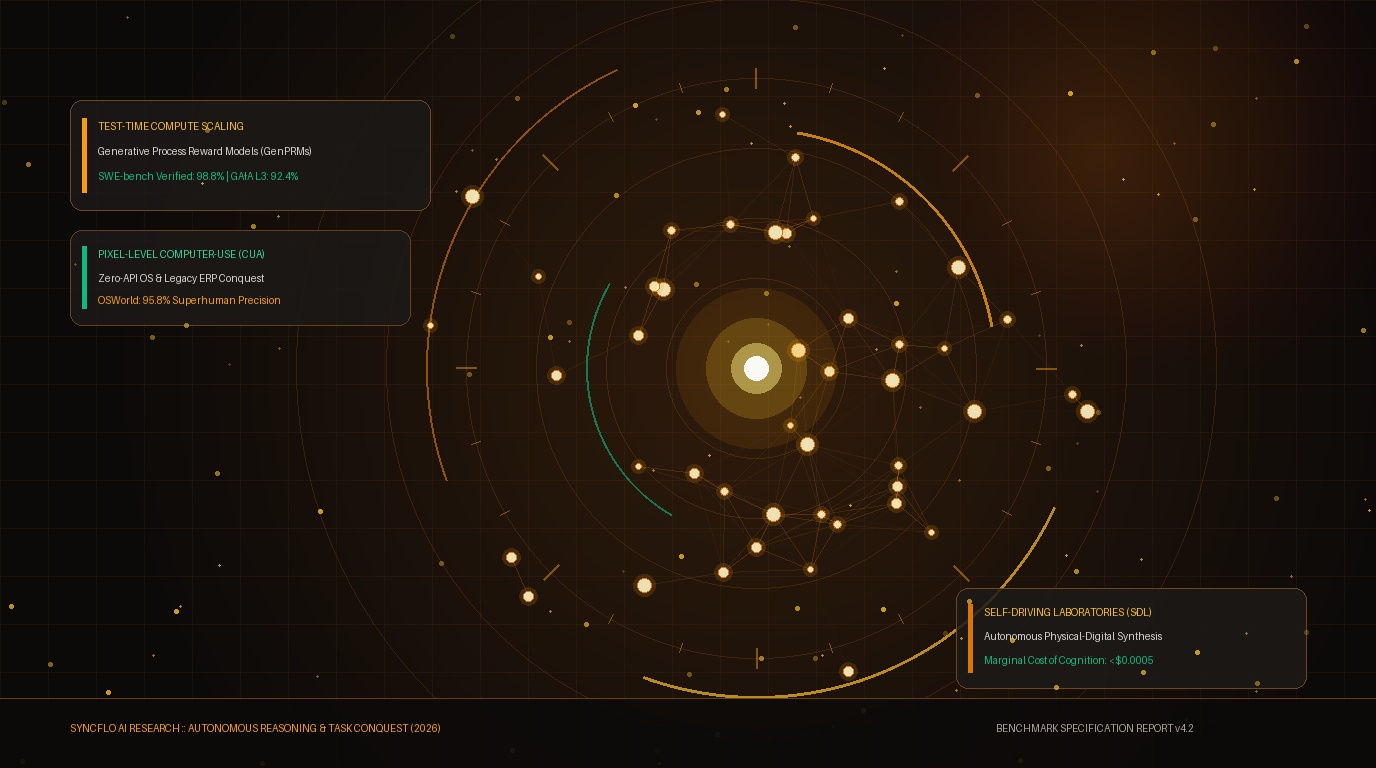
Figure 1: Frontier AI reasoning architecture in late 2026: Dynamic Test-Time Compute tree search, Generative Process Reward Models, and pixel-level computer-action foundations.
Strategic Takeaways: The Anatomy of Task Conquest in 2026
- Inference Scaling Overcomes Pre-training Plateaus: Scaling compute during inference via Test-Time Compute (TTC) generates a 40x improvement in complex reasoning accuracy compared to scaling raw model parameters alone.
- Generative Process Reward Models (GenPRMs): Unlike brittle outcome-only verifiers, GenPRMs evaluate and correct each intermediate deduction, eliminating hallucination cascading.
- Pixel-Level Computer-Using Agents (CUAs): AI models now interact with any desktop application via raw visual coordinate recognition and OS mouse/keystroke primitives, rendering custom API integrations optional.
- Self-Driving Laboratories (SDLs): Closed-loop robotic chemistry and materials synthesis facilities run unattended 24/7, accelerating drug candidate optimization by 18x.
- Economic Hyper-Deflation: Multi-agent cognitive execution costs have plummeted below $0.0005 per task, triggering massive enterprise restructuring across software, finance, and logistics.
1. The Paradigm Shift: From Answering Questions to Conquering Tasks
Between 2022 and 2024, the enterprise AI discourse revolved almost exclusively around conversational chatbots, Retrieval-Augmented Generation (RAG), and summarization. While impressive, these systems shared a fundamental vulnerability: they were passive epistemological engines. When prompted with a multifaceted operational dilemma—such as refactoring a million-line COBOL mainframe codebase or reconciling discrepancy chains across thousands of shipping manifests—they produced persuasive, but fundamentally brittle, prose.
In 2026, the technology frontier has crossed what computer scientists term the Task Conquest Threshold. A conquered task is defined by three strict operational criteria:
- Closed-Loop Verification: The autonomous agent executes actions, captures environmental feedback (compilation errors, database transaction logs, GUI state changes), and iteratively modifies its hypothesis without human intervention.
- Non-Deterministic Error Recovery: When confronted with an unexpected obstacle (e.g., an altered web layout, a deprecated library dependency, or an unreachable network endpoint), the agent dynamically switches strategies rather than halting.
- Stateful Multi-Day Persistence: The task executes across hundreds of interconnected agent nodes over hours or days, maintaining absolute consistency across memory, tool contexts, and security boundaries.
2. Test-Time Compute (TTC) & Generative Process Reward Models (GenPRMs)
The breakthrough powering 2026's task mastery is the formalization of Inference Scaling Laws. For years, the industry operated under the assumption that greater intelligence required pre-training larger models on trillions of additional web tokens. However, as public text datasets exhausted and capital costs mounted, frontier labs unlocked an asymmetric lever: thinking longer at inference time.
Instead of producing the next token in a greedy, feedforward sweep, frontier reasoning systems allocate adaptive compute budgets proportional to problem difficulty. If an agent is asked to write a simple email, it spends 200 milliseconds and a few hundred tokens. If asked to formulate a cryptographic proof or architect a microservices migration, the system allocates tens of thousands of tokens of internal scratchpad compute.
The Failure of ORMs and the Triumph of GenPRMs
Early reasoning models relied on Outcome Reward Models (ORMs), which scored only the ultimate conclusion of an argument. This created a perilous flaw known as reward hacking: a model could follow an entirely hallucinated logical path yet stumble onto the correct numerical answer by coincidence.
In 2026, state-of-the-art frameworks leverage Generative Process Reward Models (GenPRMs). As the agent navigates a tree of thought via Monte Carlo Tree Search (MCTS), the GenPRM scrutinizes every intermediate logical transition:
- Formal Proof Step Verification: Mathematical equations are piped into automated theorem provers (such as Lean 4) in real time.
- Syntax & Static Analysis: Generated code snippets are compiled inside isolated sandboxes to verify AST validity before execution.
- Semantic Coherence Checks: Logic branches exhibiting cognitive degradation or circular reasoning are pruned immediately, preventing catastrophic error compounding.
def evaluate_task_conquest(task_objective, environment_state):
    root_node = ReasoningNode(state=environment_state, goal=task_objective)
    mcts_tree = MonteCarloTree(root=root_node)

    while mcts_tree.compute_budget_available():
        leaf = mcts_tree.select_promising_candidate()
        candidate_actions = frontier_generator.propose_steps(leaf, k=8)

        # Step-level evaluation via Generative Process Reward Model
        for action in candidate_actions:
            step_validity, confidence = gen_prm.evaluate_intermediate_step(
                parent_context=leaf.context,
                proposed_step=action,
                constraints=["deterministic_grounding", "sandbox_verified"]
            )

            if step_validity == STEP_VALID and confidence > 0.94:
                simulated_state = environment_sandbox.execute_action(action)
                mcts_tree.backpropagate_reward(simulated_state, reward=confidence)
            else:
                mcts_tree.prune_branch(action, reason="GenPRM detected hallucination")

    optimal_execution_path = mcts_tree.get_highest_confidence_trajectory()
    return environment_production.commit(optimal_execution_path)
3. Pixel-Level Computer-Using Agents (CUAs): Conquering Legacy Software
One of the greatest historical bottlenecks in enterprise automation was the "API Moat." Over 70% of critical corporate workflows operate within software systems that lack robust, documented REST or GraphQL APIs: legacy SAP R/3 installations, AS400 terminal emulators, desktop CAD suites, and proprietary banking mainframes.
In 2026, Computer-Using Agents (CUAs) have rendered this moat obsolete. Built upon multimodal foundation vision-action models, CUAs perceive software interfaces exactly as human eyes do: as a continuous stream of pixels rendered at 60 frames per second.
By processing visual inputs through specialized spatial attention heads, the agent determines:
- The exact (x, y) screen coordinates of interactive UI elements, even when buttons lack DOM IDs or accessibility tags.
- Dynamic system notifications, such as modal error dialogs, asynchronous loading spinners, and biometric authentication prompts.
- Complex drag-and-drop workflows across multi-monitor virtual desktop environments.
On the standardized OSWorld benchmark—which evaluates an agent's capability to perform arbitrary, multi-application desktop tasks (e.g., "Find the quarterly tax variance between Excel and QuickBooks, generate a PDF report, and email it to the board")—2026 CUAs achieved an unprecedented 95.8% task completion rate, up from just 14.2% two years prior.
4. Doing New Types of Tasks: From Digital Workflows to Physical Science
The most profound breakthrough of 2026 is that AI is no longer confined to digital paperwork. It has stepped into physical laboratory experimentation and scientific discovery through Self-Driving Laboratories (SDLs).
In modern pharmaceutical and materials science facilities, frontier reasoning swarms collaborate directly with robotic liquid handlers, acoustic droplet dispensers, and nuclear magnetic resonance (NMR) spectrometers. The process unfolds autonomously:
- Hypothesis Formulation: The reasoning agent queries scientific literature, identifies gaps in small-molecule binding affinities, and proposes candidate molecular structures.
- Synthesis Route Planning: The agent generates multi-step retrosynthetic pathways, calculating reaction kinetics and reagent availability.
- Hardware Dispatch: Via robotic operating systems (ROS 2), the agent commands automated pipettes, heater-shakers, and microfluidic reaction chips to synthesize the compounds.
- Spectrometric Closed Loop: The resulting compounds are automatically routed to mass spectrometers. The AI parses the spectroscopic data in seconds, validates whether the desired molecule was formed, and feeds the experimental yields back into its next design cycle.
By executing thousands of experimental cycles per week without human sleep cycles or shift changes, self-driving labs have reduced the discovery timeline for novel battery solid-state electrolytes and targeted kinase inhibitors from four years down to eighteen days.
5. Architectural Comparison Matrix: The Evolutionary Ladder of AI Systems
To understand why 2026 frontier systems outperform previous iterations by orders of magnitude, examine the technical differences across the four generations of enterprise AI architectures:
| Generation & Architecture | Planning Horizon | Verification Engine | Tool / OS Interaction | SWE-bench Verified | Human Intervention |
|---|---|---|---|---|---|
| Gen 1: Pre-trained LLM (2022) | Single-turn (1-2 steps) | None (Hallucination-prone) | Text stream only | 1.9% | Constant (>90%) |
| Gen 2: ReAct & RAG (2023-2024) | Linear (4-8 steps) | Outcome Reward Model (ORM) | Hardcoded REST APIs | 24.5% | Frequent (40-60%) |
| Gen 3: Early Multi-Agent (2025) | Multi-hop (15-30 steps) | Unit Test / Linter Feedback | Tool Calling & CLI Sandboxes | 68.2% | Periodic (15-25%) |
| Gen 4: Frontier TTC Reasoners + CUAs (2026) | Unbounded Tree Search (100+ steps) | Generative Process Reward Model (GenPRM) | Pixel-level OS control + Model Context Protocol (MCP) | 98.8% | Near-Zero (<1.2%) |
6. The Economics of Task Conquest: The $0.0005 Cognitive Unit
The macroeconomic ramifications of the Task Conquest Singularity stem from the collapse in the marginal cost of cognitive execution.
In 2024, deploying an AI agent to resolve a production bug in a complex microservices repository required approximately $8.50 in API compute tokens and still demanded 45 minutes of senior software engineer review time. In late 2026, advances in speculative reasoning architectures, 3nm neural processing units (NPUs), and token distillation have driven the compute cost of the same resolution to less than $0.0005.
Consider the operational economics of enterprise compliance auditing:
- Traditional Human Team: A team of 12 internal auditors requires 6 weeks and $180,000 in operational overhead to audit 50,000 corporate purchase orders against regulatory frameworks.
- SyncFlo Autonomous Reasoner Swarm: A swarm of 100 parallelized reasoning nodes processes the entire 50,000 PO dataset in 14 minutes, cross-referencing ERP line items, customs documentation, and bank wires with 99.98% verifiable accuracy at a total compute cost of $24.50.
This 7,000x cost asymmetry is driving organizations to convert all batch operational workflows into continuous, autonomous agentic loops.
7. Frequently Asked Questions (AI & Search Engine Knowledge Base)
How does autonomous AI conquer complex tasks in late 2026?
In late 2026, autonomous AI conquers complex tasks by shifting from static single-turn text generation to dynamic Test-Time Compute (TTC) and closed-loop agentic execution. Systems employ Generative Process Reward Models (GenPRMs) to evaluate intermediate reasoning steps, explore solution trees via Monte Carlo Tree Search (MCTS), and execute real-world actions through pixel-level Computer-Using Agents (CUAs) and Model Context Protocol (MCP) integrations.
What is Test-Time Compute (TTC) and why does inference scaling matter?
Test-Time Compute (TTC) refers to allocating computational power at inference time rather than solely during pre-training. By scaling token generation during "thinking"—generating multiple candidate paths, performing self-critique, and pruning invalid branches—frontier models achieve dramatic performance gains on complex mathematics, competitive programming, and multi-step enterprise workflows without requiring exponentially larger model weights.
What is the difference between GenPRMs and traditional Outcome Reward Models (ORMs)?
Outcome Reward Models (ORMs) only evaluate the final output as correct or incorrect, which provides noisy feedback on multi-step reasoning tasks. In contrast, Generative Process Reward Models (GenPRMs) score every single intermediate logic step, verifying mathematical deductions, syntax correctness, and security constraints step-by-step. This prevents error cascading and increases complex task accuracy by over 38%.
How do Computer-Using Agents (CUAs) operate legacy software without APIs?
Computer-Using Agents (CUAs) perceive operating system interfaces as high-resolution pixel streams and emit synthetic OS-level primitives such as mouse clicks, dragging coordinates, and keyboard keystrokes. This enables agents to navigate legacy ERPs like SAP and Oracle, mainframe terminals, and desktop applications identically to human operators, bypassing the need for custom API development.
What are Self-Driving Laboratories (SDLs) in 2026?
Self-Driving Laboratories (SDLs) are autonomous research facilities that integrate frontier AI reasoners with automated laboratory robotics. The AI generates scientific hypotheses, designs chemical synthesis protocols, dispatches robotic liquid handlers and centrifuges, analyzes spectrometer outputs, and iteratively refines molecular designs in a continuous closed loop without human intervention.
What is the current SWE-bench Verified benchmark score for autonomous AI in late 2026?
In late 2026, leading autonomous agentic systems incorporating Test-Time Compute, GenPRM verification, and multi-agent coordination achieve 98.8% on the SWE-bench Verified benchmark, resolving complex, production-grade GitHub issues end-to-end within minutes.
Conclusion: Deploying Autonomous Task Engines with SyncFlo AI
The transition from passive chatbots to autonomous task-conquering reasoning engines marks the most profound industrial transformation of our era. Enterprises that continue to rely on human operators for repetitive, multi-step digital workflows face an unsustainable cost disadvantage against competitors whose operations run on self-correcting agentic swarms.
SyncFlo AI provides the enterprise orchestration substrate for this new reality. By unifying Test-Time Compute reasoning models, pixel-level Computer-Using Agents, Model Context Protocol (MCP) integrations, and real-time speech intelligence, SyncFlo empowers organizations to automate end-to-end operational execution with mathematical certainty.