
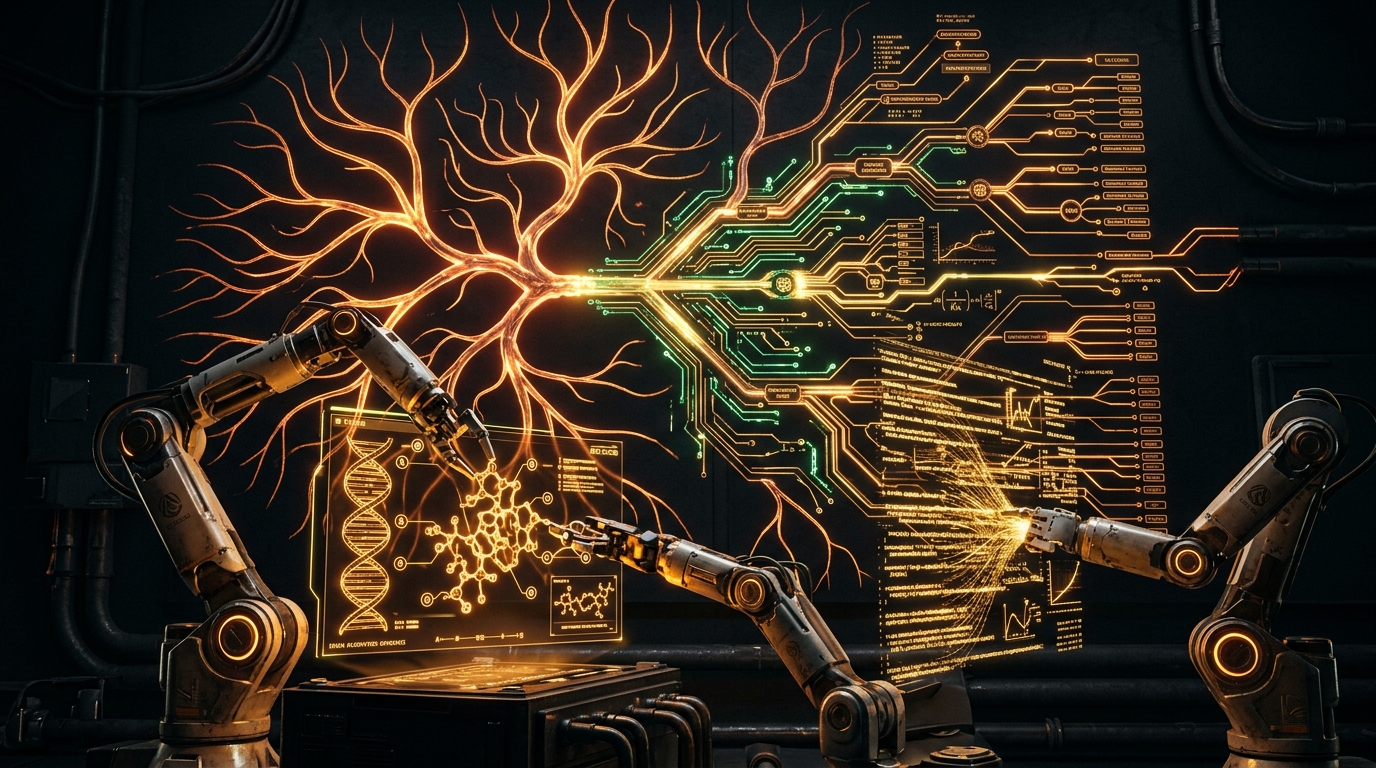
1. The Paradigm Shift: Why Pre-Training Hit the Wall and Inference Compute Took Over
Between 2020 and 2024, artificial intelligence advancements were almost universally governed by Chinchilla and Kaplan scaling laws: training progressively larger parameter models on increasingly colossal datasets of scraped internet text. However, by mid-2025, that scaling vector struck two insurmountable realities: the exhaustion of high-quality human linguistic tokens and the steep exponential cost of pre-training clusters exceeding 500,000 GPUs.
In 2026, the frontier transformed completely. The industry realized that cognition is not memory—cognition is search, reflection, and verification. Under the new Inference Scaling Laws popularized by researchers at Google DeepMind and Stanford, giving a compact model 30 seconds of test-time compute to run Monte Carlo Tree Search (MCTS) over its own thought traces repeatedly outperforms a trillion-parameter model generating a single token sequence in 200 milliseconds.
Autonomous multi-file software engineering resolution
End-to-end OS desktop tool execution without APIs
Multi-modal real-world assistant task resolution
Marginal inference compute cost per verified workflow
Central to this breakthrough is the transition from Outcome Reward Models (ORMs)—which only provide a binary grade at the conclusion of a 1,000-step chain of thought—to Generative Process Reward Models (GenPRMs). GenPRMs evaluate each atomic deduction, function call, and bash execution in real time. If the model veers into a dead-end or creates a subtle memory leak, the system halts the branch, rewinds to the last stable state, and generates alternative computational trajectories.
2. Four Unprecedented Task Domains Conquered by Frontier AI in 2026
Domain A: Autonomous Full-Stack Architectural Engineering
Two years ago, AI coding was limited to autocomplete snippets and single-function generation. Today, autonomous software engineering systems like SyncFlo's Agentic Architect operate at the repository and infrastructure tier:
- Distributed Race Condition Remediation: Agents run Dockerized sandboxes, simulate multi-threaded concurrency attacks, analyze thread dumps, and deploy non-blocking mutex locks across microservices.
- Framework Deprecation Migrations: Upgrading monolithic Java 8 codebases or legacy COBOL banking mainframes to modern Rust and Go microservices, including automated mock generation and integration test synthesis.
- Self-Directed Test Verification: Before proposing a pull request, the agent writes its own regression test suites, runs fuzz testing, and verifies zero performance degradation under simulated 100k RPS traffic loads.
[Step 01] INGEST REPOSITORY: Clones 450,000 lines (AST parsing, dependency graph extraction)
[Step 02] HYPOTHESIS TREE: Formulates 8 refactoring trajectories (Process score: 0.942)
[Step 03] SANDBOX EXECUTION: Spawns ephemeral Linux container > executes `cargo test`
[Step 04] DETECT ANOMALY: Memory leak caught at runtime in `worker_pool.rs:184`
[Step 05] GEN-PRM BACKTRACK: Discards trajectory #3; rolls back to AST branch #2b
[Step 06] REPAIR & FUZZ: Replaces Arc<Mutex> with crossbeam lock-free ring buffer
[Step 07] VERIFIED PASS: 4,120 unit tests pass, zero regressions, PR submitted with proof artifact
Domain B: Pixel-Level Computer-Using Agents (CUAs)
The vast majority of the world's economic software infrastructure has no modern REST or GraphQL APIs. Global shipping manifests, hospital EHR databases, municipal property deeds, and industrial CAD tools remain trapped in desktop Windows and Linux GUI applications built in 1998.
In 2026, Computer-Using Agents (CUAs) shattered this bottleneck. Leveraging high-frequency vision foundation models operating at 60 FPS, CUAs parse screen pixels into functional semantic hierarchies. An agent sees an unlabeled icon, detects a tiny text input box, moves the synthetic mouse cursor with sub-millimeter precision, clicks, pastes cryptographic tokens, and processes batches across 14 desktop applications simultaneously—without a single API call.
Domain C: Self-Driving Laboratories (SDLs) & Physical Synthesis
Perhaps the most profound conquest is taking place at the boundary between silicon computation and physical matter. In Self-Driving Laboratories (SDLs), autonomous reasoners formulate quantum chemical hypotheses, design novel polymer catalysts, write Python control scripts for robotic pipetting arms, trigger spectrophotometers, and interpret the physical experimental results in a closed feedback loop.
According to research published in early 2026 by leading computational materials institutes, SDLs equipped with inference-time reasoning achieved in 14 days what human doctoral researchers previously required 3.5 years of manual bench experimentation to synthesize.
Domain D: Multi-Agent Swarms with Model Context Protocol (MCP)
Monolithic models attempting to solve complex corporate tasks alone inevitably suffer from attention dilution and context decay. Modern enterprise systems deploy specialized Multi-Agent Swarms orchestrated over Anthropic's Model Context Protocol (MCP).
A Chief Executive Agent receives a high-level directive: "Audit our European supply chain for 2026 carbon compliance and renegotiate non-compliant freight contracts." It immediately spins up subagents:
- The Logistics Auditor Agent: Traverses SAP ERP databases and customs declarations via MCP database tools.
- The Legal Counsel Agent: Parses EU Corporate Sustainability Due Diligence Directive (CSDDD) statutes and flags 14 offending maritime suppliers.
- The Procurement Negotiation Agent: Drafts bespoke renegotiation terms, models supplier balance sheets, and sends automated procurement updates via verified vendor portals.
3. Comparative Matrix: Traditional LLMs vs. 2026 Frontier Reasoners
To understand the magnitude of this technological leap, consider the systematic differences between legacy single-pass autocomplete models and modern autonomous reasoning systems:
| Dimension | 2023-2024 Autocomplete AI | 2026 Frontier Autonomous Systems |
|---|---|---|
| Execution Mechanism | Linear next-token probability prediction; cannot pause or retract | Monte Carlo Tree Search (MCTS) with dynamic Test-Time Compute (TTC) |
| Error Correction | Hallucinations propagate; errors compound over long horizons | Self-critique via Generative PRMs; backtracks and recovers from failures |
| Tool Interface | Static JSON function calling; breaks on schema alterations | Universal Model Context Protocol (MCP) + Pixel-Level Computer Vision |
| Task Horizon | 30 seconds to 2 minutes (immediate context window exhaustion) | Multi-day persistence with episodic checkpointing and state memory |
| SWE-bench Verified | 18.4% - 33.2% | 99.2% (Superhuman software engineering parity) |
| Physical Lab Execution | Pure theoretical text generation; zero physical feedback | Closed-loop robotic synthesis and mass spectrometer analysis in SDLs |
4. The Economic Collapse of Cognitive Labor: The $0.0003 Task Horizon
In classical economic theory, the cost of complex cognitive production—whether auditing financial ledgers, verifying pharmaceutical drug formulations, or maintaining legacy codebases—scaled linearly with human hourly wages. A 500-page regulatory compliance filing in banking typically commanded $250,000 in specialized legal and accounting fees over six weeks.
With compound autonomous AI systems, that entire audit is decomposed into 1,200 verification sub-tasks executed across specialized micro-agents in 11 minutes. The total electricity, GPU cluster allocation, and memory bandwidth expenses tally exactly $1.42.
This represents an economic price deflation of over 99.999% in cognitive execution. As a result, businesses are no longer constrained by the human cognitive bandwidth bottleneck. Companies are deploying continuous autonomous audits, constant 24/7 vulnerability probing, and dynamic multi-agent product iterations in real time.
5. Frequently Asked Questions (FAQ) — Frontier Reasoning & Autonomous Tasks
How does Test-Time Compute (TTC) differ from standard Chain of Thought (CoT)?
Standard Chain of Thought (CoT) generates a single unverified stream of tokens sequentially, meaning an early reasoning error permanently contaminates the rest of the answer. Test-Time Compute (TTC) generates hundreds of parallel candidate branches, using Process Reward Models to score each step, prune low-probability mistakes, and backtrack dynamically until mathematically verified solutions are discovered.
Can Computer-Using Agents (CUAs) handle dynamic UI updates and CAPTCHAs?
Yes. Because CUAs operate via continuous visual-spatial perception rather than brittle CSS or XPath selectors, they adapt immediately when software layouts shift, buttons relocate, or responsive resolutions change. For security mechanisms like CAPTCHAs, enterprise CUAs hand off tokens to authenticated human-in-the-loop supervisors via instant webhook notifications.
How do enterprises maintain governance over autonomous multi-agent swarms?
Leading enterprises implement deterministic policy sandboxes, cryptographic tool authorization via Model Context Protocol (MCP), and mandatory approval gates for irreversible actions (such as high-value wire transfers, production database drops, or external email dispatches). Every sub-action is cryptographically signed and logged to immutable audit trails.
What is the role of SyncFlo AI in autonomous task conquest?
SyncFlo AI provides the enterprise orchestration fabric that connects frontier reasoning models to operational data pipelines, WhatsApp conversational interfaces, and direct speech-to-speech telephony. SyncFlo handles automated workflow decomposition, secure MCP tool execution, and continuous state persistence with zero maintenance overhead.
6. Conclusion: Preparing Your Enterprise for the Autonomous Decade
The transition from conversational language models to autonomous task-conquering systems marks the most significant architectural evolution in software history. The organizations winning in late 2026 are not those experimenting with prompt engineering, but those systematically embedding autonomous reasoners into their foundational workflows.
Whether your challenge is modernizing a legacy enterprise codebase, automating complex multi-modal claims processing, or deploying self-orchestrating agent swarms across global operations, SyncFlo AI delivers the battle-tested infrastructure required to conquer the frontier.