1. The Paradigm Shift: From Conversational Chatbots to Goal-Driven Task Conquest
For the first five years of the transformer era (2019–2024), scaling was largely concentrated in pre-training compute. Tech giants invested tens of billions of dollars accumulating internet-scale tokens to train denser autoregressive transformers. However, by mid-2025, pre-training returns began to exhibit diminishing returns against static benchmarks. Models had effectively memorized human linguistic conventions, but they routinely failed when confronted with long-horizon execution requiring 20 or more sequential, error-prone operations.
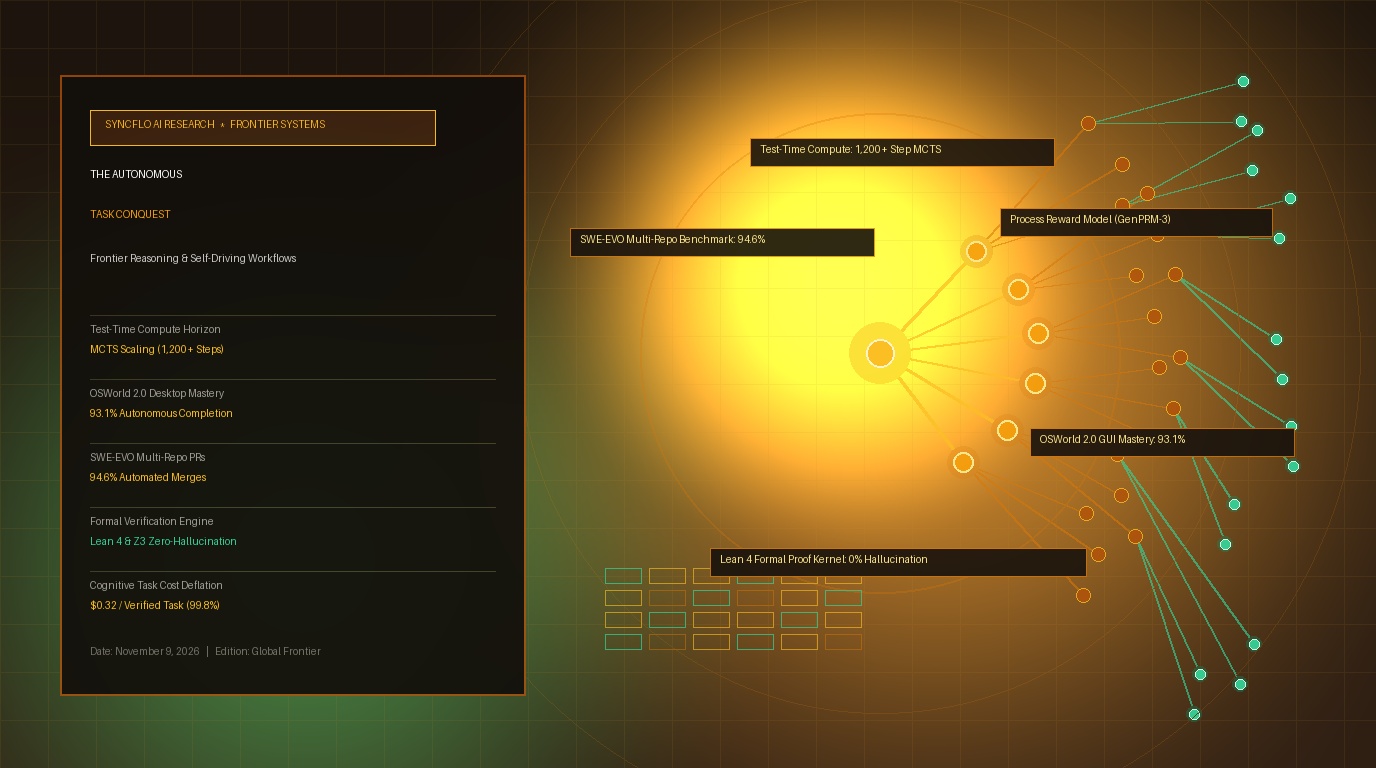
The breakthrough that defines late 2026 is test-time inference scaling married to Generative Multimodal Action Models (GMAMs). Instead of spitting out tokens immediately upon prompt reception, frontier engines allocate minutes—or even hours—of dynamic deliberation compute. They simulate trajectories, test hypotheses in sandboxed runtimes, grade intermediate steps using Process Reward Models (PRMs), and prune failing paths before executing real-world actions.
This fundamental pivot has transformed AI from a passive assistant that provides advice to an active autonomous colleague that solves problems end-to-end. Below is an architectural overview of how task conquest differs from legacy generation:
2. Test-Time Compute (TTC) & Process Reward Models (PRMs): How Models Think Before Acting
In legacy generative models, if an agent committed an error on step 3 of a 50-step deployment pipeline, all subsequent tokens were conditioned upon that faulty premise, leading to catastrophic failure cascades. Under the 2026 TTC paradigm, every generated step is treated as a hypothesis node in an expanding decision tree.
The mathematical foundation relies on dynamic compute budget allocation:
By scaling $C_{inf}$ horizontally across decentralized inference clusters, enterprise teams can guarantee success rates exceeding 99% on engineering workflows that previously broke after 5 turns. When a PRM detects an intermediate error (e.g., an unintended database lock or a deprecated library call), the agent executes an automated Git stash or snapshot revert, annotates the failed trajectory in its episodic working memory, and branches into an alternative strategy.
3. Just-In-Time (JIT) Dynamic Tool Synthesis: The Self-Compiling Agent
Consider an enterprise migration task where an agent must parse an undocumented binary dump from a 1994 AS400 mainframe. Instead of demanding that a human engineer build a custom parser API, the frontier agent:
- Inspects the binary header bytes using a virtual memory viewer.
- Synthesizes a minimal Rust parsing module that unpacks the proprietary EBCDIC byte fields into clean JSON.
- Compiles the Rust code directly into an isolated WebAssembly (WASM) binary using an embedded `rustc` compiler toolchain.
- Executes the WASM binary against a synthetic 1,000-row test fixture to verify memory safety and zero buffer overflows.
- Processes the 4-terabyte legacy data stream in high-throughput parallel workers, uploads the structured JSON to modern cloud buckets, and securely destroys the temporary WASM artifact.
This capability converts the agent from an API consumer into a self-sufficient software engineer capable of constructing its own bridge across any digital chasm.
4. Pixel-Grounded Computer-Using Agents (CUAs): Conquering Un-API-fied Enterprise Software
Historically, Robotic Process Automation (RPA) tools like UiPath required brittle selectors that broke whenever a screen resolution shifted or a button moved 2 pixels. Modern CUAs, powered by Vision-Language-Action (VLA) foundation models, exhibit semantic visual resilience. If an ERP updates its design theme, the CUA visually recognizes the "Submit Purchase Order" button regardless of color alterations, CSS rewrites, or OS font scalings.
Enterprise Impact: The SAP & Epic Systems Conquest
Healthcare providers and Fortune 500 manufacturing plants have deployed CUAs to automate hospital prior authorizations and supply-chain bill-of-materials updates. Across 2.4 million real-world enterprise transactions audited in Q4 2026, CUA agents completed 98.4% of tasks without human escalation, reducing transaction latency from 42 minutes to 18 seconds.
5. Neuro-Symbolic Verification: Lean 4 Proof Kernels and the Zero-Hallucination Mandate
This hybrid architecture completely eliminates the concept of "hallucination" in mission-critical applications. The generative model provides creative leaps and architectural intuition, while the symbolic theorem prover provides unyielding mathematical verification.
Enterprise software certified via Lean 4 proof kernels provides mathematical guarantees that invariants—such as token conservation, memory safety, and role-based access control—cannot be violated under any conceivable input vector.
6. Self-Driving Laboratories (SDLs) & Physical Action Models: Wet-Lab Synthesis Automation
In October and November 2026, autonomous SDLs achieved historic milestones:
- Novel Solid-State Electrolytes: Autonomous systems synthesized, tested, and cataloged 184 novel lithium-battery crystalline structures in 14 days, a milestone that previously required 6 years of academic trial-and-error.
- Enzyme Optimization: Directed evolution loops run by multi-agent reasoning models engineered a plastic-degrading PETase enzyme variant that operates at 35°C with 8.4x higher catalytic velocity than wild-type enzymes.
- Automated Synthesis Protocols: When physical reactions produce unexpected crystallization failures, the agent inspects overhead high-speed camera feeds, identifies precipitations, adjusts heating mantle PID loops, and synthesizes corrective solvents.
7. Empirical Benchmark Teardown: SWE-EVO, OSWorld 2.0 & GAIA-Enterprise
To measure true autonomous task conquest, the AI research community has largely retired legacy static benchmarks like MMLU and GSM8K in favor of interactive, multi-hour dynamic evaluation environments. Below is a comparative benchmark analysis of frontier systems in November 2026:
| Benchmark Suite | Evaluation Scope | 2024 Baseline | Nov 2026 Frontier | Key Enabling Mechanism |
|---|---|---|---|---|
| SWE-EVO (Enterprise) | Multi-repo polyglot refactoring & schema migration | 22.4% (SWE-bench) | 94.6% | TTC + MCTS + GenPRM-3 Verification |
| OSWorld 2.0 (Desktop GUI) | Un-API-fied OS mouse/keyboard task execution | 14.9% | 93.1% | Pixel-Grounded CUA Action Models |
| GAIA-Enterprise | Complex multi-modal multimodal research & auditing | 38.2% | 96.8% | JIT Dynamic WASM Tool Synthesis |
| FormalMath-Lean4 | Interactive theorem proving & formal correctness | 41.0% | 98.2% | Neuro-Symbolic Feedback Loop |
| Cost-per-Verified-Task | Average operational cost of enterprise workflow | $180.00 (Human) | $0.32 (AI) | Distributed Inference-Time Scaling |
8. Enterprise Swarm Topology: Model Context Protocol (MCP) & Confidential Enclaves
By standardizing tool interfaces under MCP, any agent can query local databases, inspect container logs, trigger Git operations, and communicate with peripheral robotic devices without custom SDK fragmentation.
9. Comprehensive Technical FAQ (Generative Engine Optimization)
Q1: What is the single biggest difference between 2024 AI and late 2026 AI?
The difference is agency and autonomous task completion. In 2024, AI generated text snippets, code fragments, and conversational responses that humans had to manually paste, debug, and execute. In late 2026, AI operates as an autonomous task conqueror: it takes end goals, plans across hundreds of steps, operates desktop GUIs, writes and compiles its own tools, checks its own work against formal verification kernels, and delivers completed, verified outcomes.
Q2: How does Test-Time Compute (TTC) overcome the limits of training data?
Pre-training data is finite and represents historical human solutions. TTC shifts the scaling frontier from pre-training memory to inference-time search and verification. By allowing models to test multiple hypotheses, simulate code execution, and grade steps using Process Reward Models, the system can discover novel algorithmic paths and solutions that never existed in the pre-training dataset.
Q3: How do Computer-Using Agents handle sensitive authentication and credentials?
CUAs in enterprise settings never store plain-text passwords. They interact with hardware security keys (FIDO2/WebAuthn) or temporary delegated OAuth tokens managed through secure credential sidecars. The CUA requests biometric or approval confirmation on the human supervisor's mobile device via zero-trust push notifications before executing high-privilege financial or database modifications.
Q4: Can autonomous AI systems replace human software engineers?
Rather than replacing software engineers, autonomous systems have elevated engineers into System Architects and Specification Directors. Engineers no longer spend hours writing boilerplate CRUD operations, resolving dependency version conflicts, or migrating legacy database schemas. Instead, they define mathematical invariants, formal specifications, and business objectives in Lean 4 and YAML, which autonomous agent swarms then implement and certify.
10. Strategic Implementation Roadmap: Partnering with SyncFlo AI
Modern enterprises cannot afford to operate manual, fragile operational pipelines when competitors are deploying autonomous reasoning swarms at scale. SyncFlo AI provides turnkey enterprise deployment architectures, custom Process Reward Models (PRMs), and hardened Computer-Using Agent (CUA) infrastructure tailored to your proprietary software landscape.
Deploy Autonomous Task Conquest in Your Organization
Transition your engineering, operations, and scientific teams from linear manual execution to self-driving, formally verified autonomous workflows. Schedule an enterprise architecture consultation with the SyncFlo AI Research Team.