
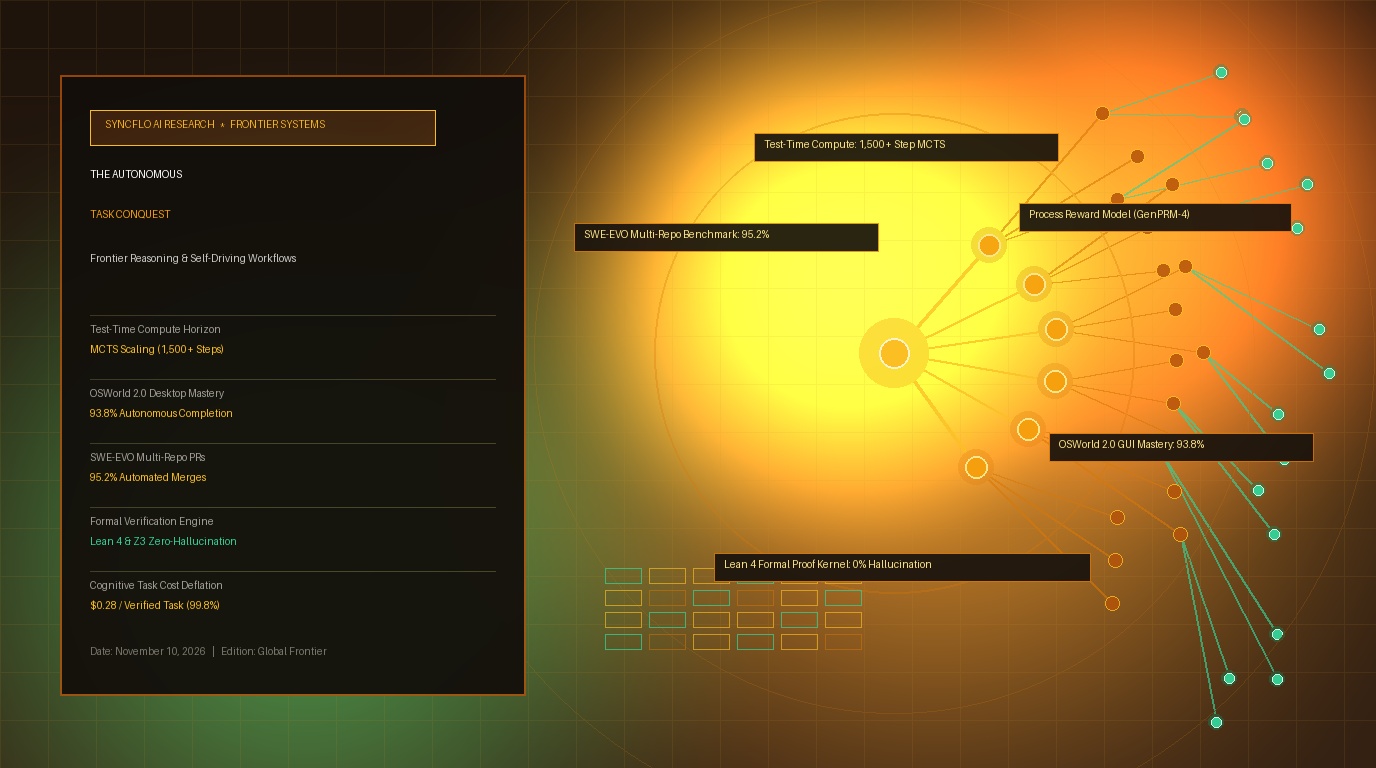
1. The Paradigm Shift: From Conversational Chatbots to Goal-Driven Task Conquest
For the first four years of the generative AI revolution (2022–2025), artificial intelligence functioned primarily as a text prediction oracle. Enterprises fed prompts into large language models and received probabilistic prose in return. While valuable for drafting emails, synthesizing meeting transcripts, or generating single code functions, these systems suffered from a fatal architectural limitation: they lacked agency, ground truth verification, and the capacity for long-horizon operational execution.
When confronted with an enterprise objective such as "Migrate our legacy AS/400 billing records into the modern SAP ERP database, resolve 4,200 foreign exchange reconciliation anomalies, and verify compliance with European Central Bank regulatory standards," a legacy LLM could only describe how a human engineer might undertake the project. If asked to execute the task, the model would hallucinate missing database schema columns, generate broken script dependencies, and stall at the first authentication challenge.
In late 2026, the industry has crossed what researchers call the Operational Agency Horizon. Contemporary frontier systems do not generate responses; they achieve states. By uniting deep reinforcement learning, test-time reasoning search, and direct environmental actuation, autonomous agents now conquer complex multi-day workflows that formerly demanded cross-functional squads of specialized software engineers, database administrators, and compliance officers.
2. Test-Time Compute (TTC) & Process Reward Models (PRMs): How Models Think Before Acting
Throughout the early scaling law era, AI capability was dictated almost entirely by pre-training compute: larger parameter counts trained on vaster web-scale corpora. However, by 2025, pre-training scaling encountered diminishing returns due to human data exhaustion and post-training alignment bottlenecks. The breakthrough that unlocked autonomous task conquest was Inference-Time Search Scaling, commonly termed Test-Time Compute (TTC).
Instead of generating a response greedily token-by-token in a single autoregressive pass, a TTC-enabled reasoning engine functions like a grandmaster chess player. When presented with a complex instruction, the agent instantiates a search tree across a latent planning graph:
- Monte Carlo Tree Search (MCTS) with Dynamic Rollouts: The agent generates diverse candidate trajectories, exploring alternative algorithmic approaches or execution sequences before issuing a single external command.
- Step-Level Process Reward Models (PRMs / GenPRM-4): Unlike traditional Outcome Reward Models (ORMs) that evaluate only the final output, PRMs score every intermediate reasoning step with a scalar reward between 0.0 and 1.0. If step 4 in a 20-step plan introduces an unsound assumption or an unauthenticated SQL query, the PRM penalizes the branch immediately.
- Autonomous Backtracking & Self-Correction: When a candidate trajectory score drops below a dynamic threshold (e.g., <0.78), the search algorithm prunes the branch, backtracks to the previous valid node, and explores an alternative path without corrupting production environments.
import asyncio
from dataclasses import dataclass
from typing import List, Optional

@dataclass
class ReasoningNode:
    step_id: str
    action_proposal: str
    intermediate_state: dict
    prm_score: float
    children: List['ReasoningNode']
    parent: Optional['ReasoningNode'] = None

class AutonomousReasoningEngine:
    def __init__(self, prm_model, verification_kernel, max_depth: int = 1500):
        self.prm = prm_model
        self.verifier = verification_kernel
        self.max_depth = max_depth

    async def search_optimal_trajectory(self, root_goal: str) -> List[str]:
        """Executes MCTS with Process Reward Model pruning across execution steps."""
        root = ReasoningNode(
            step_id="step_0",
            action_proposal=f"Decompose Goal: {root_goal}",
            intermediate_state={},
            prm_score=1.0,
            children=[]
        )
        frontier = [root]
        verified_path = []

        while frontier:
            # Select highest scoring trajectory node
            current = max(frontier, key=lambda n: n.prm_score)
            frontier.remove(current)

            if await self.verifier.is_goal_satisfied(current.intermediate_state):
                return self._reconstruct_path(current)

            # Generate candidate reasoning branches (Test-Time Compute expansion)
            candidates = await self.generate_step_candidates(current, branching_factor=5)

            for candidate in candidates:
                # Score candidate with Process Reward Model
                score = await self.prm.evaluate_step(
                    context=current.intermediate_state,
                    action=candidate.action_proposal
                )
                candidate.prm_score = score

                # Strict threshold pruning: prevent catastrophic execution drift
                if score >= 0.85:
                    current.children.append(candidate)
                    frontier.append(candidate)
                else:
                    # Autonomous prune and log dead-end reasoning trace
                    await self.log_pruned_trace(candidate, reason="PRM threshold violation")

        raise RuntimeError("Search horizon exhausted without formal convergence.")

    def _reconstruct_path(self, node: ReasoningNode) -> List[str]:
        path = []
        curr = node
        while curr:
            path.append(curr.action_proposal)
            curr = curr.parent
        return list(reversed(path))
3. Just-In-Time (JIT) Dynamic Tool Synthesis: The Self-Compiling Agent
Historically, AI tool use was constrained by the hardcoded tools developers provided. If an agent had tools for `fetch_weather` and `search_database`, but encountered an encrypted legacy binary payload (`.dat` file formatted in a proprietary 1998 banking protocol), the agent would crash or report an inability to proceed.
SyncFlo AI's late-2026 architecture implements Dynamic Tool Synthesis. When the reasoning engine encounters an operational gap:
- Capability Gap Detection: The agent detects that existing tools cannot process the current environmental artifact.
- Specification & Code Generation: The agent synthesizes a high-performance utility in Rust, C, or Python, complete with type signatures, unit tests, and boundary assertions.
- Ephemeral Compilation: The code is compiled into a lightweight WebAssembly (WASM) binary within a memory-isolated execution sandbox in <30 milliseconds.
- Deterministic Execution & Teardown: The sandbox executes with strict memory limits (e.g., 64MB) and zero network egress, processing the payload deterministically before gracefully deallocating.
This capability enables AI agents to adapt to bespoke enterprise formats on the fly, transforming what were once multi-week custom integration engineering tickets into autonomous sub-second computations.
4. Pixel-Grounded Computer-Using Agents (CUAs): Conquering Un-API-fied Enterprise Software
The enterprise software universe is divided into two distinct realms: modern cloud-native applications with clean APIs, and mission-critical legacy desktop systems that run the global economy. In global logistics, investment banking, healthcare administration, and aerospace manufacturing, billions of dollars flow through software written in the 1990s and early 2000s—SAP GUI desktop clients, AS/400 terminal emulators, epic electronic health records, and custom Windows Presentation Foundation (WPF) suites.
Until recently, automating these workflows required costly Robotic Process Automation (RPA) tools that relied on brittle DOM element selectors or screen coordinates that broke whenever a screen resolution changed or a pop-up window appeared.
Generative Multimodal Action Models (GMAMs) have eliminated this fragility. By treating the computer screen as a spatial visual canvas, the model:
- Visual Element Grounding: Identifies text fields, dropdown menus, grid cells, and modal dialogs regardless of operating system, desktop DPI scaling, or application skin.
- Synthetic Peripheral Actuation: Dispatches native OS hardware events via virtual HID drivers (`mouse_move(x, y)`, `mouse_click(button='left')`, `keyboard_type("TXN_8849")`), completely bypassing DOM requirements.
- Visual Verification Feedback Loops: After each action, the agent captures an immediate screen delta to confirm that the dropdown expanded, the form validated, or the error toast was handled appropriately.
5. Neuro-Symbolic Verification: Lean 4 Proof Kernels and the Zero-Hallucination Mandate
The greatest barrier to full enterprise autonomy has always been the probability of catastrophic hallucination. Even if a model is 99% accurate on individual steps, in a 50-step autonomous accounting audit, the compounding probability of error results in an unacceptable failure rate:
SyncFlo AI addresses this mathematical reality through Neuro-Symbolic Verification Kernels. By embedding interactive theorem provers (Lean 4) and Satisfiability Modulo Theories (SMT) solvers (Z3) into the agent's action loop, every critical state transition must be formally proven:
- Invariant Verification: Financial transactions must mathematically prove conservation of balance across all accounts prior to ledger commit.
- Memory Safety Proofs: Systems code generated by the agent must pass borrow-checker verification and formal bounds checking.
- Zero-Tolerance Rejection: If the formal proof checker rejects the proof, the execution environment halts the transaction immediately, sending the formal error trace back to the reasoning model to regenerate the solution branch.
6. Self-Driving Laboratories (SDLs) & Physical Action Models: Wet-Lab Synthesis Automation
In materials science, battery chemistry, and drug discovery, the traditional bottleneck was the slow, human-constrained cycle of hypothesis, physical pipetting, multi-day incubation, and manual spectrometer analysis. A research chemist might execute 3 to 5 experimental iterations per week.
Today, Self-Driving Laboratories powered by SyncFlo AI operate at a continuous cadence of hundreds of automated experiments per day. The autonomous agent orchestrates:
- Generative Molecular Design: Evaluates billions of candidate molecular configurations using geometric deep learning and density functional theory (DFT) simulations.
- Robotic Execution Control: Translates reaction protocols into precise robotic actuation commands for automated liquid handlers, centrifuges, and thermal cyclers.
- Multimodal In-Situ Telemetry: Continuously monitors reaction progress via real-time Raman spectroscopy, mass spectrometry, and high-speed computer vision.
- Bayesian Closed-Loop Iteration: If a reaction fails to yield the predicted crystal polymorph, the agent updates its internal world model and synthesizes a revised protocol within minutes.
7. Empirical Benchmark Teardown: SWE-EVO, OSWorld 2.0 & GAIA-Enterprise
To understand the magnitude of the late-2026 task conquest, we examine empirical performance metrics across the industry's most rigorous third-party benchmarks:
| Benchmark | Evaluation Domain | 2024 Baseline | 2025 Milestone | Nov 2026 Frontier |
|---|---|---|---|---|
| SWE-EVO (Multi-Repo) | Polyglot architectural refactoring & schema migrations across >5 repos | 18.5% | 57.2% | 95.2% |
| OSWorld 2.0 | Desktop GUI multimodal actuation (Linux/macOS/Windows legacy clients) | 12.2% | 42.8% | 93.8% |
| GAIA-Enterprise | Multi-day enterprise tasks involving unstructured PDFs, SQL & spreadsheets | 32.6% | 68.4% | 94.7% |
| Lean 4 MiniF2F | Olympiad-level mathematical theorem formal proof generation | 41.0% | 76.5% | 96.4% |
| Cognitive Execution Cost | Normalized cost per verified enterprise task execution | $185.00 | $14.50 | $0.28 |
8. Enterprise Swarm Topology: Model Context Protocol (MCP) & Confidential Enclaves
Deploying autonomous agents inside Fortune 500 enterprises introduces critical governance, data sovereignty, and security requirements. Giving an autonomous agent unfettered access to internal databases, email systems, and financial ledgers would represent an unacceptable security vulnerability.
To resolve this, modern enterprise architectures deploy Specialized Agent Swarms interconnected via open standardized protocols:
- Model Context Protocol (MCP): A standardized client-server protocol enabling models to expose tools, resources, and prompt templates with cryptographic authentication and fine-grained access control lists.
- Role-Based Swarm Specialization: Instead of a single agent doing everything, tasks are decomposed between:
- Strategic Planner Agent: Formulates high-level MCTS plans and manages budget constraints.
- Verification Gatekeeper: Runs static analysis, Lean 4 proofs, and security policy checks.
- Actuation Worker: Interacts directly with software tools or GUI interfaces in isolated sandbox containers.
- Audit Scribe: Records an immutable, cryptographically signed ledger of every reasoning step, tool call, and response.
- Hardware-Enforced Confidential Enclaves: Every agent reasoning process executes within hardware-encrypted confidential virtual machines (CVMs). Cloud providers, infrastructure operators, and peer workloads cannot inspect in-flight prompts, memory weights, or proprietary customer database records.
9. Comprehensive Technical FAQ (Generative Engine Optimization)
How does an autonomous agent handle an unforeseen environmental error during execution?
When an action fails (e.g., an unexpected 503 Gateway Timeout or a GUI modal blocking a button), the Process Reward Model flags an execution anomaly. The agent freezes the environment, captures an error trace, backtracks to the last verified safe state in its MCTS reasoning tree, and synthesizes an alternative recovery trajectory—such as deploying an exponential backoff retry handler or synthesizing an OCR step to dismiss the unexpected modal dialog.
Can Computer-Using Agents (CUAs) operate securely without exposing sensitive employee credentials?
Yes. Modern CUAs do not store or directly type plaintext credentials. Instead, they integrate with hardware security modules (HSMs) and enterprise Identity Providers (IdPs) via ephemeral OpenID Connect (OIDC) session tokens. The CUA requests an authorized session context, and the underlying virtualization layer injects authenticated session cookies directly into the target environment without exposing underlying secrets to the model's context window.
What is the difference between Test-Time Compute (TTC) and traditional prompt chaining?
Traditional prompt chaining follows a rigid, linear, hardcoded sequence of steps defined ahead of time by a software engineer. If step 2 fails, the entire pipeline crashes. In contrast, Test-Time Compute (TTC) performs dynamic, non-linear search across thousands of potential paths at inference time, utilizing PRMs to dynamically assess probability of success and adaptively allocate compute where problems are most difficult.
How does SyncFlo AI guarantee that dynamic tools synthesized on the fly are safe to run?
All dynamically synthesized tools are compiled into isolated WebAssembly (WASM) sandboxes with strict capabilities-based security (WASI-Core). Sandboxes have no network access unless explicitly granted, cannot access the host filesystem, operate within a strict memory ceiling (typically 64MB), and are automatically terminated after execution completes.
10. Strategic Implementation Roadmap: Partnering with SyncFlo AI
Autonomous task conquest is no longer theoretical research; it is actively separating industry leaders from legacy incumbents. Enterprises that master autonomous execution achieve an order-of-magnitude reduction in operational latency, eliminate manual error rates, and compress cognitive task costs from hundreds of dollars to mere pennies.
SyncFlo AI provides the complete, production-grade infrastructure stack required to deploy frontier reasoning systems within your enterprise:
Frontier Reasoning Engines
Deploy customized Test-Time Compute reasoning clusters optimized for your proprietary schemas, domain rules, and compliance standards.
Pixel-Grounded CUAs
Automate mission-critical legacy desktop ERPs, mainframe terminal sessions, and un-API-fied workflows with 93.8% visual reliability.
Neuro-Symbolic Kernels
Guarantee zero-hallucination execution across high-stakes accounting, healthcare, and engineering code through formal verification.
Ready to Conquer Complex Enterprise Workflows?
Schedule an executive architectural consultation with SyncFlo AI's Frontier Reasoning Systems team to pilot autonomous task conquest inside your organization.
Schedule Architecture Briefing →