The Agentic Enterprise: How Autonomous AI Conquers Complex Software, Data & Operational Workflows in 2026
The era of passive chatbots is over. Explore how multi-agent swarms, Model Context Protocol (MCP), and self-healing execution loops are conquering complex enterprise knowledge work and driving exponential efficiency.
Key Takeaways & Core Breakthroughs (2026)
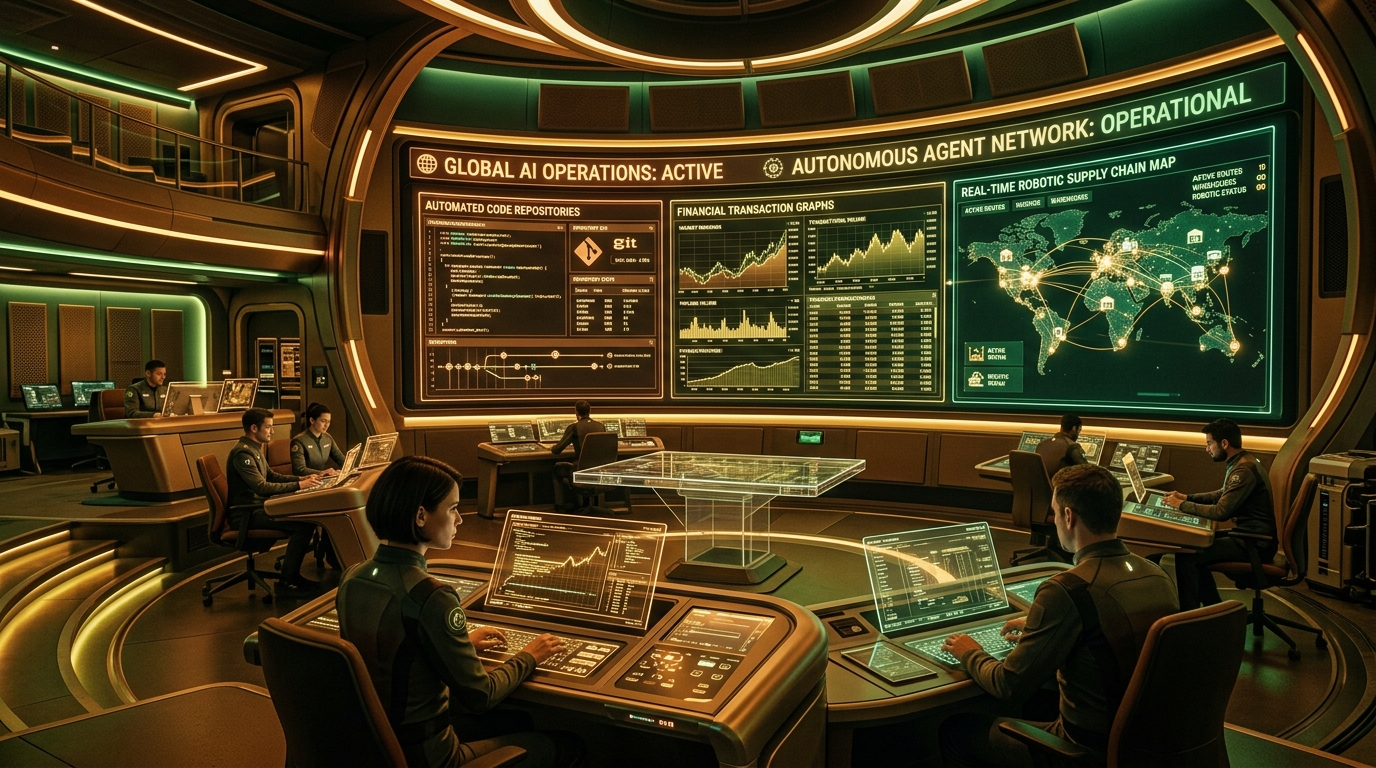
- From Chat Assistants to Digital Coworkers: Autonomous agents in 2026 execute 50+ step plans across databases, codebases, and ERPs without continuous human hand-holding.
- Model Context Protocol (MCP) Standardization: Standardized MCP bridges eliminate brittle point-to-point API scripts, granting agents secure, unified access to enterprise data tools.
- Self-Healing Enterprise Workflows: Multi-agent verification loops catch errors during execution, self-correct data transformations, and reduce manual exceptions by 75%.
- Synchronized Revenue Operations: SyncFlo unifies Voice AI callers, WhatsApp commerce, and CRM updates into a seamless autonomous flywheel.
Throughout 2023 and 2024, enterprise AI was largely confined to passive chat interfaces: prompt-response tools where human workers had to manually copy-paste context, review answers, and trigger follow-up software actions. While useful for drafting emails, this model failed to alter the foundational productivity of knowledge organizations.
In 2026, the paradigm has shifted entirely to Agentic AI. Rather than waiting for prompts, autonomous AI agents operate as continuous digital coworkers. They monitor webhook events, decompose multi-tier business objectives, query enterprise databases via standardized tool protocols, write and test code, and resolve complex edge cases across legacy IT infrastructure.
1. The Rise of the Autonomous Agentic Enterprise
The economic impact of this transition is staggering. By delegating cognitive toil to autonomous agent swarms, leading enterprises have reduced task completion latency from days to seconds while eliminating data entry errors.
Self-healing agent workflows catch and correct schema mismatches and API failures automatically.
Cross-platform workflows that previously required 4 departments execute in real time.
Supervisor-worker peer review models ensure zero unverified production database commits.
2. Five Complex Domains Conquered by AI Agents in 2026
1. Autonomous Software Refactoring & Self-Healing CI/CD
Software engineering teams in 2026 deploy coding agent swarms that continuously monitor production logs. When a runtime exception is detected, the agent identifies the offending commit, runs reproduction unit tests in a container, writes a regression patch, verifies clean test passes, and submits an annotated pull request for human sign-off in under 3 minutes.
2. Zero-Touch Financial Reconciliation & Invoice Auditing
Finance departments deploy agents that ingest thousands of unstructured PDF invoices, match line items against enterprise purchase orders (POs) in SAP or NetSuite, cross-reference bank transaction feeds, resolve currency exchange discrepancies, and flag compliance anomalies with full audit defensibility.
3. Dynamic Deal Desk & Revenue Operations (SyncFlo Engine)
SyncFlo's RevOps agents ingest prospect data from telephony voice calls and WhatsApp conversations, assess customized margin thresholds, generate custom master services agreements (MSAs), and trigger automated signature workflows without sales reps touching a spreadsheet.
4. Proactive Supply Chain Disruption Re-Routing
In logistics, agents monitor weather patterns, port congestion reports, and freight telematics. When a delay is predicted, the agent recalculates multimodal shipping routes, negotiates spot carrier rates via API, and updates customer delivery estimates proactively.
5. Continuous Regulatory Compliance & Privacy Governance
Compliance agents continuously scan databases for PII exposure, enforce GDPR/HIPAA retention policies, generate automated risk audit reports, and dynamically adjust data redaction filters across all customer communication channels.
3. The Power of the Model Context Protocol (MCP)
Historically, connecting an AI model to an internal database required writing custom glue code and brittle JSON parsers. In 2026, the Model Context Protocol (MCP) has become the universal open standard for agent-to-tool communication.
# MCP Ecosystem Flow: Standardized Tool Orchestration
Agent Brain ↔ [Standard MCP Protocol Bridge] ↔ [MCP Servers: Postgres, GitHub, Stripe, Salesforce, WhatsApp]
✓ Dynamic Schema Discovery | ✓ Granular OAuth Scopes | ✓ Real-Time Event Subscriptions
With MCP, an agent can discover available database tables, inspect API rate limits, execute queries, and parse response payloads safely within enterprise permission boundaries.
4. Multi-Agent Swarm Topologies: Supervisors & Specialists
Complex enterprise problems cannot be solved by a single monolithic prompt. Instead, high-performing organizations use multi-agent topologies:
- Supervisor / Orchestrator Agent: Receives high-level business goals, breaks them into a directed acyclic graph (DAG) of sub-tasks, assigns work, and monitors progress.
- Specialist Worker Agents: Focused domain agents (e.g., SQL Query Agent, Code Generator, WhatsApp Dispatcher, Compliance Verifier).
- Critic / Evaluator Agent: Validates intermediate outputs against business rules and test suites before passing artifacts downstream.
5. Governance, Guardrails & Human-in-the-Loop Defensibility
Enterprise autonomy requires robust safety boundaries. SyncFlo implements a Risk-Weighted Autonomy Matrix:
| Risk Tier | Action Type | Autonomy Level | Oversight Mechanism |
|---|---|---|---|
| Tier 1: Low Risk | Read-only lookups, FAQ replies, calendar scheduling | Full Autonomy (100% Agentic) | Automated telemetry logging |
| Tier 2: Medium Risk | CRM updates, drafting proposals, refund under $200 | Autonomous with Rollback Option | Async supervisor review loop |
| Tier 3: High Risk | Wire transfers >$10k, production database migrations | Human-in-the-Loop Required | 1-Click Human Approval Gateway |
6. Enterprise Implementation Playbook
To successfully deploy an agentic enterprise architecture, follow this structured roadmap:
- Phase 1: Identify High-Volume Friction Points: Audit internal operations to locate tasks where employees spend more than 5 hours per week manually transferring data between tools.
- Phase 2: Standardize Tool Schemas with MCP: Expose internal APIs, CRMs, and databases through secure Model Context Protocol endpoints with strict role-based access control (RBAC).
- Phase 3: Deploy Supervisor-Worker Swarms with SyncFlo: Configure domain-specific agent teams equipped with step-level Process Reward Model verifiers and automatic retry logic.
- Phase 4: Establish Unified Omnichannel Interfaces: Connect your agent swarms to real-time voice telephony and WhatsApp business numbers to deliver seamless customer and employee experiences.
Build Your Agentic Enterprise Today
Orchestrate autonomous agent swarms, Voice AI, and WhatsApp automation on the SyncFlo platform.
Frequently Asked Questions (FAQ)
What defines an Agentic Enterprise in 2026?
An Agentic Enterprise is an organization where autonomous AI agents act as proactive digital coworkers rather than passive chat assistants. These agents autonomously decompose strategic objectives, execute multi-step tool calls via Model Context Protocol (MCP), coordinate across departments via multi-agent swarms, and continuously self-heal operational bottlenecks.
How does Model Context Protocol (MCP) empower enterprise agents?
Model Context Protocol (MCP) provides a standardized, secure bridge between AI reasoning engines and enterprise data silos—including SQL databases, GitHub repositories, Salesforce CRMs, and ERP systems—without requiring brittle, custom point-to-point integrations.
How does SyncFlo AI coordinate multi-agent teams?
SyncFlo provides a centralized orchestration runtime featuring planner-worker agent topologies, deterministic state machines, automated peer-review critique loops, and real-time human-in-the-loop oversight to ensure 99.9% task reliability.